
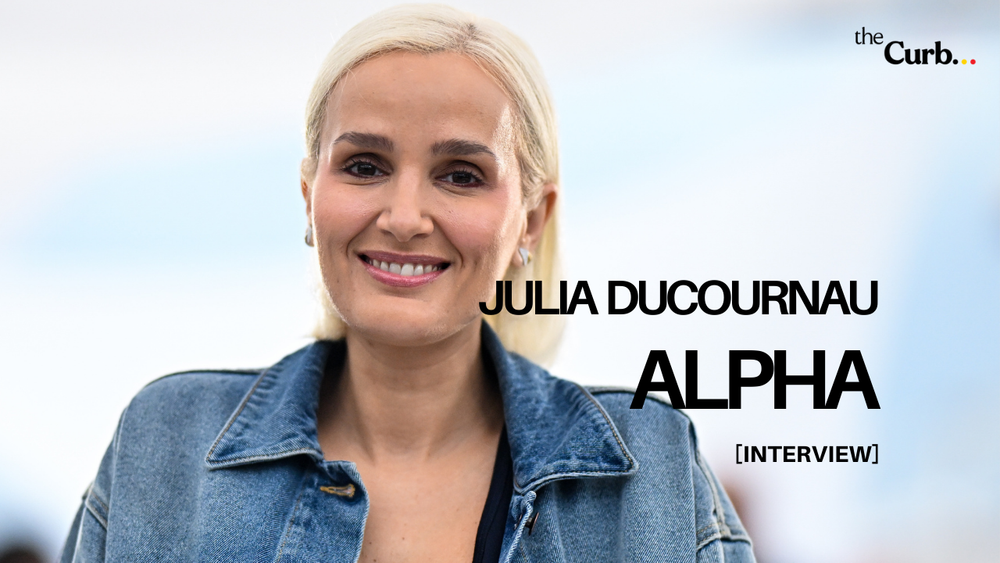
Four years after winning the Palme d’Or for Titane, French filmmaker Julia Ducournau returned to the Cannes Film Festival with Alpha, a haunting and unexpectedly tender meditation on grief, generational trauma and the lingering shadow of the AIDS crisis.
Now screening as part of the Alliance Française French Film Festival, Alpha marks a shift for Ducournau. Where Titane shocked audiences with ferocious body horror, her new film unfolds with a quieter emotional intensity. Set in a coastal French city gripped by a mysterious blood-borne epidemic, the film follows Alpha, a rebellious 13-year-old played by newcomer Mélissa Boros, whose life is upended after she returns home from a party with a crude tattoo. Her mother, a doctor played by Golshifteh Farahani, works in a hospital treating victims of the disease, which slowly turns its sufferers into marble-like statues. As panic spreads through the community, Alpha becomes increasingly drawn to her troubled uncle Amin, played by Tahar Rahim, an addict already living in the shadow of the illness. Through their fractured family, Ducournau explores fear, stigma and the generational trauma left in the wake of the AIDS crisis.
Speaking in Cannes with a cigarette glowing in her hand, Ducournau reflected on returning to the festival after her Palme d’Or win.
Coming back to Cannes with Alpha, is there more pressure or less pressure than last time?
Julia Ducournau: The same. It’s always an event. At least at my level. I don’t know for anybody else, but for me it’s like starting from scratch all the time. You come up with a new movie, and nothing is granted. Especially in Cannes. So yes, it’s stressful. But at the same time, I’m super happy with my crew. We formed a really strong family while making the film.
Titane was extremely violent and intense, while Alpha feels more tender and emotional. Does that reflect a change in your life or your work?
JD: From one film to the other, my search is to try and let emotion in more and more. Maybe some people manage to do it right away, but for me it’s a real journey. I try to expose myself more film by film. Hopefully I’ll do so again in the next one, because it’s an ongoing journey for me. I don’t feel that I have landed the plane with Alpha. For me it’s something very personal, but it’s also research, trying to expose myself and let the audience in.
What do you mean by “research”?
JD: You know what I discovered? That I could use words as well. My first two features are not very talkative. I still work with the body a lot, obviously, and I still work with dancing – I love to film dance scenes – but using words to this extent was something new for me. I don’t like saying too much and I don’t like imposing my emotions too much. So writing was already hard, weighing every word. Then with the actors, all of a sudden my words sounded worthwhile. They made them sound worthwhile, which is a very soothing feeling. With words you also have to find the right distance for your camera. You have to question yourself constantly. For me it’s way harder to do a simple dialogue sequence than to choreograph a five-minute oner with 300 extras. That, I know I can do.
You’re telling a story about prejudice and generational trauma that manifests as a disease, and it seems to be very political. In what way is Alpha personal for you?
JD: It’s very personal. I always said that Titane was a film I needed to make in anger. The character is so unlikable at the beginning that in order for me to relate to her I had to feel her anger. And as a woman it’s very easy to feel anger. With this film it was more a fight against the state of numbness that we all feel nowadays, with what the world is showing us. It’s too much and it’s too direct. It petrifies our brains and our hearts. My way of dealing with that was to go back to the first time I felt like this when I was a kid, which was during the peak of the AIDS pandemic. There was this feeling of imminent apocalypse and this feeling that the world was letting us down.
What do you remember about that time?
JD: The shame. The constant shaming. People could not talk. They had to hide. Getting basic health care was impossible for some people. And there was fear everywhere, seeping into every breach of society. Even into kids. I remember being at school and when kids would fall and there was blood on their knee, everyone would say, “Oh, I’m not playing with you anymore.” Do you know how fucked up it is for kids to think like that? How fucked up does the adult world has to be for that to happen? That is an extreme low in our humanity. And it’s a shameful period that I think we still haven’t fully measured the impact of.
After Titane, some audiences might come to your films expecting shock or violence. Is that a pressure you felt going into making Alpha?
JD: Personally, I like not knowing anything before seeing a film. I don’t watch trailers. I don’t read interviews. I just go. As a director you hope people will see your film in that state of mind. But obviously with social media and marketing it’s becoming harder and harder to have that kind of experience. So, I just hope that people who expect violence will be taken by emotions instead, something they’re not expecting. In the end, if you’re expecting a big scare and you end up in tears, it’s not a bad bargain. Maybe it’s even better. A twofer.
Both Titane and Alpha could be seen as films about outsiders struggling to be understood and then letting go of someone they love. Is that something that attracts you as a filmmaker?
JD: I actually don’t feel that my characters are outsiders. I think the society around them is the outsider. About letting go? That’s the hard part. Letting go means grieving and mourning. It means putting words on the feelings you have. That’s why I was talking about the numbness that I hate nowadays. It’s very important to feel things first, and then to name them. If you don’t, you reproduce the same cycle over and over again. That’s how trauma gets passed on through generations. In the film, Alpha’s mother hasn’t grieved at all. She says it from the beginning: “I’m reliving the same thing again.” But she’s not. She just hasn’t let go of anything, so the trauma gets passed on to the child.
Why do you think intergenerational trauma is rarely addressed so directly in French films?
JD: I think it’s becoming more present now. People who create things are always in dialogue with each other. Even if we’re on different sides of the world and have never met, we feed each other with our work. You can see that in this year’s films. The AIDS pandemic is also becoming more of a concern in cinema in the past five years than it has ever been before. And that’s insane when you think about the lapse of time. It took almost two generations for us to really talk about it. Not only about the disease and the people we lost, but about the shame society put on those people, and the shame society should feel for doing that.
Given Alpha was so personal, were you also drawing on personal experiences of the actors when you were shooting it?
JD: That was crucial for the film. When I thought about casting Tahar Rahim and Golshifteh Farahani, I had never met them. But I had seen their performances, and I felt they were very generous people. When I met them that idea was confirmed. I knew they would give everything to the film. But if you expect actors to give so much of themselves — their lives, their experiences, their traumas — you also have to give something back. So, we shared a lot with each other about our lives, our relationships to family, mourning and death. And we became close very quickly. And then we adopted Mélissa immediately. She has incredible spontaneity and instinct. She’s very smart and also a very hard worker. It felt very emotion-led, like I was working with my intuition.
How do you guide actors through scenes that rely so heavily on emotion?
JD: It’s a lot of preparation. I’m not one to believe in surprises on set. I like things to be prepared and people to be comfortable with each other very quickly. Directing is really a back and forth. I can’t expect actors to give me something that I can’t give them. That means care as well. For example, Tahar was very careful about his health during the shoot, and I was always checking how he was doing. You never push someone beyond their physical limits. But emotionally, if there is trust, you can go very far.
One of the most striking elements of the film is the marble-like transformation of the infected bodies. Where did that idea come from?
JD: That was a construction, I built on a lot of different ideas, it wasn’t like it came to me like lightning. The first thing I thought was that I wanted to make them beautiful. I wanted to be sure there was absolutely no way the audience would feel repulsed by them. I wanted immediate empathy. That led me to the idea of recumbent effigies — the statues of saints in churches and cathedrals. They are human beings, but they are not in the same state as we are. For me it was the closest way to portray death. That moment when life leaves the body and when the eye becomes stone. We know it’s not real, but it feels like seeing life leaving the body. And what I like about it is that there is no distance. It becomes something sacred. It makes them eternal, like saints or martyrs.
Screening or Streaming Availability from JustWatch: