
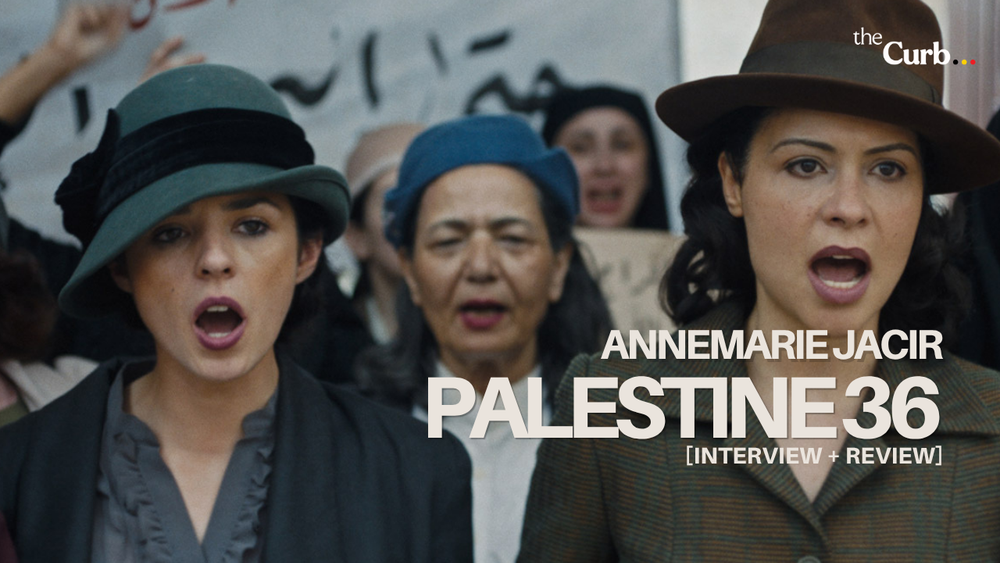
“We still can't talk about our history in Palestine. Our voices are still threatening. Our story is threatening.” – Annemarie Jacir
Annemarie Jacir’s stunning historical film Palestine 36 depicts the creation of Israel by the British Colonial powers who controlled the territory from approximately 1916 after the area was liberated from the Ottoman Empire. Palestine 36 is set in the period between the Balfour Declaration that stated that Jewish people had the right to claim a “national home” in Palestine in 1917, and the rebellion of Palestinians against the British rule that was clearly favouring Jewish settlers in Mandatory Palestine through to the Peel Commission decision to end the mandate and set up partition between the Palestinians and the Jewish Settlers.
Most of the action takes place at the very beginning of the Arab strikes and is focused on the British military action against the strikes through the eyes of a young rural Palestinian, Yusuf (Karim Daoud Anaya) who is working in Jerusalem as a driver for Amir (Dhafer L'Abidine) a wealthy Palestinian businessman and political hopeful. The Amir household is a centre for liberal intelligentsia in Jerusalem with Amir’s sophisticated and worldly journalist wife, Kholoud (Yasmin Al Massri) writes under a male pseudonym criticising the increased hostility towards Palestinians by the British authority and the Jewish Settlers.
Yusuf travels between Jerusalem and his mountain village home which is seen as in some ways a dereliction of his true duty to his father and their farming. The village is next to a Jewish settlement, and the elders hope they can simply speak with the settlers and convince them to stop encroaching on their land. When Yusuf’s father is shot and his brother arrested, he sees that the sheen of the wealthier class is self-interest. Along with a group of striking workers who turned rebels (the notable Saleh Bakri as Khalid one of the workers who realise the British are punishing Palestinians) Yusuf’s life changes irrevocably as he goes from a promising young, educated man to a man in a war with the people who have controlled his life.
Jacir’s film, co-scripted by Salma Dabbagh mixes historical figures such as High Commissioner Wauchope (Jeremy Irons) and Charles Tegart (Liam Cunningham) with fictionalised characters representing the British army and diplomatic bureaucracy. It also considers the viewpoints of Palestinian characters who are “Westernised” and those who live simple lives on the land. Yusuf bridges the two “classes” but as much as it is the story of his village (and many like it) it is the story of generations of Palestinians who were thrust into a colonial milieu that they have no control over regardless of their respective class. A young widow, Rabab (Yafa Bakri) and her young daughter Afra (Wardi Eilabouni), become witnesses to British barbarity while Rabab’s mother Hanan (Hiam Abbas) and father, refuse to give up their homes. A young (and naïve) British civil servant, Thomas (Billy Howle) visits the villages trying to get the people to sign land rights documents. He believes that there will be some guarantee from his government that the Arab and Christian population will have rights if they follow the rule of law. His disillusionment is palpable as he comes to understand that “laws” and “rights” are highly flexible under the triple dealing of the British and an unseen Zionist influence.
His counterpart, the violent, cruel, and rapacious Captain Wingate (Robert Aramayo) is the most basic and bare-faced version of enforced colonialism. It would be considered in other films for his character to be exceedingly one note if not for the history that backs up the existence of men like him.
Jacir also brings to light the Palestinian women who were educated in Europe and both politically and socially aware and progressive. Kholoud is not only wealthy, but she is fundamentally aware of how European class systems work. She maintains an outward appearance as a society hostess but also works tirelessly in the press to bring to light the many injustices forced upon Palestinians. Her disillusionment is coupled with danger when she realises her social cachet is meaningless and her activism and journalism have been monitored and she is essentially an easily dealt with nuisance by the British governance.
Although Jacir is scathing about the British actions, she is still working with empathy towards the Jewish refugees who enter Jerusalem. By including contemporary newsreels of refugee settlers arriving by boat because of intense antisemitism, Jacir favours showing humanity in history. The British are experts at colonial subjugation and set the blueprint for a divided land and the playbook of Imperialism. Annemarie Jacir wants to remind the world that what is happening now is a product of hundreds of years of Britain and Europe claiming dominion over lands they believe needed “civilisation” creating the sense of “the other” whose land and identity are being erased.
Palestine 36 along with Cherien Dabis’ All That’s Left of You is an essential document and filmic experience that places the humanity of the Palestinian people at the forefront of a long history of displacement and loss. “I don’t want to fight,” says Khalid to his dock man workmates. “No one does,” is the reply. If there is a core theme to Palestine 36 it is that fighting is necessitated because peace was never really an option when absolute subjugation was the goal.
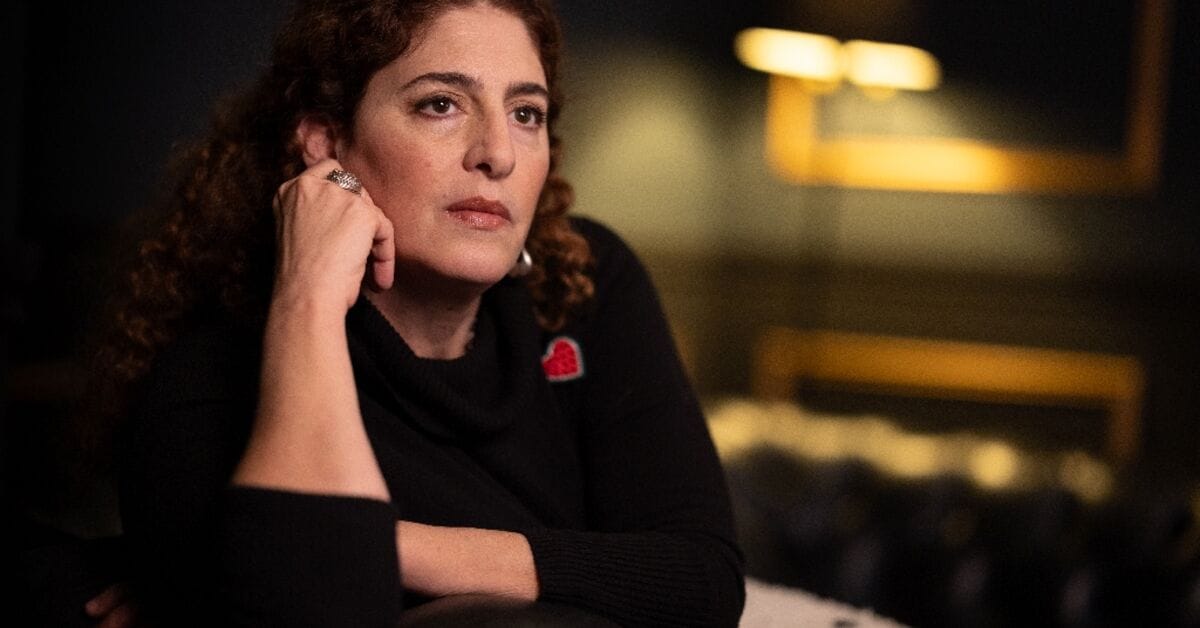
Nadine Whitney had a chance to speak with Annemarie Jacir about why she felt this story needed to be told and specifically needed to be told now.
Palestine 36 is a really great history lesson for people who do not realise how much British colonialism helped create Israel as it exists today. That the structure of colonialism was already in place by the British in Palestine and had been for more than thirty-years before the Peel Commission. What made you decide to tell this particular story now?
Annemarie Jacir: Yeah, it's surprising how few people make the connection and realise the responsibility that the British have in setting up the whole system of colonialism, as they did in many, many, places, but particularly in Palestine. It’s the basis for the whole occupation as we know it today. Everything is this blueprint that stayed behind, and it's actually almost strange how little it's changed.
All the details of how to control and occupy a people are placed from that (British colonial) moment. The British were experts at it by the time they came to Palestine because they had been you know dealing with rebellions and controlling people and in so many places in the world. By the time they got to Palestine they left that legacy to the Israelis who've now taken to it but on 500 to 1000 speed.
It was important for me to tell it because it's never been told on screen before. I'd never seen this depicted in detail before. It's so important, yet there’s been nothing to watch about it.
I think it's there's that whole cyclical nature that I'm living with. What I’ve known since I was born has been military occupation. It's been control. It's the story of my parents and it's the story of my grandparents too. We are just living this cycle again and again. There are some years where it's calm and then it blows up again. We’re trapped and occupied. I feel like the way to get out of it is to come to the root of it to understand it. I feel that's a way to get out of it.
There are so many good points you and Salma Dabbagh (the co-screenwriter) make about the British Empire too. Just with the collection of stamps that the young girl collects. The stamps are from Nigeria, Rhodesia, Burma, and Australia (where I live), and they’ve all got the same man’s head on them The King of England.
AJ: I don't think the Peel Commission decision of 1937 or the Balfour Declaration of 1917 really enter the minds of people as history. I can't tell you the number of people who've told me I didn't realise the British were in Palestine, even that the British were here at all.
Australia and so many places, are trying to talk about the history from the point of view of the colonised, addressing that, seeing the story. It is so important,
When the films was released in the UK it meant something for everybody who's been colonised and who knows the story, but also for the British. We were surprised the film had success in the UK. I think surprised everybody, including the UK distributor, because the film is quite tough on the British. Yet the cinemas were filled with young people, young British people. It's incredible. The expectation with a period historical film that it would be an older crowd. Yet the audience was very young.
When I went to the UK, I felt that the audience really like asking questions and wanting to know more. And we were afforded a lot of generosity and curiosity, not defensiveness.
I wanted to go back to the part where you mentioned that the uprisings and British Rule are rarely see in film. I recently saw Leila and the Wolves (a 1984 drama film from Lebanese director Heiny Srour) which foregrounds these occupations and also the work women did to support rebellion.
AJ: The rebellion is always mentioned in oral history, in documentary. For Palestine 36 everybody on the crew, everybody on the team has a family member who could tell a story about the revolt that they know from their families. It's very much present.
You've made it very immediate, but also you've given it a female focus that is lacking in a lot of a lot of films about Palestine and the Middle East.
AJ: Yeah, for sure. You know that that that importance of being a part of the revolt, not necessarily being on the ground holding the gun, but Rabab (Yafa Bakri) the mother of the little girl, Afra (Wardi Eilabouni) is feeding the men and her mother Hanan (Hiam Abbass) is part of the revolt as much as her husband is. But we’ve never talked about that.
Palestine 36 has very little action in that way – showing battles and skirmishes between like the British and the Palestinian rebels. We wanted to make the film about all the other things that are also of what a revolt is.
The women going to you know going up those stairs to confront the High Commissioner played by Jeremy Irons are protesting as citizens. They’re crying out against the theft of their country. That's a really you know incredibly powerful moment as well. In that often there is sense that there there's always kind of a regression in in female empowerment in Arabic countries. For example, Kholoud is one of the most influential people in Palestine through her social standing and journalism.
AJ: She's, of course, based on real people. I wanted to say something about Yasmin Al Massri who plays Kholoud. Yasmin grew up as a Palestinian refugee in Lebanon. When I gave her the script and she read it she you know said, “I love Kholoud. I love her. This is fantastic. But did we have women like this?”
And I then I shared with her the women that that Kholoud 's character is based on, and the whole history of it. And she was so amazed, and she talked about that a lot. She said, “I didn't know these women existed because as Palestinians, we were robbed of learning about our own history. She said, "I didn't know we had Kholouds. I didn't know we had women like that because, you know, we've been completely robbed of our story that we don't even get to learn about that. She was so amazed by Kholoud that we had women like her.
We still can't talk about our history in Palestine. The film was banned by the Israelis when we tried to show it in Jerusalem, even though there are no Israelis even in the film. It's pre-state. That says a lot. Our voices are still threatening. Our story is threatening.
It’s even defined what I can call myself. I can't tell you that I'm a Palestinian. Israel wants us to say I am an Arab Israeli. That's it's like that's not a term that's okay with us, like we don't call ourselves that.
When we had our American release, in some places they're not allowed to write Palestine in the newspapers, in a publication. You cannot write Palestine. Every time I said that I live in Palestine, they changed it to I live in the Palestinian territories. Every time I talked about you know working in Palestine, they changed it. You cannot print Palestine in the United States. I didn't know that until we released this film in the United States. But what they couldn't change was the title Palestine 36. So that was like they were stuck with that. So that was a good thing. I realised the title had a benefit.
As you were saying, there are no Israelis in the film. We see two examples of Jewish Settlers and neither gaze is hostile. Particularly the explanation Rabab gives to Afra about the nearby settlement. It’s empathetic because she says they’re not allowed to be in other countries although she’s unsure why. And the inauguration of Radio Jerusalem spoken Hebrew and in Arabic (and English, of course) – but even then it's a propaganda tool under High Commissioner Wauchope.
AJ: The radio inauguration where Wauchope (Jeremy Irons) is saying we're going to bring the communities together. Jeremy has three scenes in the film that are very important I think in tracking the British policy and the first one he's wearing his civilian nice suit. The second time we see him is with the women's protest, and he says, "Oh, my hands are tied by London.” By the third time he's completely decked out in his military, and he says, "We have got to separate them, it’s war.” Beginning with we bring them together. Now it's complete separation. Otherwise, “They're going to eat us alive.” And it's all about the agenda, right? The colonial agenda in all of those cases.
When we cut to archives, and we see Jewish refugees arriving from Europe. We see boats of desperate people, and I very specifically put that there because I think it's important to see those faces. You see a woman, a child. I'm very haunted by that. There's one shot of a woman just she just looks completely traumatised. You know you could tell she's gone through something, and very important to that sequence is the end of it. There's a Nazi passport. You see a paper that documents that those are the documents they arrived with a Nazi passport, and I wanted that was important to see that because I think when we talk about Palestine, we have to talk about the British responsibility.
When we talk about anti-Semitism and Jews who had to escape Europe, I think it's important to make your point on that fact that it was you know this is traumatic. Then you hear this British actual newsreel voice. These people are refugees arriving after facing horrific things but the way they voice these newsreels is strange and almost bubbly. I find those the newsreels the British newsreels very bizarre because there's like really serious things that you're seeing, and then you have this sort of silly voice talking about it.
Can you tell me about the decision to colourise the news reels?
AJ: Yeah, that was very important for me. It was something I had to fight a lot for because, of course, we were so broke with what happened to this film and having to stop and start so many times (the film was made in Palestine). It was a financial disaster, but I wouldn't let go of the fact that I wanted the newsreels colourised. And my producers were like, "Okay, I'm ready. Just it's going to be black and white. I mean, it's not going to be black and white. It's got to be colour. I will have less newsreel, but colour.
They're amazing images, and I feel like a couple of things were happening for me. The main thing was that when you go to colourise images, it's just full of life. You really feel the life, and you see the life that was there, and that is the world of the characters. If they had remained black and white, they would simply sort of remind the audience of the “past.” It would take the audience out of the story and backwards. Oh, this actually happened. Now we continue with our story. Oh, here's something that you know, this is what happened. This is history, and now we come back to narrative. I didn't want that. It really was important for me that the audience stays inside this story and moving forward, propelling forward the immediacy of the story.
The fact that that it's history, but it's history that is just evolving from the same place, evolving from the world. This is alive. This is what's this is what the characters see when they go to Jerusalem. I could never afford to create a street set in the 1930’s. This is not Hollywood. We can't take over an entire street and you know have like you know VFX, and you know put 100 extras or 1000 extras in the streets or whatever.
I think the other part of colourising the archives was I think reclaiming them in a way. The British filmed so much; they really filmed everything, and to be able to know colourise the film is a way of saying they are our own people. Those are our those are our people that we're seeing on the screen there. I feel like it was reclaiming, making it ours again.
Director: Annemarie Jacir
Screenplay: Annemarie Jacir and Salma Dabbagh
Cast: Karim Daoud Anaya, Hiam Abbas, Jeremy Irons, Robert Aramayo, Saleh Bakri, Yasmin Al Massri, Billy Howle
Cinematography: Hélène Louvart
Editor: Tania Reddin
Palestine 36 is currently in select Australian cinemas.
Screening or Streaming Availability from JustWatch: