
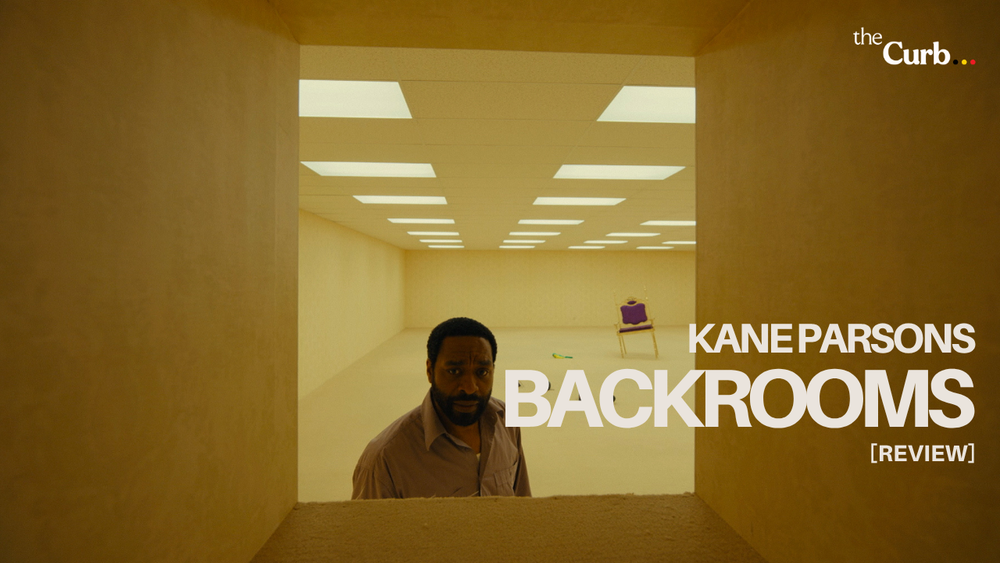
Kane Parsons is a smart director. He and his script writer Will Soodik (building on the world created by Kane in his YouTube videos) mine both the common fear of being trapped in an uncanny space, and the more metaphysical questions about inexplicable singularities and the unknowable realms that could exist just a whisper from the quotidian. Backrooms is a queasy and thoroughly uncomfortable journey into a mystery realm that never completely answers the questions it presents, nor adheres to any specific rules. It’s a nightmare presenting as an extension of those quotidian spaces opening up a universe of faceless and impersonal design; inescapable as their real-world replications.
Parsons takes the viewer immediately into the world of the “backrooms” using the traditional found footage style he employed in the web series. A man is filming the never-ending and shifting space made up of a sickly yellow wallpaper and the interminable hum of fluorescent lighting. The familiar become unfamiliar; making it the very essence of “the uncanny”. His discomfort increases as the space replicates itself into something glitching in the matrix of familiarity. A large seabird is trapped with him – how did it get there? How did any of this messed up “dental surgery waiting room meets Escher and Alice in Wonderland” get wherever “there” is? Most importantly for the man, why is the space trying to hurt him?
It’s 1990 and Clark (Chiwetel Ejiofor) is a man simmering in his discontent. The alcoholic owner of a failing furniture showroom “Cap’n Clark’s Ottoman Empire” located on a strip mall in Santa Clara; Clark’s furious at his wife, Barbara, for throwing him out of their house. A house that he pays for. A house that he’s “tolerated” Barbara’s law studies meaning she’s not earning. A house that represents the death of his dreams of being a working architect. So too, his furniture warehouse. He spends as much time as he can in his cluttered office drawing buildings (notably distorted) and bemoaning the general state of the place. He makes late-night TV ads dressed as a pirate with a wooden leg filmed by his assistant Kat’s (Lukita Maxwell) boyfriend Bobby (Finn Bennett).
Clark is a client of Dr. Mary Kline (Renate Reinsve) a psychiatrist whose theoretical and practical treatment revolves around the individual taking themselves off pre-determined paths informed by the past and opening a window into a new life. Mary explains that Clark is alone because he expects to be alone and therefore pre-emptively acts in a manner that will fulfil his expectations. The harm of the past not only informs a version of the future but ensures that it returns to that point. Mary, herself, is also alone and Backrooms explicitly ties her past trauma to her psychiatric framework. She encourages Clark to role-play his final argument with Barbara, possibly with the hope that Clark sees how his anger and resentment have carved a pattern into his psyche. A pattern that has left him without a home (he lives in the showroom) and unable to form connections.
Sadly, Mary herself is alone. She watches a TV ad for her book and self-help tapes while sitting with a solo tray in front of her which holds her dinner and a reminder of a happier time that became something dark. Both Clark and Mary are already trapped before they enter the backrooms that nestles against a wall in Clark’s store basement. However, what they each yearn for is fundamentally different.
Backrooms is a triumph in its highly individual vision and the technical prowess involved to realise the horrible maze of anxiety. Jeremy Cox’s cameras: period specific video cameras using character POV, as well as the omniscient camera, are truly disorienting as they capture (or partially capture) the monumental production design by Danny Vermette. Repetition becomes entropic, but beyond the repetition is the sense of sentience within the singularity. It renders memories, but it misremembers as the human mind does. “Imagine telling someone who has never seen a dog to draw one based only on a description,” Clark says to Mary. The backrooms is a sentient place, but does it fundamentally misunderstand the people who end up there? Or does it understand them all too well?
Clark enters willingly into the backrooms and due to his spatial awareness as an architect he’s able to navigate them to an extent. He does know how to find the exit and when he discusses his discovery with a rightfully sceptical Mary, his anger flashes again. He will bring her proof, and she will have to apologise to him. Bringing proof means Kat and Bobby enter with him and the backrooms incorporate them in their deranged and dangerous way. Mary enters the backrooms to find Clark, and the maze also incorporates her memories and her distress. Despite being monitored by a former medical company known as Async the zone is beyond comprehension, beyond human, yet it’s the gestures and concessions it makes to the humans inside it that are the most frightening part of the film.
Backrooms isn’t without its issues. Where it succeeds is in its unique puzzle box mystery that provides some hints as to what is happening. Where it fails is that those hints are hindered by the overstated psychology of Clark and Mary. The film is much more threatening when the explorer is unknown; an employee of Async attempting to map out something potentially infinite faced with the aggression of the place itself. The audience has some idea of how Clark and Mary might respond to their situation, but is the audience actually that interested in the characters? Isn’t the better route through the backrooms the one that reacts specifically to the uncanny space without the “map” of their psychological profile?
Backrooms is a mystery that takes place in the familiar and unknown making it a very specific distillation of the horror of the ordinary. It depends on the liminality of blandness: the places we traverse over and over and rarely pay attention to. Kane Parsons offers up a unique vision of the unmemorable being threatening because of the very nature of its blankness. It’s a vision of hell. To be trapped under fluorescent lights, stained gypsum board, and synthetic carpet is all too evocative of somewhere no one wants to be even with a timed exit such as the end of a workday. Kane Parsons places us inside the interminable with genius and genuine menace.
Director: Kane Parsons
Cast: Chiwetel Ejiofor, Renate Reinsve, Mark Duplass
Cinematography: Jeremy Cox
Writer: Will Soodik