
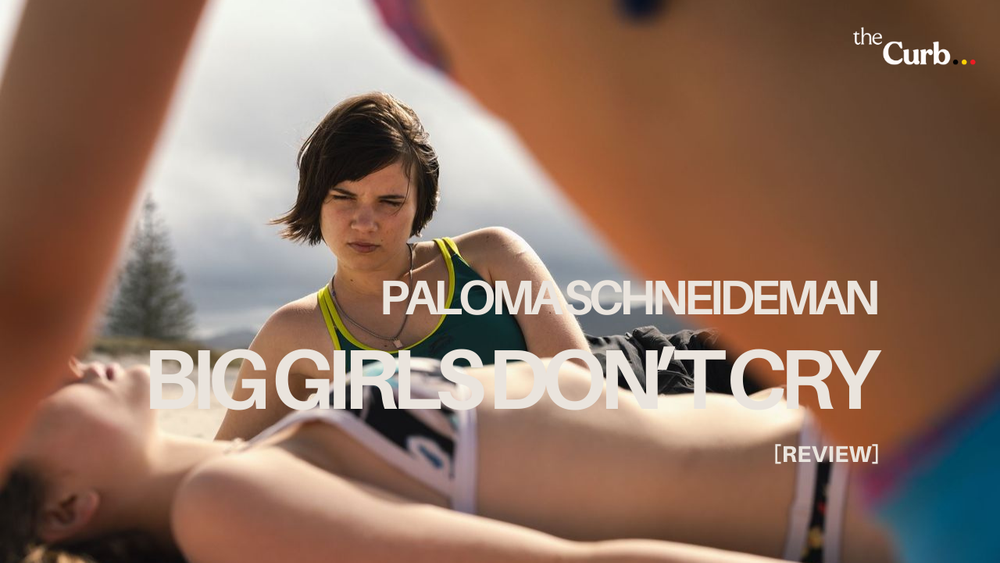
Middle school exists in a strange in-between world. You are no longer a child, but adulthood is still miles away. Everything feels heightened: friendships, embarrassment, curiosity, desire. Your body begins changing faster than your mind can keep up with it, and every moment feels like a test you didn’t study for. Watching Big Girls Don’t Cry, directed by Paloma Schneideman, feels like stepping back into that fragile, confusing space where every emotion is too big and every mistake feels permanent.
Set in the mid-2000s, the film follows Sid, played with astonishing tenderness by Ani Palmer. Sid is fourteen, restless and unsure of where she belongs. She watches the older girls in her life with a kind of quiet fascination, especially Lana, the effortlessly cool girl who seems to glide through every room like she owns it. Sid wants desperately to be seen as older, braver, cooler than she really feels. When her sister Adele brings home her American college friend Freya, played by Rain Spencer, Sid clings to the possibility that proximity to these older girls might unlock some secret knowledge about how to exist in the world.
Like so many girls at that age, Sid experiments with identity the only way she knows how: by trying things on and hoping they fit. Sometimes that means exaggerating stories about what she’s done or who she’s kissed. Sometimes it means drinking when she shouldn’t, just to prove she can. At one point she pierces her own belly button, an impulsive act that is both painful and strangely tender, because it feels like the kind of decision you make when you’re desperate to grow up faster than time will allow.
What makes Big Girls Don’t Cry feel so honest is how it understands that adolescence is rarely graceful. It’s messy, awkward, occasionally humiliating. Schneideman doesn’t soften those moments. Instead, she lets them sit on screen exactly as they feel in real life — uncomfortable, confusing, and sometimes painfully funny. Watching Sid navigate those experiences brings back the sharp memory of what it felt like to be fourteen and convinced that everyone else had already figured out something you hadn’t.
At the center of it all is Sid’s quiet realization that the feelings blooming inside her don’t quite match what the world expects of her. The film captures the early stages of queer self-discovery with remarkable sensitivity. Sid doesn’t have the language for what she’s feeling yet, and more importantly, she doesn’t really have anyone to guide her through it. No one is overtly cruel to her, but there’s an absence where support should be. The world assumes she’s straight, and that assumption quietly shapes every interaction around her.
That loneliness is something the film captures beautifully. Growing up queer, especially in the mid-2000s, often meant figuring things out alone. There were fewer visible examples, fewer open conversations, fewer safe places to ask questions. Schneideman approaches that reality with incredible gentleness. Sid’s confusion never feels sensationalized or tragic. Instead, it feels deeply human — the slow, uncertain process of recognizing yourself.
Ani Palmer carries the film with a performance that feels startlingly real. There’s a vulnerability in the way she moves through scenes, like someone who is constantly aware of how closely she’s being watched. She captures the particular awkwardness of teenage girlhood so perfectly: the shifting confidence, the sudden embarrassment, the longing to be admired mixed with the fear of being exposed. It’s the kind of performance that feels less like acting and more like memory.
The supporting cast adds warmth and texture to Sid’s world. Rain Spencer, in particular, brings an easy charisma to Freya, the kind of older girl who seems effortlessly comfortable in her own skin. Watching Sid observe her feels like watching someone stare through a window into the life they wish they understood.
Visually, the film is drenched in nostalgia. The cinematography has a soft, sun-washed quality that feels like a memory you can almost touch. Summer light spills through bedrooms and kitchens, catching on posters, messy hair, and teenage bedrooms cluttered with fragments of identity. The mid-2000s details are subtle but vivid — the clothes, the music, the glow of a computer screen late at night. It all creates the feeling of flipping through an old photo album from a life you once lived.
There’s a quiet beauty in the way Schneideman frames adolescence. The camera lingers on small moments: the nervous glance across a room, the tension in a conversation that no one quite knows how to finish, the strange intimacy of sitting beside someone you want to impress. These moments accumulate until the film begins to feel like a mosaic of girlhood itself.
What ultimately makes Big Girls Don’t Cry so moving is how deeply it understands the vulnerability of growing up. It remembers what it felt like to be young and uncertain, to want desperately to belong somewhere, and to slowly realize that the person you are becoming might not fit the story everyone else expects.
It’s a tender, nostalgic, quietly powerful film about queer self-discovery and the fragile chaos of adolescence. And by the time it ends, you don’t just feel like you’ve watched Sid grow up a little — you feel like you’ve remembered a piece of your own past too.
Director: Paloma Schneideman
Cast: Sni Palmer, Noah Taylor, Rain Spencer
Writer: Paloma Schneideman
Producers: Thomas Coppell, Vicky Pope
Cinematographer: Maria Ines Manchego
Editors: Cushla Dillon, Chia-Chi Hsu