
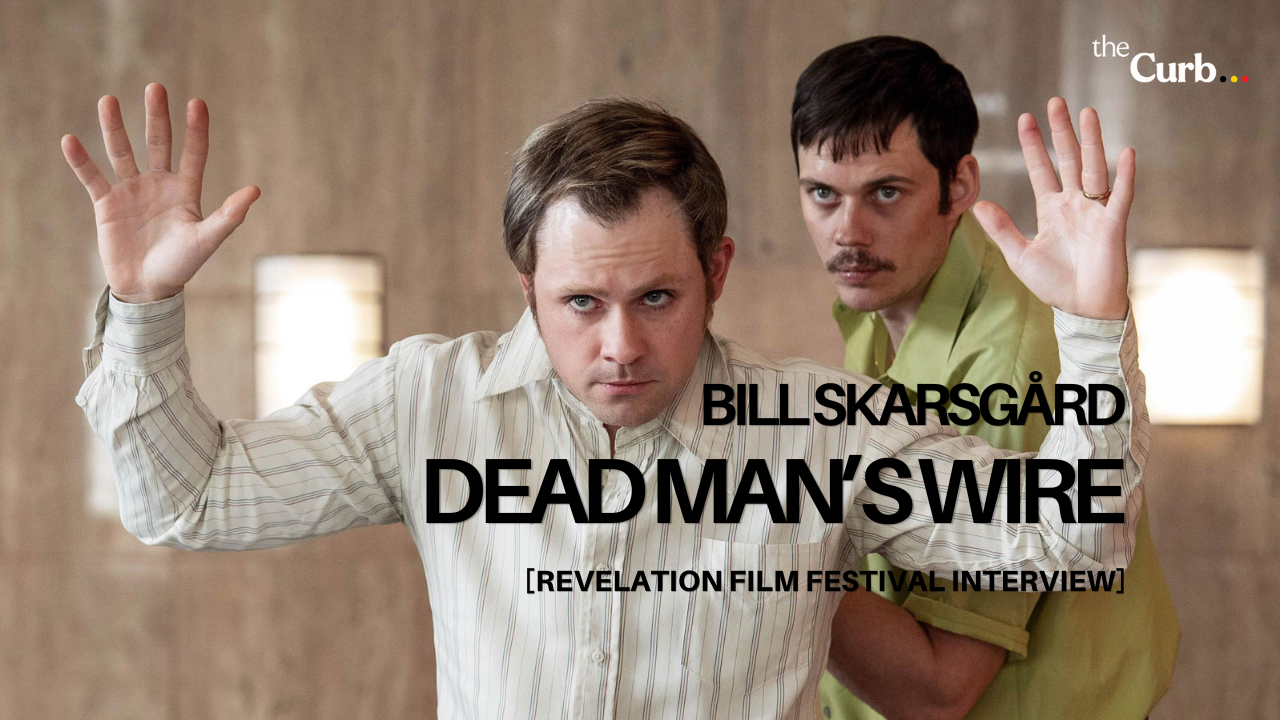
On a winter’s day, February 8, 1977, in downtown Indianapolis Tony Kiritsis took mortgage broker Richard Hall of Meridian Mortgage hostage via a wire-rigged trigger rifle that would go off if Tony wasn’t keeping it steady. What followed was a tense standoff in which Tony kept Richard in his apartment and waited for a public apology from Meridian Mortgage’s owner M.L. Hall for deliberately gouging Tony of his investments. The situation became a media frenzy where Tony, becoming increasingly discombobulated, expected his demands would be met and his freedom guaranteed.
Gus Van Sant, working off a script by Austin Kolodney, turns the true crime story into a tense thriller, social commentary, and a black comedy. Featuring a knockout performance by Bill Skarsgård as Tony, and equally solid work by Dacre Montgomery as Richard; Dead Man’s Wire is a timely reminder of how the media focuses public attention on desperate and destructive acts. Supporting performances include Colman Domingo, Myha’la, Al Pacino, and Cary Elwes.
Nadine Whitney spoke with Bill about how he prepared for the performance and his takeaways from the Tony Kiritsis story.
Dead Man’s Wire is the opening night film for Revelation Perth International Film Festival. It also screens on 11 & 15 July 2026. Tickets area available here:


How does Dead Man’s Wire reflect on society's fascination with danger, crime, and spectacle?
Bill Skarsgård: Thematically it is commenting on sensationalising news and danger and the excitement of following something live as it is unfolding. This was before OJ Simpson, before all of that. It was the 1970s the world looked quite different at least when it comes to the media and how things are covered. It was before 24/7 news channels.
I think we are always going to be drawn towards something that is sensational and I think it's easier for us to sensationalise danger and fear. The media does it, politicians do it. There’s something about us as human beings that were drawn towards spectacle.
I think it is a is a way bigger thing than just what happens in the movie, but the movie is obviously a high-stakes situation and it's dangerous and people are going to tune in. It's a comment on that especially with the live airing the press conference at the end with a guy having a loaded shotgun wired to another man's neck. Potentially people are tuning in secretly hoping that it would go off.
How did you get a feeling for the period? Are there any films you watched that helped you?
Bill Skarsgård: I think the late 1960s and 1970s era films contain my favorite films ever, like they're all in there in that decade. It wasn't so much that I had to go and revisit them as they are my favorite films, I think I'm very familiar with most of them. What was serendipitous is that I was watching Elaine May’s film Mikey and Nicky (1976), and I hadn't worked for a while. I was just kind of like “What do I want to do?” and I hadn't seen May’s film. While I was watching it, I felt, “Okay, whatever this is, this is what I want to do.” I wanted to do something that is so loose and if you're following two guys (Peter Falk and John Cassavetes) basically on a journey in 24 hours and there's a lot at stake. It's just a fantastic film.
I haven't done the kind the Cassavetes style of just like loose and improvised and long takes where the cameras just there capturing it all. A week later the script for Dead Man’s Wire came to me. I'm reading it. It’s in the 1970s it's with a master like Gus Van Sant. The film really came at the right time for me.
I’ve always been drawn to those types of films. I think Dog Day Afternoon for sure and any sort of Sidney Lumet film. Network was to me, “Okay this movie came out four months before the real events happened and I could picture Tony Kiritsis going and seeing this in the theater and thinking, “I'm mad as hell and I'm not going to take it anymore!” Network, which is one of my favorite films, became sort of spirit guide for Tony.
I just wanted to go further into something you just said there about Cassavetes and Elaine May and is that sort of reactive and naturalistic acting on onset. Did you find you had that with Dacre Montgomery as Richard specifically because you are on screen with him for most of the time.
Bill Skarsgård: I didn't know Dacre Montgomery before, but we got along really well right off the bat. He’s very eccentric, he's very opinionated, and he's quite obsessive just like myself. I think we vibe with our creative expressions. We had a few couple of days of rehearsals with Gus Van Sant, just the three of us in a room talking through the roles of the characters and the script. We rehearsed some of the scenes and blocked a few of them. In terms of how we move, actually a lot of the time Dacre would move as Dick in a way I as Tony didn't want him to move, so that became the dance: don't go there, you should go here you, should stop. What Dacre was doing really fed into my performance.
Then the way we shot it was a lot of handheld cameras and Gus creates this setting and then he just lets us explore it. and You find a way through it and improvise and it's very organic. It’s the way I like to work. Whatever your scene partner is doing you counteract it or react to it, or you follow it. Whatever Dacre would do would as Richard when he would resist more. the more aggressive I got and that’s fed into the scene. It was a lot of fun, I really enjoyed working with him.
I think that you know the script was great, Austin Kolodney did a great job, and a lot of the dialogue is verbatim what Tony said. It’s interesting to be able to listen to the real guy saying the lines that you're actually going to say. I've never had that experience before I but I have played real people before so that was quite interesting.
There’s so much dialogue and Tony is yelling, he's angry. That there was a rhythm to it in the script was very important for me. You don't write dialogue the way he speaks 'cause he's kind of jumps around. We know what happened, for example when he was calling 911 and saying that the kidnapping was happening. It’s kind of bizarre so you have to find the rhythm that was structured in it.
Gus was very much sort of like just exploring, he was much more just kind of creating a setting and atmosphere was like “Whatever you guys do I'll capture it.” The way he shoots the film which is all handheld. A lot of the times they would go on for a physical 12-minute take and the cameras are there, but you completely lose yourself in it.
I think it's part of Gus’ style as well he has that in him. The sort of documentarian film he's done it before. Elephant (2003) was like a 12-page script, and he showed up and just created the whole movie that loose way. I really wanted it, and I was terrified. I said I didn’t know if I'm going to know the character well enough to feel come to just ad lib and improvise freely. Tony was a great character and was so defined and it was very clear kind of the energy of what he was that like that improvising around it came very naturally.
I could speak fluent Tony when we were shooting so things would just come and a lot of stuff was improvised, and I always love to sort of surprise myself when I’m filming when you're just like “I don't know where that came from” and everybody is kind of laughing or whatever. A good improvisation is not thought out it just happens in the moment. It's coming out of you live and direct and there's something I love about that process. It worked really well with the style of the movie and also how Gus likes to work. With Dacre as well; like he would do something, I would do something, and we’d just feed off of each other. A lot of the funnier moments I think just kind of ended up happening on the day.