John Boorman relates some wisdom a great director once gave him: “David Lean once said to me ‘John, we all make failures. Try not to make a famous one.’”
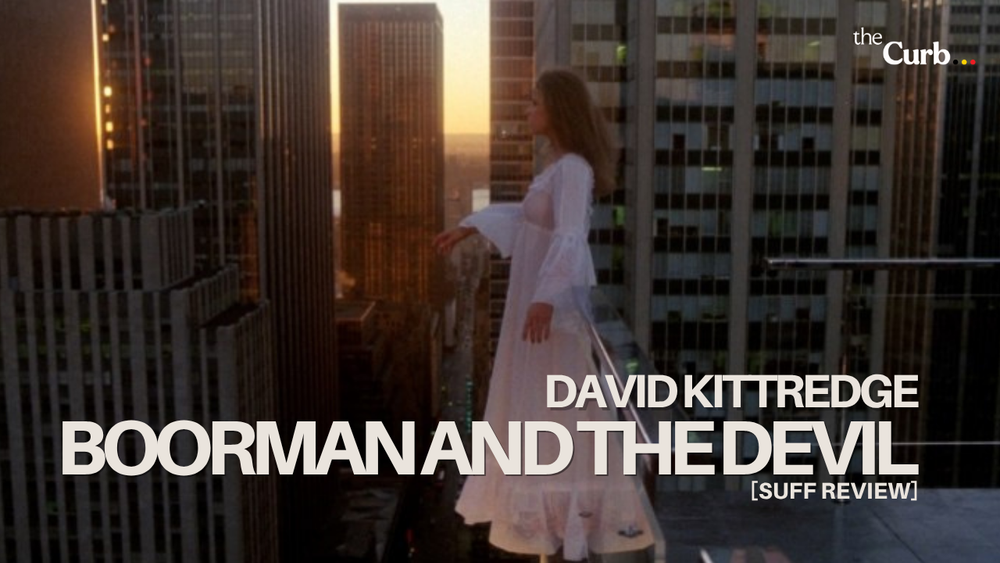
There’s a kind of open sadness when he laughs that in making Exorcist II: The Heretic he managed to make one of the most famous filmic failures in memory. To say that John Boorman remains traumatised by the reaction to his 1977 “sequel” to the wildly popular William Friedkin blockbuster from 1973 The Exorcist is reasonable. Even after so many years and a career that re-righted itself with his Arthurian epic Excalibur in 1981, Boorman remains haunted by The Heretic. One of the reasons, of course, is just how much schadenfreude Friedkin himself revelled in at the film flopping. The other reasons are expertly covered by David Kittredge’s documentary Boorman and the Devil.
There isn’t perhaps one specific moment or person who can be blamed for how poorly The Heretic was received. Perhaps the most obvious issue comes down to the fact that Boorman didn’t like Friedkin’s film and was not keen on replication despite his friend Stanley Kubrick telling him that is exactly what a sequel needs, plus more of the aspects that audiences loved. Despite having three original cast members return; the most essential being Linda Blair as Regan MacNeil; Boorman was more interested in making a philosophical treatise on the nature of God and the idea that eventually human beings will evolve into a shared thought collective. Well, at least that’s part of the legend which even in the documentary changes depending on who is telling the story.
Boorman’s chances of the sequel he wanted to make, an investigation into those topics spearheaded by a young priest and the original detective in the first film Lieutenant William F. Kinderman, were dashed when Lee J. Cobb passed away in 1976. The ringing refusal of William Peter Blatty to write the sequel and the same refusal from Ellen Burstyn to appear in the sequel as Regan’s mother Chris MacNeil also created significant blocks to finding a story that Boorman could direct with fidelity to the original film.
We can look back now and see that The Exorcist is a franchise that should have perhaps never been a franchise. With the exception of the reappraisal of 1990’s The Exorcist III directed by the author William Peter Blatty, no Exorcist property has been successful in terms of audience and critical response. Named directors have dipped their fingers into the holy water and have come out scalded. Paul Schrader tried a prequel in 2004, and David Gordon Green tried a connected reboot in 2023 with The Exorcist: Believer for which the main good was that Ellen Burstyn was able to donate her entire salary to fund an MFA acting program for BIPOC students. I’m unsure anything good came of Schrader’s prequel which is languishing exactly where it should be – in a pile of “Oh, Paul!” flops.
The reason that I mention how messy the sequel (or prequel) business is for The Exorcist is that one of the people discussing Boorman’s film in the documentary is popular horror director Mike Flanagan who was handed the reins for the extremely expensive rights acquisition and is making the next Exorcist film. David Kittredge collects some extremely interesting people to talk about the film including critic and historian Bilge Ebiri, Joe McBride, Joe Dante, and the always switched on Karyn Kusama.
As interesting as it is to hear from critics and fellow directors the real value is in the interviews with Linda Blair and the now deceased Louise Fletcher, and in Boorman’s own reflections and the strangely egotistic Rospo Pallenberg. Those, along with people who did technical work on the film including the inventor of the Steadicam Garrett Brown and second assistant director Victor Hsu.
We hear from Linda Blair how great the original script was by William Goodhart and how terrible the rewrites mostly spearheaded by Rospo Pallenberg were. There’s also a general feeling of disdain for Pallenberg displayed by almost everyone who worked on the film. Louise Fletcher, who is remarkably generous to all her co-workers and cast on the movie (including the excessively drunk Richard Burton), stops short of having anything good to say of Rospo. Linda Blair speaks of her active dislike of the man. There seems to be a consensus that when John Boorman contracted valley fever from the imported dirt for the Ethiopian scenes and the filming was essentially halted that Pallenberg’s “take over” of the script and final direction for the movie was not only a disaster but a trial that made people want to quit the production altogether.
John Boorman had made three films that each moved him into the A-list category of directors. Point Blank starring Lee Marvin in 1967, Hell in the Pacific once again with Lee Marvin and Akira Kurosawa’s collaborator Toshiro Mifune in 1968, and the lauded Deliverance in 1972. However, John Boorman was also the director of the Sean Connery in a mankini science fiction mind-warper Zardoz in 1974 (in the room where Boorman is interviewed is a small Zardoz mask and presumably one of the prop swords for Excalibur). It wasn’t the man who made Deliverance who was devising the mood of The Heretic (although he wanted Jon Voight for the role of Father Lamont that went to Richard Burton), it was the man who made Zardoz.
Linda Blair and Louise Fletcher both give wonderful oral histories of their time on The Heretic and what it meant for both of them. Fletcher was coming off a multi-award-winning high after taking home an Academy Award, a Golden Globe, and a BAFTA for her performance in One Flew Over the Cuckoo’s Nest in 1976. She was very happy to be offered the part of psychiatrist and doctor Gene Tuskin as it was another leading role and one that would show her range beyond villain. Linda Blair was happy to see the paycheque and ensured she didn’t have to wear Pazuzu/Regan makeup (she did have to tap dance). A lot of money went to the primary cast, including the late addition of Richard Burton. Even more money went into creating a soundstage set (with some location filming including poor Linda on the roof in New York) that, despite the eventual reaction to the movie, was indeed an artistic innovation on a grand scale.
Boorman admits that he didn’t pay enough attention to audience expectations for a sequel. In 1977 the idea of a sequel itself for a premium film was quite new. Serials and B-movies had long existed with versions of sequels, but in 1977 the reference for a sequel was The Godfather Part II. In the late 1970s there was a glut of New Hollywood auteurs putting out bloated films. Francis Ford Coppola’s Apocalypse Now didn’t do as well as expected (there are three versions of the movie now and of course it is considered a masterpiece). Michael Cimino and Heaven’s Gate in 1980 was a death knell to allowing huge budgeted “epics” (the kind of films that the New Hollywood directors took over from). Boorman realised that Heretic was part of the death of studio investment – although there was a complex system of blind bidding by cinemas to get rights to expected blockbusters that somewhat sheltered the studios.
What went wrong? How did a film shot by William Fraker of Rosemary’s Baby and Bullitt fame, scored by the incredible Ennio Morricone, and starring Richard Burton, Louise Fletcher, and a returning Max von Sydow, become both a punchline and a dire warning?
A lot of it can come down to the script which makes precisely zero sense in places. The lack of an ending in Georgetown that appeared even vaguely to wrap up what came before it. A reliance on new methods of pseudoscience such as ESP as a main plot device. The heavy sexualisation of Linda Blair who plays Regan as a sixteen-year-old. Burton’s inability to do much due to his chronic alcoholism. Locusts… The weird turn of Kitty Winn’s Sharon as a Pazuzu influenced villain. Rospo Pallenberg. Locusts… James Earl Jones spitting out a tomato while dressed as a jaguar. Locusts… and a little movie called Star Wars – which ironically would usher in a universe of sequels.
David Kittredge’s documentary is a granular excavation of a world famous “bad film” but done with such respect for the people who worked on it, especially the still shaken John Boorman. It’s almost enough to revisit Exorcist II: The Heretic with new eyes, although even the stars of the film (and many in the documentary) don’t recommend that. Kittredge sees the value of failure, and in failure of epic proportions. Boorman and the Devil is a treat for film enthusiasts and anyone who ever really dropped the ball and got back up.
Director and writer: David Kittredge
Participants: John Boorman, Linda Blair, Karyn Kusama, Louise Fletcher, Rospo Pallenberg, Mike Flanagan
Animation: Rob Ross
Boorman and the Devil is playing at Sydney Underground Film Festival 2026