Coward screens at the Melbourne International Film Festival on 15, 20, 22 August 2026. Tickets are available here:

In 2022, the Belgian Department of Foreign Affairs unveiled a new passport. Across its pages, where Australia has vistas of cities and native animals, Belgium put characters from Hergé’s Tintin. It was an insight into how a small, proud country sees itself as distinct from its larger neighbours, and into what, out of all its achievements, it most wants to project to the world. Art, in the form of a young, adventurous and curious man.
Also in 2022, the 31-year-old Belgian director Lukas Dhont released his second film, Close, a tender portrait of teenage male friendship and the tragedy that follows its rupture. It won the Grand Prix at Cannes and confirmed what his debut Girl had suggested – that Dhont was supremely gifted at making films about young protagonists whose nature sets them at odds with their surroundings. Four years earlier, Girl had taken the Caméra d’Or. This May he returned a third time, and for the third time did not leave empty-handed. Coward premiered in Competition on 21 May, drew a thirteen-minute standing ovation, and sent its two unknown leads, Emmanuel Macchia and Valentin Campagne, up to collect a shared Best Actor prize from the jury. It also took the Prix du Cinéma Positif, an award given to the film in Competition judged most likely to inspire hope.
Set along the Belgian frontlines of the First World War, Coward is Dhont’s most ambitious film by some margin. Some critics have called it a film about war with almost no war in it. Others have called it a romance, a film about longing in the style of Brief Encounter or Casablanca. Almost all of them remarked on the complete lack of women in its cast.
Andy Hazel spoke to Dhont at Cannes, where he was immaculately dressed in a navy suit and white shirt, his hair swept back in a James Dean wave with just a hint of stubble. He was, as the critic Richard Lawson once joked of him, immediately irritating, merely by virtue of being so young, handsome, talented and well-spoken. The image is worth noting, because an image is where the film began.
“The start of the project was finding this black and white photograph,” says Dhont. “It was of young soldiers right behind the front line who were wearing sandbag skirts and who were dancing and making other comrades smile. When I saw that picture, I was incredibly moved by these young men trying to create something in the midst of all that destruction, trying to find collaboration and community when they are conditioned to compete and fight.”
He also found himself, as he puts it, “confronted with the politics of memory, because that’s the type of image that I feel we have so rarely seen. It’s an image from the past, but in a way, it’s been living in the shadows.”
Once he had the photograph, he went looking for more. Dhont says he was surprised by the volume of material he found that explored this underreported world of wartime gender-fluid performance. Diary entries, drawings, playbills, whole song sheets from the revues staged behind the lines by the British, the Americans and the Belgians. Nearly every song in Coward is set to lyrics lifted from those journals. But finding them required work he still seems faintly annoyed about having had to do.
“Why have those images lived so hidden and so invisible?” he asks, brow furrowing, letting the silence sit. “Why have we pushed so many images of brutality and of violence to the front? Why did I have to dive deep into the archives of the Imperial War Museum in London to find the material and photos and the journals?”
One testimony didn’t make the film but shaped it entirely. “There was one young man who described that a comrade of theirs had dressed up as their mother and had given them a kiss good night before they went to bed,” Dhont says. “To me, that is like an antidote to all the stories of men looking for power and looking to destroy and looking to compete. This is men who try to express the most tender parts of themselves.”
Dhont is careful to distinguish what he is doing from a simple corrective. He is not arguing that the brutality wasn’t there, but that there is a historic imbalance in our understanding, and one he feels the film redresses.
“We live in a time where we are ready to speak about the violence done by men,” he says. “The violence done by a very patriarchal society that has pushed people to certain behaviour. I think it’s great that we’re there, but my desire as a filmmaker is to not only talk about that violence but also propose something different. Show something different that has always been there.”
That principle was built into the script he wrote with his regular collaborator Angelo Tijssens. “What we’ve shown a lot is the battlefield, the trenches, the scenes of violence. What we’ve shown less is these scenes of men taking munition boxes and building a podium with them. Using shells to make jewellery. Transforming the things they have to destroy into things that they can bring humour and light with. Already in the setup of the script, there is this idea of trying to find ways to talk about the violence, but not, where possible, show it.”
The characters of Tijssens and Dhont’s previous films have always communicated through silence and gesture more than speech, and in Coward silence carries a specific historical weight. “Silence is the easiest way sometimes of living,” Dhont says. “There’s so much that goes on inside of ourselves, and to share that with someone, to be so vulnerable, it’s an act of bravery.”
Charged with depicting this bravery are two actors who appear in almost every scene of the film. Dhont found them by opposite routes.
Tijssens and Dhont wrote Pierre as the son of a farmer. “People who work in agriculture have a very specific way of using the body,” he explains. “They work with the land, with nature, with the fields.” So Dhont, a committed street-caster, went to the agricultural schools of Belgium. In the courtyard of one, a young man approached him and barely spoke. “He didn’t really dare to use his voice. Very soft speaking, very timid, and that was the character we had written. Someone who really doesn’t dare to use his voice and adapts to the voice of others.”
That was Emmanuel Macchia. Valentin Campagne, who plays Francis, came from acting school and is his mirror image in terms of energy and extroversion. “He wants to take space,” Dhont says. “He would be dancing on the table if he would be here.” When they were put together, their mismatch provided the film with a complementary energy. “Emmanuel came out of his shell because of the openness that Valentin had and there was a truthfulness and an authenticity that Emmanuel has that made Valentin become more than just a performer.” It was that combination the jury rewarded, sending the two of them up together for the Best Actor prize.
When it came to building the world around them, Dhont cites Jean Renoir’s La Grande Illusion not only for its refusal to show much violence and its dismantling of the idea of the enemy, but for one scene, when dresses are brought into the prison camp and a man puts one on. “The reaction of all these men to this woman, the closest thing that they have to a woman in their present day,” says Dhont. “That was very much in echo with what I read in the journals. These men who performed femininity in the camp, they weren’t shouted at, they weren’t outcast, they were admired. The people who were really good at this were stars among their comrades. That is such a modern idea, but today we wouldn’t dare to believe it.”
It was this world, and this moment in it, that allowed his lead characters to find each other at all. “In their societies there was no possibility for them to meet,” Dhont explains. “This was a sort of moment out of society. That’s a very weird contradiction, that this very violent time also gave an opportunity to some.”
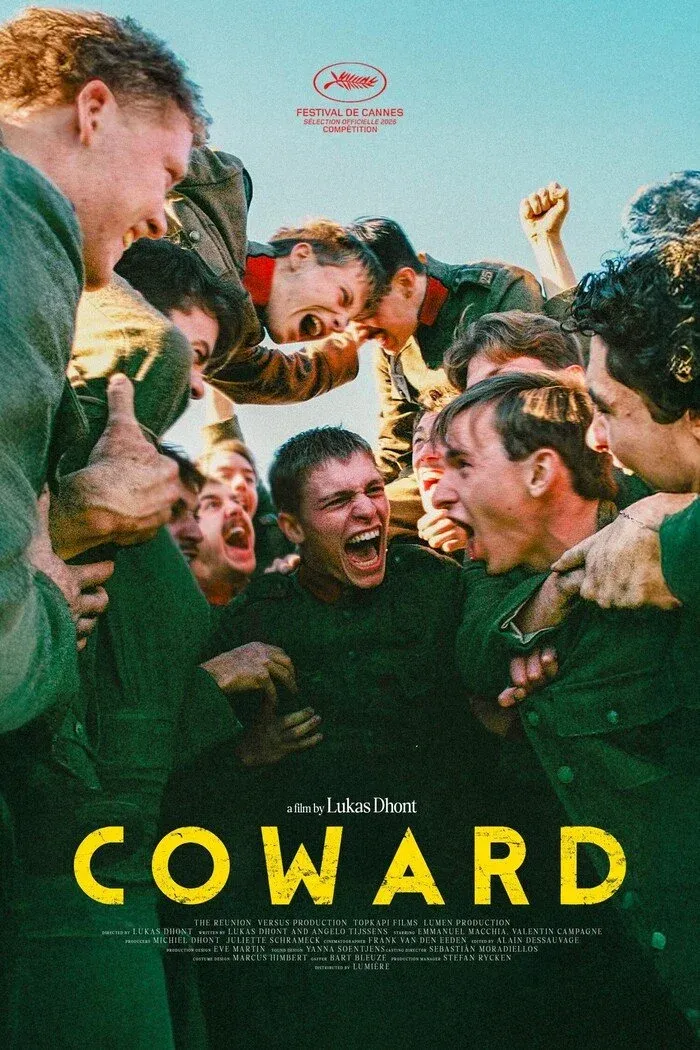
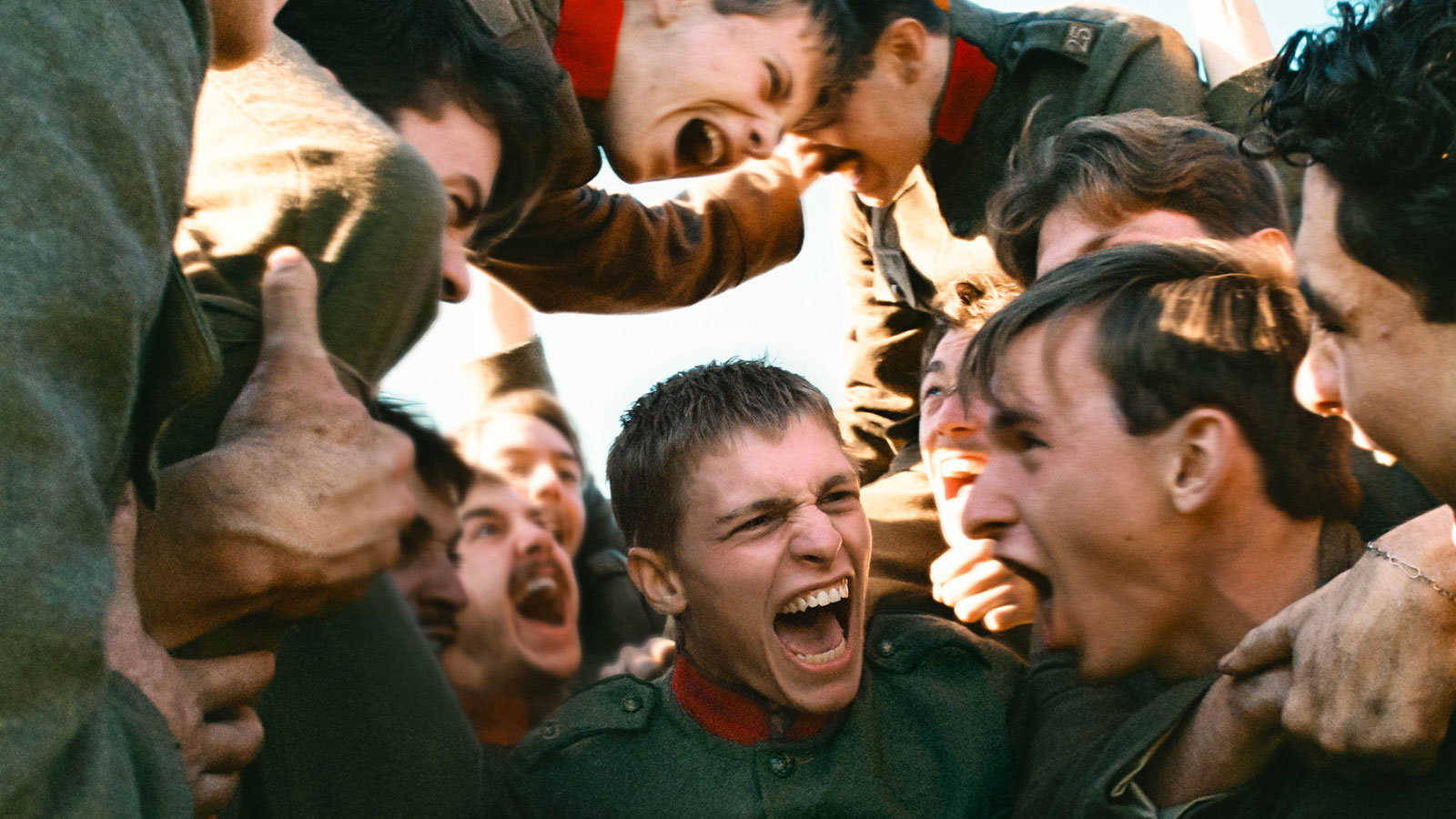
Dhont intended the title of the film to be a provocation. Accompanied with the image of a group of men, huddled together, creates a striking tension, one that film builds, carries and rips open. “I have a difficult relationship with that word because I feel that the fear of that label has been so destructive to so many people,” Dhont says. “Even when you start writing scripts, the first thing you learn is that it’s about the hero’s journey. I’m sure for many, the fear of being called a coward is what pushed them to move forwards.” What interests him more than the reaction of a society built on honour, is the fear that fuels it. “Sometimes we fear an enemy, but many of us also fear parts of who we are. It takes a lot of courage to allow ourselves to be the completest versions of who we are, the messy versions.”
He is not, he insists, handing down a verdict. “I’m not interested in trying to tell you who is a coward,” he says. “What I’m interested in is showing that the world has decided what cowards are. Cowards are men who choose love and not war. Cowards are men who try to escape from doing their duty.”
Which brings us to the sex. “As a queer man growing up, not having a lot of scenes that showed sex in a messy way – and with messy, I mean two people who don’t know how that works looking for ways to do it, and the vulnerability of that. Usually when you see a sex scene, people know what they are doing and go for it.” He wanted something clumsier and more tender. “Two people who haven’t had the chance to discover their bodies, or another body, because they live in a time where that love is supposed to be very, very silent,” is how he puts it, before shrugging. “Of course, I’m much more interested in filming sex than in violence, but in a way that feels elegant and feels like something that you can project onto and imagine.”
One scene in particular has proven, even in preview screenings, to have sparked conversations afterwards. When Pierre shaves Francis’s legs, and the two lock eyes. This scene, Dhont says, embodies the eroticism he is talking about. “That’s a scene in which these two characters have to live their sensuality in public and find ways to express their attraction in a time where that is such a dangerous thing,” he says, brightening. “I find that incredibly sexy, because a secret is often treated as something violent and cruel, but what I loved in Pierre and Francis is that there’s a joy to the secretiveness. A joy to that understanding they have of one another that the rest doesn’t know about.”
He describes the characters he keeps writing – in French, fleur de peau – as people who “have their hearts on their bodies rather than inside,” moving through a world that attacks the heart they wear on their skin. Love finds its ways. For me, the film is so much about longing and about yearning. When we worked on the script, we didn’t underestimate the power of that.”