
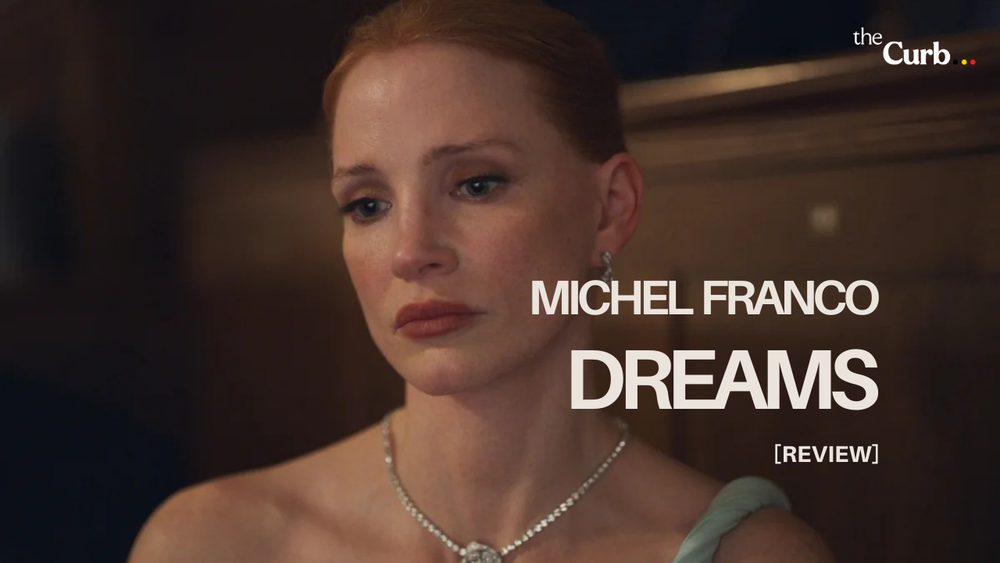
Dreams is a film that looks stunning but feels utterly lifeless. Michel Franco clearly knows how to capture beauty—especially in ballet—but all the visual polish in the world can’t make up for a story that lacks heart, depth, or emotional resonance. From the very first scene, the film sets up a collision between wealth and desire, power and talent, but then it retreats into icy distance, leaving the audience watching from afar instead of feeling anything.
Jessica Chastain plays Jennifer McCarthy, a wealthy, high-powered socialite whose life revolves around her family’s foundation and its public acts of charity. Her existence is one of control and perfection: designer wardrobes, private jets, and staff ready to cater to her every whim. Enter Fernando, a Mexican ballet dancer who risks everything to reconnect with Jennifer. His journey is dangerous, urgent, and full of stakes that could have made their story pulse with tension—but Franco treats it like a mere plot point. The film sets up danger and longing, but never allows us to inhabit those feelings. Instead, the romance between Jennifer and Fernando feels sterile, their chemistry more theoretical than real.
Jennifer’s wealth dominates every scene. Her life is a series of carefully orchestrated gestures meant to impress, to signal taste, refinement, and power. Fernando, by contrast, is vibrant, talented, and alive—yet the narrative never gives us enough insight into why he loves Jennifer so completely. The film shows us her allure, her control, her status, but it never convinces us of what she offers that he couldn’t find elsewhere. Their interactions are meant to feel tense and passionate, but they mostly feel like exercises in entitlement and submission. Jennifer’s arrogance overshadows any vulnerability she might have, while Fernando’s devotion is frustratingly underdeveloped.
Franco seems caught between critiquing privilege and reveling in it. The contrast between Fernando’s struggle and Jennifer’s opulent life is obvious, but it’s never lived in. There’s no grit, no messiness, no reality beneath the surface. The ballet sequences, as elegant as they are, feel like islands of vitality in a story otherwise frozen in polished monotony. Watching Fernando dance is the only time the film feels human, but these moments are fleeting, and the film quickly returns to sterile, controlled interactions that leave no emotional mark.
The social and political undertones—immigration, wealth, and power—are suggested but never explored. Fernando’s hardships could have provided a lens into the consequences of privilege and systemic inequality, but the film skims over any meaningful engagement with these ideas. Instead, it leans on melodrama: Jennifer’s manipulation, Fernando’s quiet suffering, and a series of shocking moments meant to provoke reaction rather than insight.
By the third act, Dreams becomes exhausting. The darker plot developments feel overplayed, and the moral commentary is heavy-handed. Jennifer’s control over Fernando could have been compelling, a study in power dynamics and obsession, but it comes across as performative cruelty rather than nuanced character development. Fernando’s talent and perseverance are admirable, but the script rarely allows us to care about him as a person. The power imbalance between them dominates every scene, and neither character feels fully realized.
Ultimately, Dreams is a film that looks like it could have been brilliant but ends up hollow. Franco demonstrates undeniable technical skill and an appreciation for visual storytelling, but the emotional stakes never land. We’re shown a world of glamour, wealth, and desire, but the story behind it feels flat, the characters distant, and the tension artificial. The film flirts with themes of obsession, privilege, and longing, but never truly inhabits them.
Dreams is a lesson in style over substance. It’s gorgeous, precise, and meticulously composed—but it’s also cold, detached, and frustratingly empty. The potential for passion, risk, and real human emotion is present but untapped. By the end, all that remains is admiration for its aesthetic craftsmanship, paired with disappointment that a story with so much promise feels so hollow beneath the surface.
Director: Michel Franco
Cast: Jessica Chastain, Isaac Hernández, Rupert Friend
Writer: Michel Franco
Producers: Michel Franco, Eréndira Núñez Larios, Alexander Rodnyansky
Cinematographer: Yves Cape
Editors: Óscar Figueroa, Michel Franco