
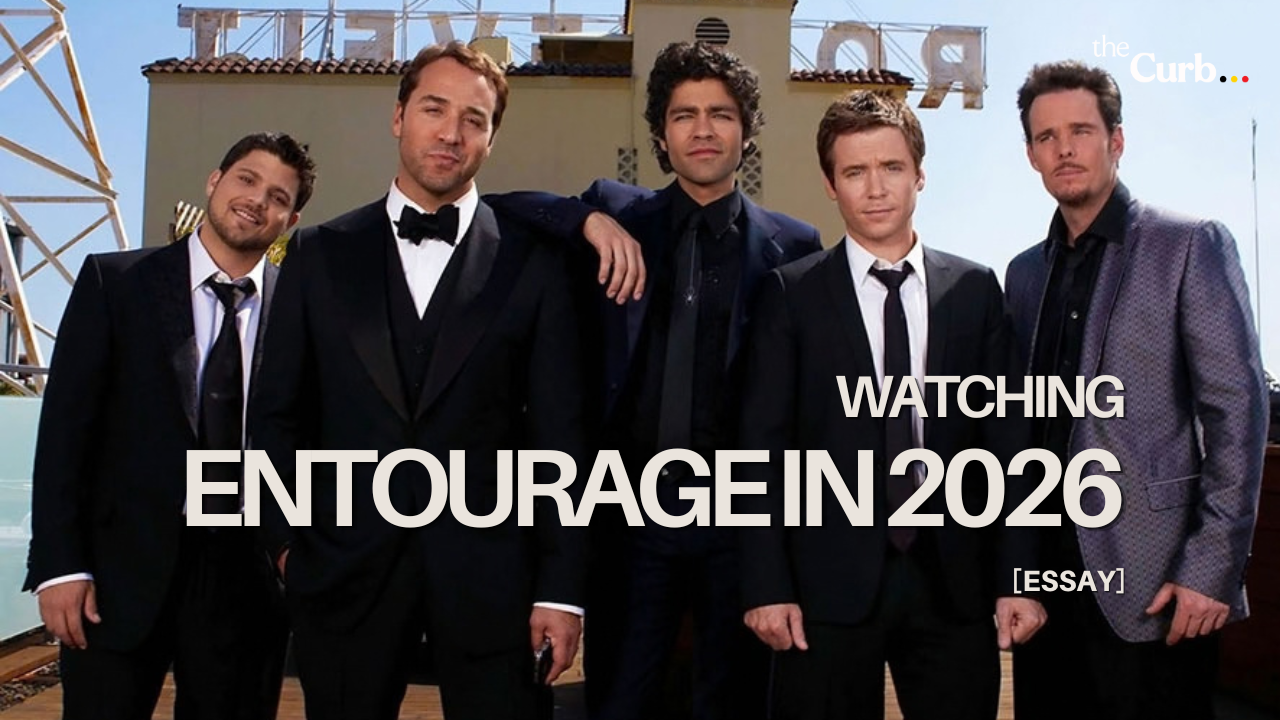
Revisiting HBO’s famously male and hyper-sexualised Hollywood fantasy made me question my own ambitions as a woman in the film industry – those within reach, and those that remain untouchable.
When I started watching Entourage I had no context for the show. Neither its content nor its position within the cultural zeitgeist had been brought to my attention. In fact, I had never even heard of it.
What made me want to watch it? To answer this question, you must take into consideration 1. my deep sense of nostalgia for the era that I grew up in, and 2. my biggest guilty pleasure; the 90s to early 2000s sit-com. I have systematically consumed everything from the likes of Sex and The City to Dawson’s Creek to How I Met Your Mother, and everything in-between.
So when Entourage made an appearance on my HBO Max homepage it seemed to have the makings of everything I would enjoy; not to mention its main characters were freshly navigating the world of Hollywood for the first time. As an amateur writer/director this played into my own sense of aspirational fantasy more than I was expecting.
As I began watching I was very quickly confronted with a barrage of foul language and bad behaviour from the male characters. While this conduct is consistent throughout all our main characters, including the show’s moral compass and sensitive core Eric Murphy (otherwise known as ‘E’) played by Kevin Connolly, the most grotesque statements come from the mouth of Ari Gold (Jeremy Piven). As Ari uttered the line “You fire a guy, you create a rival. You fire a woman, you create a housewife” I had to physically pick my jaw up from the floor.
By the end of the first season, this vernacular was so embedded within my expectations, it was no longer shocking. I liken it to the experience of watching Tarantino’s Kill Bill. By the end of the series, I had become so desensitised to severed limbs that the excessive depiction of gore felt like a part of the set dressing.
By now, audiences are no stranger to the anti-hero protagonist. Yet, I wondered if this was really the intention behind the show. Were the creators Doug Ellin and Mark Wahlberg exposing the misogynistic double standards of Hollywood? Or unveiling the ‘man’s world’ playbook of the industry? If so, were they condemning these values or merely reflecting their reality?
A narrative’s moral compass can often be measured by its repercussions for bad behaviour. However, genuine consequences for the actions of Vincent, his entourage and his agent Ari remain to be seen. While the characters are knocked from their pedestal from time to time, (there would be no story arc if they weren’t) they never seem to fall too far. A typical season of Entourage creates conflict that will generally be resolved during the season finale. All bad behaviour is forgiven, if not rewarded – landing a role in a Scorsese film after a bad investment in a vanity project, an engagement after repeatedly ignoring romantic rejection, or a company merger after a double-crossing gone wrong. Problems are overcome seamlessly and usually through happenstance.
So why was I still watching? What I saw playing out in front of me was a work-life I realised I could never have. Now I’m not saying I want to live in a world where people are allowed to use misogynistic and homophobic slurs. I am incredibly thankful for the progress we have made towards more inclusive and respectful work environments since the show aired in 2004.
However, throughout my work within the film industry, I have witnessed first-hand how male crew members were able to pursue a ‘hard-ass’ persona or ‘bite back’ to win respect while the female crew could never pull off such abrasive tactics. They would not be deemed ‘The Man’ but instead be labelled ‘difficult’ and ‘uncooperative’. While I know this is not a novel statement, I mean to highlight that, while other industries have made some real progress towards inclusivity, the attitudes throughout the Australian film industry today remain consistent with those exhibited in retrograde shows such as Entourage. By watching the male protagonists of Entourage get away with what I couldn’t, my experience turned into a type of voyeurism and Ari, the vulgar unrelenting agent, became my surrogate.
Whether traveling across countries, taking calls in the middle of the night or bursting into meeting rooms, Ari is awarded all the visual cues that flag his diligence and commitment to his career. Amidst the vitriolic façade, I found in Ari someone who, like me, strove to have it all. Ari was a man trying to juggle a volatile and demanding career while maintaining a thriving relationship and commitment to his family. The difference between us? Ari was successful.
At the forefront of Ari’s success is his ability to solve anything. If Vince or any member of his titular ‘entourage’ is in a bind, Ari will provide the answer. Ari’s evergreen treasure chest of solutions is made up of a suite of strong-armed tactics summarised under the umbrella of influence. Where his influence fails, his deep pockets fill the gaps. Funded by his wife Melissa, a beneficiary of generational wealth, he uses her money to do what she never would - create an empire.
As I continued to dissect Ari’s success, I realised that his behaviour demonstrated a reward system totally unfamiliar to me and contrarian to the one that I had inherited. Ari’s success relied on tactics such as harassment and bribery. The louder he was the better the outcome. In contrast, women are told we must be polite, respectful, and not overstep. As a result, I found myself engrossed in a world of opposites. A world that allowed me to experience what I had otherwise been denied, a sense of fulfilment within a male dominated industry.
While of course there are examples of successful women within the industry, their success is always conditional. I spoke to a female cinematographer once who confided that the reason she cut her hair was because she felt she was not taken seriously in her role. After the chop, she found that the transformation in perception was instantaneous.
These conditions can involve maintaining a palatable image of feminine success; fulfilling content expectations (their work must be either about or for women), or perhaps they have previously established success in a more traditionally tolerated role for women, such as acting. It is my belief that, although acting serves as incredible preparation and insight into the directing process, it is the established name attached to an actress that allows so many women to make the jump from acting to directing. To test this theory, I encourage you to consider the household names of the female directors on our screens today - Olivia Wilde, Greta Gerwig, Halina Reijn and Rachel Sennott (creator of I Love LA - referred to by Sennott as ‘Entourage for e-girls’). While the talent of these women is undeniable, did they get their chance to prove their talent because they had already been accepted as faces on the silver screen?
Unlike his real-life female counterparts, Ari’s success is entirely unconditional. In an industry where I am faced with a growing list of impossible conditions, watching Entourage allowed me the experience of being ‘in the room’ - to be a part of the conversation and to be heard without having to surrender or bludgeon my identity as a woman.