
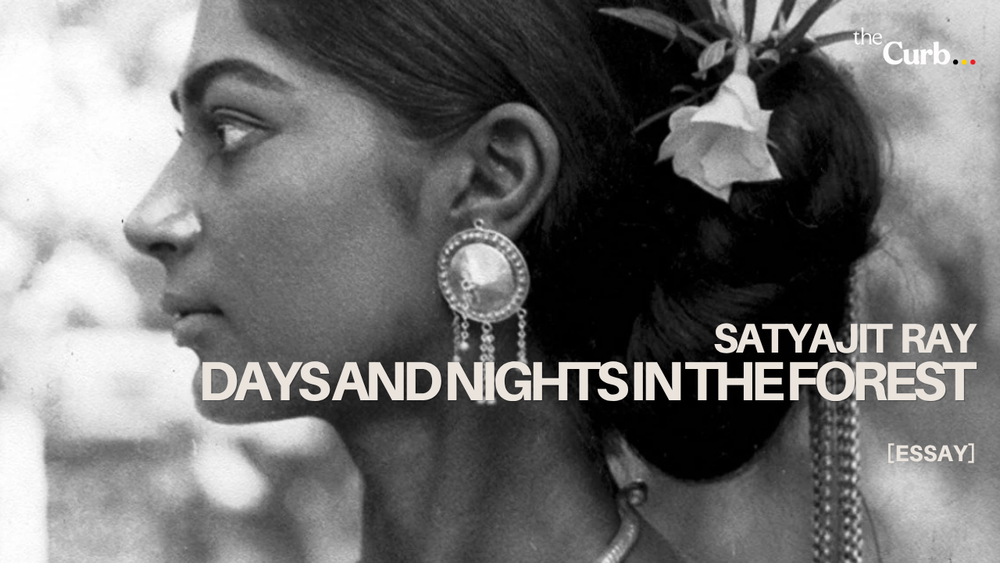
In Satyajit Ray’s Aranyer Din Ratri (Days and Nights in the Forest, 1970), four urban, middle-class young men from Kolkata—Ashim (Soumitra Chatterjee), Sanjoy (Subhendu Chatterjee), Hari (Samit Bhanja) and Shekhar (Robi Ghosh)—take a road trip to the forests of Palamau (present-day Jharkhand). They want an escape from the city and briefly sever all contact with civilisation. In today's urban lingo, I guess this trip would be labelled a 'digital detox'. From the film's opening sequence, before we see a single shot of the Palamau forests, we get an inkling that this journey might be more than just a weekend getaway.
“Foresters are beautiful in forests; children in mothers’ arms,” Ashim says. Sanjoy reads aloud from ‘Palamou’, a celebrated travelogue by Sanjib Chandra Chattopadhyay, first serialised between 1880 and 1882, and widely considered an ode to Bengal that embraces modernity in the nineteenth century. “All have a tiny piece of cloth tied around their waists,” he reads, taking particular delight at the titillating description of the Santhali tribal women, Indigenous to the Santhal Pargana region of Jharkhand. Sanjoy changes the topic to describe local drinking habits, to which Shekhar exclaims, “Men and women both consume alcohol, quite the Western society!” This response is telling—Shekhar cannot imagine women of a tribal culture drinking alongside men as anything but an example of the very culture that once colonised him. In his mind, the only comparable benchmark of social freedom for the Santhali people is Western modernity.
Bandopadhyay (2006) notes that while these statements seem outlandish, their appeal among Bengali elite circles has remained strong enough that they have not yet become outdated clichés. The men on this journey see themselves as ‘bhadralok’. This translates as ‘gentlemen’ in English, but is more specifically a self-ascription for the educated, urban, and upper-caste class that emerged under colonial rule in Bengal. Today, the term is more flexible, loosely adopted by Bengalis who believe they are bastions of culture, civility, and polite society (Ray, 2020).
When viewed this way, Ray’s project is clear from the first scenes. Our bhadralok group has taken the place of their former colonisers. They want to experience freedom and mischief, things not permitted in polite society. While enjoying themselves, if they can ‘civilise’ a few ‘natives’, that’s just the cherry on top. Without meeting any Santhali women, they have already imagined what they are like—bodies without a soul, available, exotic, and waiting to be ravaged. As Bandopadhyay (2006) argues, the Indigenous Santhali people serve as masks for the bhadralok to put on briefly, only to be discarded when they leave, unchanged. These men are not travelling toward people, but toward a fantasy they already hold.
The narrator of ‘Palamou’ (the writer Sanjib Chandra Chattopadhyay was also a bhadralok, an orthodox Brahmin and one of the first graduates from the University of Calcutta), made the expedition on the shoulders of palanquin-bearers in 1880. The men in Days and Nights in the Forest arrive by car. The mode of transport has evolved. Not much else has. Make no mistake: the film may carry a light-hearted, ironic sensibility, but it’s a first contact story. And like all first contact stories, it ends in violence.
“A white man!” screams an Indigenous Malay tribal woman, staring directly into the camera, before running away to inform the rest of her tribe. And so begins Lav Diaz’s sprawling epic Magellan (2025), made fifty-five years after Ray’s film and in a different part of the world, currently playing in Australian cinemas. By positioning his film’s opening from an Indigenous perspective, Diaz reorients the familiar Eurocentric script about how first contact stories have been told by confronting the white [coloniser] Messiah myth head-on. As Diaz says, “The white man is not coming to save us. He will come, but the idea of colonisation is to fracture us.”
Both films have very different openings but represent two sides of the same encounter. Ray’s camera sits in the car with the four young men as they drive into the forest, indulging their colonial fantasy. Diaz’s static, distanced camera shows what the Indigenous woman sees as she registers the fantasy from her perspective. Ray goes outward, using the coloniser’s imagination and perspective. Diaz faithfully records the terror and violence the encounter produces. Together, these approaches give a full picture of what first contact means. The power structure is decided before the parties ever meet. Ray and Diaz, both from formerly colonised societies, understand that colonial violence happens ideologically before it becomes physical. The violence is embedded in the gaze. In Magellan, violence begins when the titular character raises his sails. In Days and Nights in the Forest, it starts in a car, with four men reading from a book and forming ideas about a people they have yet to meet.
The film shouldn't be read in a political vacuum. The Naxalite movement was sweeping through parts of West Bengal and the neighbouring states of Bihar and Andhra Pradesh in the 1960s. Influenced by Maoist ideology, the movement highlighted the fault lines of the rural-urban divide, the struggle for land rights, and the fight for self-determination by tribal and Indigenous communities in the post-independence period. Ray was a leading figure of Bengal's intelligentsia and a bhadralok himself. Vasudevan (2011) observes that the humbling of his urban male characters in the film is "surely self-ironic." The skewering of the bhadralok is not the work of an outsider; rather, it's Ray turning the lens inward on himself.
Vasudevan also situates Days and Nights in the Forest as the prelude to Ray's city trilogy—Pratidwandi (1970), Seemabadha (1971) and Jana Aranya (1975)—that directly confronts the moral and political collapse of urban India in the post-Nehruvian period. Though set in a forest, Days and Nights in the Forest is very much a city film. Despite the elaborate pretence of severing contact with all civilisation, the four young men can't help but carry their urban identity and city markers wherever they go.
How successfully Ray skewers the bhadralok from within, versus how authentically he represents an Indigenous perspective he has no lived experience of, is a necessary question, but it belongs in a different essay. Ray's self-awareness about his own class does not resolve the choices his camera makes when it looks at the Santhali people. Nonetheless, it implies that the film knows more than it is willing to admit.
The tribal women in the Palamou travelogue are described as scantily clad, available, unadorned, and waiting to be introduced to civilised society. Enter Duli (Simi Garewal), a Santhali tribal woman. She first meets the bhadralok men at a local liquor shop, half-drunk, asking for an ‘aadhaa pauaa’ (half-quarter). This request from an already drunk woman among other drunk men scandalises Shekhar, the self-designated jester. With flowers in her hair, a necklace, earrings, bangles, and a fully draped garment, Duli is nothing like what the men had imagined. When Hari asks her name, Shekhar interjects, saying, “Miss India.” It’s a dismissive retort. At a Miss India pageant, class and social standing matter as much as beauty. When reality doesn't match the colonial imagination, the coloniser doesn't apologise. Instead, he responds with dismissiveness, reminding the ‘Other’ of their place.
Duli is hired by Shekhar to work at the guest house where the men are staying. Offering employment is another nod to a familiar colonial charade in which the coloniser uses commerce to exert control. Soon, the charade’s more sinister intention surfaces. As Duli picks up the broom, the camera follows her closely, lingering over her exposed back, waist, and silhouette. The men feign idle conversation, but their eyes track her every move. The camera joins as a voyeur. Hari’s interest, masked by indifference, takes shape. What follows is shocking but inevitable.
There is no tiptoeing around it; what happens in the forest between Hari and Duli is rape. That this has not been said simply and decisively in over fifty years of film scholarship deserves reflection. Critical readings have circled around the topic with linguistic gymnastics, avoiding naming the horrific act for what it is. In his Marxist reading, Bandopadhyay (2006) calls the encounter “colonial commerce”, viewing Duli through the lens of capital and labour extraction. The political economy is important, but this approach erases Duli’s interiority. She has no agency and exists only as an object of the male gaze. Vasudevan (2011) uses a structuralist and semiotic approach. He explicitly excludes the question of the representation of tribal people and does not examine the encounter with Hari. For Vasudevan, the encounter does not meet his threshold of formal analysis. Mukherjee and Singh (2017) use a postcolonial ecology lens and almost name the act, citing American critic Pauline Kael’s (1973) observation that the scene “appears like rape,” but do not follow through. Gupta (2021) notes that consent is “complicated” for Duli, but does not resolve the ambiguity. Guha (2026) offers the most recent reading acknowledging Duli’s ‘othering’, drawing on Butler to argue that Duli “materialises herself in obedience with a historically delimited possibility.” This is the closest existing discourse comes to using the word without actually saying it.
Labelling the encounter between Hari and Duli as rape does not take away anything from the film. In fact, what presents as a wry and self-ironic moral fable and comedy of manners reveals itself to be darker and more confronting. This film is a colonial first contact story in which the latent violence in the fantasy from the opening scenes finally bursts forth. The comic sensibility Ray employs throughout much of the film shouldn’t be read as misdirection or disguise. First contact narratives, when told from a colonial perspective, have often presented acts of violence through the language of adventure, discovery, and curiosity. Ray employs a similar approach, presenting darker undercurrents wrapped in humour, irony, and the genre of a male hangout movie. This is why the film feels so unsettling. As the viewer, you are forced to sit and reckon with the violence that suddenly erupts, with no prior beats to prepare you for it.
Before Hari invades Duli’s body in the forest, another form of transaction has taken place. Shekhar has hired her to do chores at the guest house where the men stay. The men pay her to keep her close. This form of ownership through promised employment creates a power imbalance that doesn’t disappear at the end of a working day. It also makes it easier for Hari to make the mental leap in assuming that paying for her labour gives him an unspoken right to her body. As Bandopadhyay (2006) argues, money and sexuality are intertwined in this film. The hand that has hired Duli is also the one that desires her.
Hari lures Duli into the forest with the promise of a wig from Kolkata, the city she dreams of moving to in the hope of a better life. This is colonial wickedness laid bare—the promise of urban modernity weaponised in exchange for sexual access. Guha (2026) reads this promise as Hari’s failed attempt at turning Duli into a simulacrum of his ex-lover, who had left him. Hari doesn’t recognise Duli’s personhood and projects his ex-lover onto her. The wig is not a gift but a catalyst through which he tries to resolve his own neurosis at her expense. Hari tries to solicit Duli’s consent through the projection of a fantasy that doesn’t involve her at all. She thinks she is being offered a life in the big city, but instead, she is agreeing to trade her personhood to become someone else.
Moreover, Hari and Duli are at opposite ends of the existing social hierarchy. Duli is a widow, economically marginalised and a tribal woman, placing her at the utmost periphery. Meanwhile, Hari is urban, educated and male. Guha (2026) characterises Duli as “thrice oppressed on account of her ethnicity, class position and gender.” The power imbalance that divides these two is both structural and historical. Providing consent assumes a position from which a person can meaningfully and categorically say no. Duli’s social conditions have removed that position entirely, even before Hari can utter a single word.
The original text on which the film is based also encourages us to read this incident as rape. Ray adapted the film from Sunil Gangopadhyay’s novel of the same name. Gupta (2021) discusses the passage from the novel in which the Santhali community confronts Rabi, Hari’s literary counterpart, in the aftermath of the encounter. “You bastard… You think Santhal girls are free?” Ray decides to condense the community's outrage into a single figure, Lakha, but the moral position of the source text is unambiguous. The community and the novel know what this was. Ray, in choosing to collapse the rage of an entire community into the figure of a single man seeking retribution, inherits that knowledge.
Towards the end of the film, Lakha, falsely accused by Hari for theft, attacks him in a fit of rage. This act of violence is neither random nor irrational. Ray makes a pointed political point through how this arc culminates: one Indigenous man attempts to temporarily restore the balance in his surroundings that four coloniser-coded men have violated through their actions. This retribution is the inevitable logic that governs every first contact narrative and the only possible ending to this story. To continue reading Days and Nights in the Forest as a gentle comedy of manners, knowing the gravity of Hari’s actions and Lakha’s retribution in the final act is a disservice to Ray and the film’s more complex ambitions. It's not the blow itself, but Hari's reaction to it, which inadvertently reveals a truism about colonial thinking. As the coloniser, Hari is shocked by the violence inflicted, not realising that his transgression could provoke such a stern reaction.
After being struck by Lakha, a bandaged Hari leaves with his friends. As Vasudevan (2011) puts it, the men are “mildly sobered”, but ultimately, nothing changes. This is the bleak takeaway of the first contact story. In the end, the coloniser absorbs the blow, nurses his wound, and returns to the city. He does not change. And the cycle continues.
The struggle of Indigenous communities toward self-determination did not end in 1970. Corporate interests have taken the mantle of the coloniser that the bhadralok occupied in Ray’s film. But the structure of cyclical violence remains identical. An outside power arrives, projecting its own fantasy of what the land and its people are for. The people who live there are the last to be consulted but the first to be displaced.
The film doesn’t reveal Duli's fate after Hari leaves. She never makes it to Kolkata and returns to the periphery from which she briefly emerged. Days and Nights in the Forest is an unsettling film to sit with once you peel back the layers. Violence simmers beneath its light-hearted surface. The inherent tension between its comedic and violent beats is the film’s most honest quality. It may present itself as a gentle comedy of manners, but this generic masquerade is part of the colonial logic—the coloniser always thinks the encounter is benign until it's not.
Days and Nights in the Forest is the Opening Night film of the 2026 Cinema Reborn Film Festival, screening on Friday, 01 May and Saturday, 09 May in Sydney, and on Friday, 08 May and Sunday, 17 May in Melbourne. You can browse the full Cinema Reborn program here.
Lav Diaz's Magellan is playing in Australian cinemas now.
Further reading:
Bandopadhyay, Sibaji. 2006. “Ray’s Memory Game.” In Apu and After: Re-Visiting Ray’s Cinema, edited by Moinak Biswas. Seagull Books.
Bogatin, Joshua. 2026. "A Language of Static Shots: A Conversation with Lav Diaz." Screen Slate. January 9. https://www.screenslate.com/articles/language-static-shots-conversation-lav-diaz.
Guha, Surangama. 2026. "The 'Othering' of Duli: Performing Indigeneity in Satyajit Ray's Aranyer Din Ratri." Studies in World Cinema 6: 23–43.
Gupta, Rebanta. 2021. “The Feminine Mystique: Representation of Duli in Aranyer Din Ratri.” All About Ambedkar: A Journal on Theory and Praxis 2 (1): 35–41.
Kael, Pauline. 1973. “Lost and Found.” The New Yorker. March 10.
Mukherjee, Akaitab, and Rajni Singh. 2017. “From Postcolonial Vision of Nature to Ecocinema: A Study of Satyajit Ray’s Aranyer Din Ratri and Goutam Ghose’s Abar Aranye.” Interdisciplinary Studies in Literature and Environment 24 (2): 224–42.
Ray, Jonaki. 2020. Understanding the Bengali Bhadralok [Review of What Happened to the Bhadralok?, by P. Ghosh]. Indian Literature, 64(4 (318)), 204–206.
Vasudevan, Ravi. 2011. “A Modernist Public: The Double-Take of Modernism in the Work of Satyajit Ray.” In The Melodramatic Public: Film Form and Spectatorship in Indian Cinema. Palgrave Macmillan, 163-198.
Director: Satyajit Ray.
Cast: Sharmila Tagore (Aparna), Kaberi Bose (Jaya), Simi Garewal (Duli), Soumitra Chatterjee (Ashim), Subhendu Chatterjee (Sanjoy), Rabi Ghosh (Shekhar), Samit Bhanja (Hari).
Writers: Adapted by Satyajit Ray. Based on the novel of the same name by Sunil Gangopadhyay.
Cinematographer: Soumendu Roy.
Editor: Dulal Dutta.
Production Design: Bansi Chandragupta.
Costume Design: Haru Das.
Music: Satyajit Ray.