
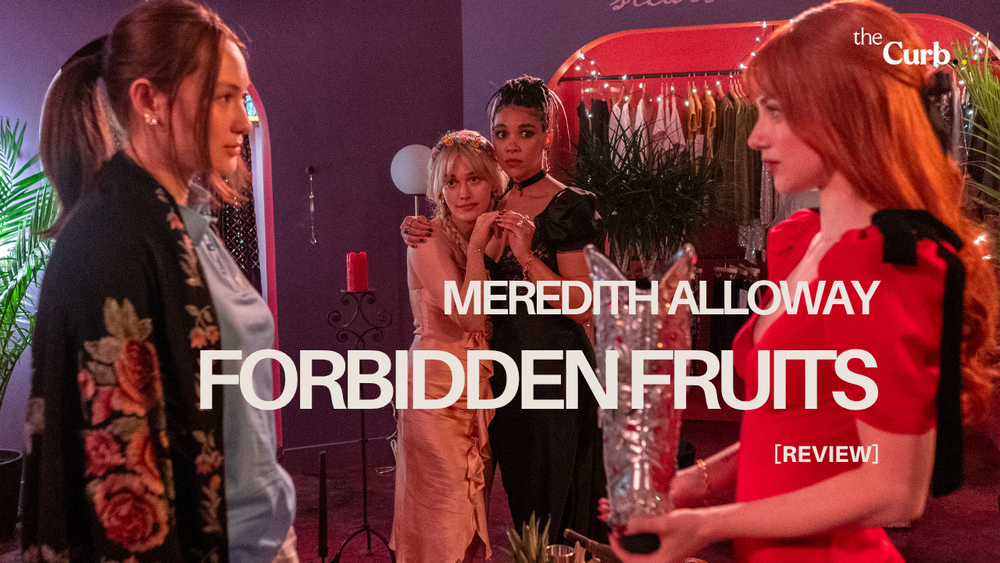
Forbidden Fruits feels like someone took the DNA of Mean Girls, filtered it through a Free People catalogue, added a heavy dose of witchcraft, and then let it spiral into full-on slasher chaos. It’s stylish in a very specific, meticulously curated way, where everything looks effortless but is actually doing a lot of work underneath—and honestly, it’s going to hit a particular audience hard, and yes… that is definitely me. From the opening moments, the film settles into a glossy, slightly surreal rhythm—part teen drama, part occult fever dream—and it never really breaks from that tone. It’s confident, a little messy in the best way, and completely aware of the experience it wants to deliver. Honestly, it’s the kind of movie that could almost instantly earn cult classic status because it feels so specific and deliberate in the world it creates.
Set inside the dreamy, hyper-aesthetic Free Eden boutique, the story follows Apple, Fig, and Cherry—three girls who don’t just run the store, they define it. Apple, played by Lili Reinhart, is magnetic, radiant, and just a touch dangerous in a way that draws you in immediately. Alexandra Shipp gives Fig a grounded, warm energy that balances the trio, while Victoria Pedretti makes Cherry feel bright, slightly unstable, and compelling to watch. Together, they form a tight, captivating unit—effortless, intimidating, and impossible to look away from. The way they move, interact, and command each scene is a masterclass in group dynamics and presence.
Then Pumpkin, played by Lola Tung, enters their orbit, and that’s when things start to intensify. She’s immediately drawn to them, and the film captures that sense of wanting to belong to something larger and more perfect than your own world. But as she gets closer, the gloss begins to fade, revealing cracks in friendships, power dynamics, and identity. Watching Pumpkin navigate that tension is engaging, often tense, and consistently unpredictable.
There’s also a subtle but palpable sapphic energy in the way the women interact. Even though the film doesn’t fully explore sexual attraction between them, the chemistry, closeness, and charged dynamics give the relationships an extra layer of intrigue. It adds depth and complexity to their bonds, making every glance, touch, and exchange feel loaded with meaning, which complements the film’s exploration of power, loyalty, and belonging.
What makes Forbidden Fruits particularly effective is how it balances deeper themes with sheer entertainment. The film explores performative relationships, identity, and the pressures of perfection, but it never feels heavy or preachy. It keeps the story clever, self-aware, and playful, highlighting the tension between glamour, power, and instability. The dialogue is sharp, and the timing of each exchange is precise, keeping the viewer both engaged and on edge.
Visually, the film is stunning. The boutique feels like a dream version of reality—soft lighting, perfectly arranged displays, and every corner meticulously composed. The wardrobe is extraordinary, with each outfit carefully chosen to define character and mood, leaving a lasting impression.
And the horror elements? They land effectively. When the film leans into its slasher side, the kills are inventive, slightly shocking, and stylistically consistent with the rest of the film. Escalation is paced well, so each moment of chaos feels earned, and when it peaks, it hits hard—combining tension, surprise, and occasional dark humor.
The soundtrack is another standout. It doesn’t merely accompany the scenes but drives them, enhancing tension, humor, and spectacle. There are moments where it energizes the chaos, amplifying the emotional and narrative beats in a way that feels both natural and heightened.
And then there’s the twist at the end. It genuinely surprised me, and the fates of the characters are handled in a way that is both shocking and thematically satisfying. The mid-credits scene clearly sets up a sequel, promising more of the same mix of tension, style, and unpredictability.
By the climax, Forbidden Fruits fully embraces its mix of chaos, style, and supernatural intrigue, delivering twists and shocks that feel earned within the world it’s built. It trusts the audience to follow along, react, and remain invested in both the spectacle and the stakes.
Overall, the film is stylish, tense, and addictive. It’s sharp, unhinged, visually striking, and balanced with enough narrative bite to remain compelling. It captures group dynamics and interpersonal tension in a way that is thoughtful, messy, and authentic. Wrapped in a glittering, witchy, slightly violent package, it’s a film that commands attention. The subtle sapphic undertones in the relationships add extra intrigue and depth, making the characters feel even more alive. It’s the kind of movie you want to experience with others, discuss, and revisit, and I’m already anticipating the sequel—ready to dive back into this chaotic, stylized world.
Director: Meredith Alloway
Cast: Lili Reinhart, Jordan Duarte, Victoria Pedretti
Writers: Lily Houghton, Meredith Alloway, (based on the stage play 'Of the woman came the beginning of sin and through her we all die' by Lily Houghton)
Producers: Trent Hubbard, Mason Novick, Mary Anne Waterhouse, Diablo Cody
Composer: Anna Drubich
Cinematographer: Karim Hussain
Editor: Hanna Park