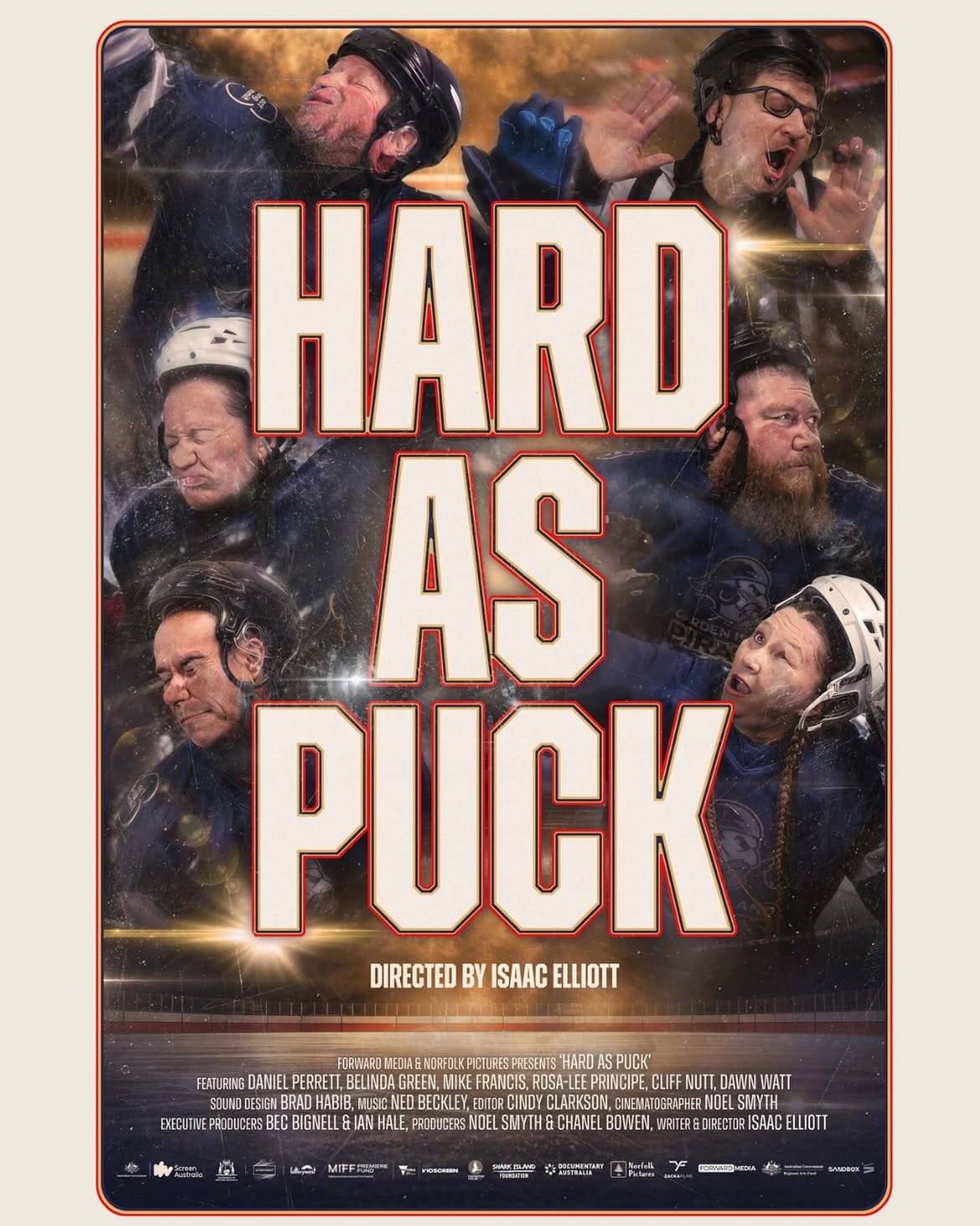
Broken bones. Smashed egos. Bruised bodies.
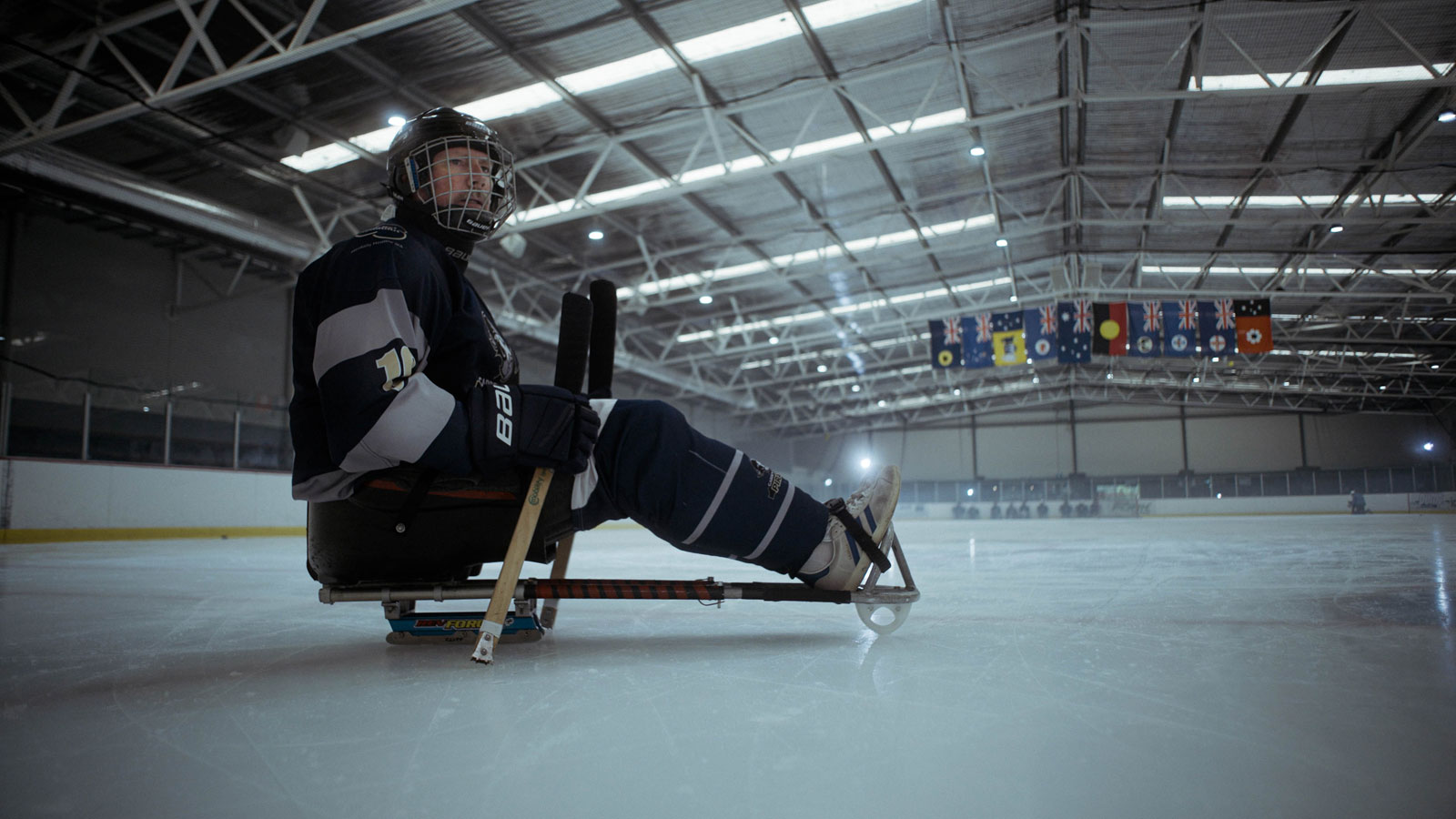
That's what players of the intense sport of para ice hockey can expect when they strap themselves into the sled and skate out onto the ice, sharp paddles in hands and the pursuit of victory in their minds.
For the Garden Island Pirates, their foes are, well, themselves. They're literally the only Perth-based para ice hockey team in the great state of Western Australia. Teammates line up against fellow teammates, bashing into each other with speed, immense violence, and a good sense of sportsmanship.
Watching players push themselves around on the ice will give you a workout just by osmosis. It's exhausting, but deeply exhilarating, stuff. All of which is captured with a vivid realisation and immediacy with Isaac Elliott's hilarious and frenetic documentary Hard as Puck, shot with immersive realisation by Noel Smyth and Kirra Hosking.
Yet, when we're not on the ice with the players as they prep for their historical first appearance at the Women’s World Para Ice Hockey Championships in Slovakia, we're in the thick of administrative duties as we're invited to follow the occasionally banal and routinely hilarious management of the teams committee management. The sizzle of sausages at fundraising events at Bunnings provides the soundtrack to infighting and casual bitchery. Teammates reluctantly become vice presidents. Vice presidents assume the role of presidents when nobody else puts up their hands.
Elliott bounces us between the thrill of the sport and the Office-like hilarity of the admin world, resulting in a thrilling documentary that invites audiences to experience a sport they never knew existed.
In the below interview, recorded ahead of the film's world premiere at the Melbourne International Film Festival, Isaac talks about his journey into filmmaking and learning how to grow as a documentarian, how he came on board Hard as Puck, the difference between riding a motorbike versus skating on a sled, and a lot more.
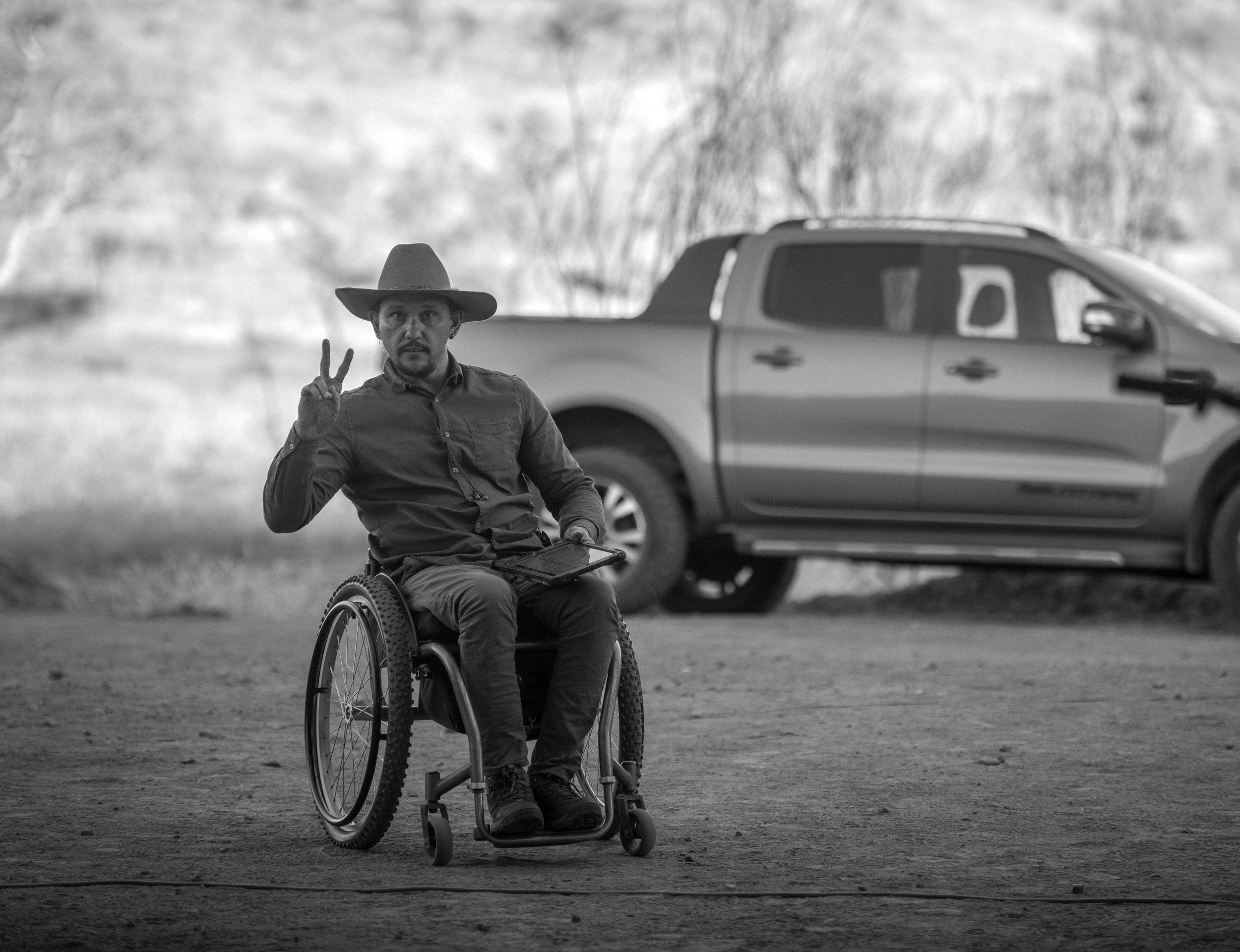
Find out more about Isaac Elliott here:

Hard as Puck screens at the Melbourne International Film Festival on 15, 16, 19, 22 August 2026. Tickets are available here:

This interview has been edited for clarity and conciseness purposes.
Can you tell me about your engagement with sports growing up in the Alice?
Isaac Elliott: I grew up in Alice Springs. My parents were the caretakers for the motorcycle club, so we were around that sport and riding from when I was like eight or nine. Even before then, when I was four or five, I was riding little bikes around other people's farms and stuff. I think I got my first bike when I was eight or nine at the motocross track, which was about 25 kilometres outside of Alice Springs, conveniently right behind a hill that blocked our ability to get TV reception. So I grew up without any television reception; we had VHS tapes and Blu-rays. We bought boxes of VHS tapes from friends, and they were moving to DVDs, and we were like, well, can we just get a box of your old tapes? Often it'd be stuff like The Flintstones recorded off TV with the fast forwarding through the ads recorded.
So I spent most of my time riding BMX and dirt bikes, and in terms of this club environment, we were the caretakers, and we paid rent by mowing lawns and whipper snippering, and sometimes painting tyres, which they would use to line the motocross track. So being part of this club environment was part of growing up. In being brought on by Chanel to direct this, I really started to see the parallels between the small club in Alice Springs and this small club in Perth, there's the same kind of human drama that happens, and the surprise that anything happens. In the motocross club, the races would happen, and yet all in the lead up and in the afterwards, there's all this infighting. You wonder how anything does happen, but there's a certain passion from a number of people that means even with all that personal drama the show must go on. They continue to go on around the country in small clubs everywhere, and yet every small club is going through the same kind of human drama, which is nobody wants to do the work that is required to make the club happen.
Which adds to the hilarity of the film. On one level, we get to see people play this bloody hard sport, and then on the other, there's like this almost Office level shenanigans of the club existing. Did you anticipate that at all when you set out to film it? Did you think, ‘I came here for the sport, and instead I'm getting this fascinating human drama as well.’
IE: Our first introduction to the team is Dan (Perrett). He was the first introduction and contact that Chanel had into the club, and he's pretty bolshy. So, right from the beginning, he was not afraid to have his opinions on camera, many of which we don't include in the film, because they go as far-reaching as politics and everything else. As a drama writer, I often start with plot, and we knew from the beginning that we had the characters to tell the story. Once you have the characters, the stories will come. We knew that we had Dan as a central character, and we did a few days of what we called ‘a writer's room’, but it was really just me trying to discover who the team was. We got them in a room for a weekend and got them to tell us their stories.
Perth is an interesting space. You're moving really fast because it's all highways and long distances between everywhere. We noticed when filming that it's like half an hour to 45 minutes between every character's house. Luckily, our main character, Bell (Belinda Green), lived about three minutes from the ice rink, so that may have played a small part in them becoming the main character. I mean, really, they were the president, vice president, and secretary, and they were really open to us filming. We became part of their little family for a year or so there, and without that kind of openness, no documentary would have ever happened.
Now we didn't know what we were going to get. We needed to start the moment the season started. The first thing we filmed was the sausage sizzle, which kicked off this idea of this club just keeping it together and doing what they can to stay alive. Very quickly the president told us, ‘I'm thinking of resigning,’ and we were like, well, here's a story, we don't know how it's going to play out. He may just resign and it'll move on, but then it didn't, and stories continued coming from that. You pulled the thread of the resignation and then it unravelled a whole number of other stories.
We attended the Federal election with Bell and Cliff (Nutt), but we couldn't find a way to keep it in the film. It felt so apt that we were making this film about an election while an election was underway. We had a couple of other characters who were bigger parts of the film, but as the editing came along, it was like ‘this is the story that it is.’ It's kind of Rats in the Ranks meets Cool Runnings. It's this small drama that reveals a universal drama amidst such an interesting sport.
You’ve talked about your journey into filmmaking and how when you first started that you felt you were out of your depth, so you trekked off and did some training and returned to it. Have you reflected on your journey to being the filmmaker you are now?
IE: When you start, you think the amount that you need to know isn't much, and it's all kind of easy, and then as you learn more, you realise how much goes into telling stories on screen. It's not just a fun thing that happens or just telling a series of events. I think I was very naive when I first started; I still don't feel that I know what I'm doing, and I think that's probably universal forever. I often still have to Google how to do something, like story structure, or in post on this, I read Save the Cat again. We have a board that says Act One, Act Two, Act Three. About a month ago, the wall was covered with every single scene we shot in order of what we shot, and then as we pulled pieces out of them, they got then put on a storyboard.
Fifteen years ago, I wouldn't have taken the planning and the character arcs and all this stuff as seriously, and that's where the juice is. I was originally a tradie, which meant that my interest for the first kind five-ten years was through the tech and the cameras, and now I find that stuff kind of pedestrian and less interesting than characters. Having a 4k camera is what it is, although an ARRI Alexa LF is pretty nice. We didn't have one for this, but no one would ever know, and that's the thing. There's a certain level that you don't need to worry so much about the tech, and it becomes about the storytelling. To be honest, I wouldn't have really understood what that meant back then.
It’s this amorphous thing that keeps building. We would go in and the DoP/producer, Noel Smyth, would ask me, ‘what are we shooting?’ I'm like, ‘we'll see what they do.’ We didn't know where the story was going, we didn't know what they were going to do. I try and feel it out, and in the end I think that we got some version of what my vision started as, without knowing all the steps we needed to take along the way and without even knowing how the story was going to be structured in the end.
I had an early thought about how truth and the exact series of events aren't always the same thing. My touchstones were the two Steve Jobs movies that came out in the same year; one was based on an autobiography, it went cradle to the grave with Ashton Kutcher, the other was completely fictionalised, set in three time periods over the course of three product announcements. Everybody said that the fictionalised version was truer to the character of Steve Jobs than the one that followed his life events in chronological order. Our north star was the truth of the characters, and the broad story of a year in the life of the club, which then gave us the ability to ask what order can we put things in to tell that story in the most truthful way, even if it's not the exact order that the events happened in? Giving us that leeway really unlocked and exploded the story.
Our first version of the film was in chronological order and over two hours long. As we started unpacking it and moving things around, we did a test screening of an early cut. One of my old lecturers at Deakin Uni, Simon Wilmot, came to the screening. Having watched it once in a cinema with an audience, he went home and sent a 1500-word email unpacking the story and its points. In that same test screening, we made up kind of cards for people to fill out to give their thoughts. We had a 50-50 split of the opening third of the film, with the first act being too fast and too slow. Our first instinct was, well, I guess we can't please everyone, and then on unpacking it even more, it became clear that we were quickly going through information while holding off starting the actual story of the film, so it was too slow to get going, but too quick with the exposition. It was just a quick dump of exposition for 20 minutes before the story started. With that and Simon’s email, we looked at the board and we could see the story play out in a kind of mathematical way. It helped the story feel like it's walking along and that we know where we're going.
What was the pitch Chanel gave you to get you on board to direct the film?
IE: Chanel emailed me, and I ignored it, because I’d just got the ability to direct an episode of Neighbours. I was like, ‘this is going to be my life, the bright lights of the cul-de-sac of Neighbours.’ And then Neighbours shut down. Then I got asked by media mentors to direct some interviews for a package that a company was making for disability access within the film industry, they needed a director to essentially just ask the questions and get the best answers out of people. It turned out Chanel, whose emails I'd been ignoring, was one of the people I was interviewing.
She was over for AIDC., I'd run away for half a day to shoot this interview, and I was like, ‘well, I can't ignore Chanel now.’ She showed me the initial pitch when it was called Mighty Pucks, and I was like, ‘first thing: that name needs to change. I love a pun, but this isn't a pun, because Mighty Ducks is already saying ice hockey.’ From there, she said, ‘I've got some development funding, we can get you over for a week. I said, ‘I'm interested in finding whether there's a story there,’ because, again, I didn't know what the story of a club could look like.
We quickly realised the games are against themselves, so a lot of this story searching was finding mistakes, because when they play against themselves, there wasn't really any clear stakes. We went over during the week they had their grand final against themselves. It was an exciting game and everyone was happy, but again, it had no stakes. ‘Okay, how is this going to be a film?’ We knew we were going to have some great characters regardless, so thought we'll see where it takes us.
We found out that Australia was going to send a men’s team to the world championships in 2024 so our goal was to get over there with them. As we were finding funding and getting access, we missed that. It then built up to the monumental world championships in the film where the women got the ability to play the first world championships ever. For Australia to be one of five teams plus a sixth amalgamation team was an incredible opportunity. I mean, that's your narrative right there.
It does help that you have such a visually exciting sport to cut to.
IE: It's not quite as fast as stand-up hockey. You’ve got to get really close and look over the barrier to see it, but when you're inside it, it's like go-karting, it’s so fast and exciting. It's because you're close to the ground, which is way more exciting than being in a big car going the same speed. We thought, how can we translate what it feels like onto the screen? At first we thought, let's get long lenses and get a lot of parallaxing on our pans and stuff like that, and that sort of does a little bit, but then a long lens often slows things down, especially as people come towards you. So I thought, we need wide lenses, but off the side of the rink with a wide lens, where you just see the glass, because the glass had to stay there, so if we weren't on the rink, we were shooting through the glass. That wasn't going to work.
So I ended up making a sled-like platform that could put the camera on the ice at skater level. It started with a furniture removal dolly and a rake handle and a few little hinges, and I found a way that you could construct the two hinges at the bottom together, so it was like a little lazy Susan bearing with a hinged handle. At first we just spun around on the lazy Susan bearing, and then I got two shelf brackets and turned it sideways, and with the rake handle angle adjustment you could twist the handle and it would turn, so you could have complete control of it. It's very rudimentary. I then pulled the wheels off and replaced them with pucks; I drilled out the pucks, put bolts through them, and then it sat very close to the ground and slid on the ice. At first it worked, and you could turn but it wobbled because it was very low tech. Bunnings hinges are not known for their precision.
When we were picking up gear from Cinemachine, the rental house in Perth, I thought ‘we could use a monopod’, but we had to take the head off and turn it upside down and put a plate on the end. I said to the guys, ‘are you using that drill press, because I want to try and make this sturdier.’ I had a piece of wood and cut it and got some extra stuff, and then we were able to use a monopod which meant we had fluid control. We were able to put more or less tension on it. Then I got a tripod plate that had a leveller, so I could still keep the camera low. I didn't put a tripod head on it, because that would lift it up about four inches.
The godsend that happened in that period between our first and second shoot was that we got a trainee cinematographer, Kirra [Hosking], who's a figure skater. She became our on-ice camera operator. She wore a full hockey outfit, knee pads, shoulder pads, everything, so that she could get in there. During training, she’d be right in there with this sled, moving behind and alongside the players. By the end of it, she got really good at using it and was not afraid to get really close with the sled. That really lifted the immersion, and brought more truth to the feeling of being on the ice and the speed that it feels like, rather than stepping back and seeing how fast they might appear from a long distance. The reality is that they're going this fast and they're this close to the ground. It is this violent.
That level of immersion means a lot from a disability perspective. So often, if there is someone who uses a wheelchair in the film, the camera is pointing down towards them, you're not at their eye level. You're not actually seeing the world from their level. What you present here is that you're on the ice with the players, you're at the eye level of people who are in these sleds. You're getting to appreciate the world from a perspective we rarely see in cinema.
IE: That became a really tough thing to get. Noel (DoP-producer) definitely had many sore back moments, because I never wanted to look down. I've shot a lot of kids' content, and again, I don't want to look down. So, how do you get the camera almost below waist level and walk with them and follow them? It seems like a really easy thing to do, but it's not as easy as it seems. It's very easy to sit something on your waist, but to go below that and hold it and keep focus and move with it and not have the camera that's doing this [wobbles hands] all the time [is difficult]. In the edit it seems so seamless, but it was quite difficult. It was important to me to stay at or below our character's eye level, they're our heroes, let's not look down at them. We did that throughout the film, not just on the ice. We kept the camera below them, as low as possible, or at eye level. They’re real people, we don't need to look down at them
On the disability front, I watched almost every sport disability doc. In every single one, without fail, Act Two is ‘the hardship of having that disability’. Every single one. Murderball is the worst for it. It can't help itself. It has this cool punk rock music that I wanted, but we couldn't afford. It pretends it's all punk rock, but it starts watching a guy get out of bed and get dressed, literally. That's the first shot of the film and then Act Two they go to hospital and all that.
In our films, there's like two mentions of disability, but never what disabilities our characters have. I just didn't want to make that the story. I have this idea of: what if all of the attempts at progress are successful? What now? I want to pretend that this can be the ‘what now’. The ‘what now’ is that it doesn't really matter. I find it boring, right? There’s the sort of realisation that the very artsy disabled people search out disabled content, but most disabled people aren't artsy, just like most of the general population isn't artsy: they search out genres. They search out fantasy films. When they search, they don't go ‘disabled film’, they go, ‘I like Game of Thrones, what shows are like Game of Thrones?’ To most people it doesn't matter and to most people that's not what they're looking for. There's a certain subset of people that want that disability sub story, and I don't want to be the person making those stories. There are disabled people in the film, but it's not what the film is about.
We wrote ‘it's not a teaching film’ on the board. We don't actually tell you a whole lot about the game, but we think that you’ll get it by context. It's basically the same as stand-up hockey, but they're in a sled. The Mighty Ducks doesn't have to tell you how hockey works, you get it by what they're doing.
So we don't teach you about the game, which again, at the very start of Murderball, it teaches you about the game and shows you how hard it is to be a disabled person. We were like, ‘well, let's not do either of those things,’ which puts a bit of a bit more pressure on the storyteller, because you've taken these two things away and gone, ‘how can we tell this story about people and find the universality in it, and not sob on anything or pull back on the other things in life that are tough?’
For a lot of disabled people, life just is what it is. They have the same human dramas and friendship dramas. Obviously, there's a lot of loneliness and unemployment, and things like that, but I just think it's that the disability part is less interesting than the human part.
I live with a hidden disability, and while I do enjoy watching films that focus on disabled stories, it's also not what I'm picking off the shelf most of the time. I don't really want to be reminded of how hard it is to get out of bed in the morning or anything like that. So I really appreciated the film just being about the people it is and some of them happen to be disabled. The part I really appreciated too was when they were doing the sausage sizzle at Bunnings, and some folks were saying ‘this sounds great, wicked, I would love to do that.’ Anybody can play it. It doesn't matter if you have a disability or not, you can hop in the sled and play alongside people. That’s the important part, because it's about community.
IE: It's really interesting in the ice hockey world how they navigate that, because at a local level they can all play together, but then if they want to play state versus state, or they want to form larger teams and verse each other, they need to find a way to incorporate non-disabled people and disabled people together to build the sport and make it as inclusive as possible. It's amazing that they can all play together. Hopefully the film will encourage some people to get down, because as much as it's similar to stand-up hockey, it's quite a bit different. Balance is still a thing. I've been in a sled a few times. I don't have the hip control. I haven't tried a taller backrest which will allow me to have more control, but it is quite hard.
I know that you've gotten back into motorbike riding after your accident, but what’s the difference between that versus being on a sled?
IE: Well, I thought being on a sled would be pretty easy. I fully did. I sometimes wake up, and I'm like, ‘Look, give me six months and I'll make the national team in sled hockey.’ Honestly, they're so good. I thought it would be easy, because I can run my motorbike and I can keep upright. I can do jobs, I can do all of that, but it's because I'm holding on with the handlebars. When you're on the sled, when your sticks aren't on the ground, which is when you're moving, they just have to stab and push rather than slide on the ground, your balance is somewhere else. It’s in the hips, so core strength is a huge part of it.
There are very few sledders that make it to the international standard level, because core strength is such a big part of it, especially when somebody comes on and bumps you. I don't know how they stay up. I don't know. Seeing the international level players, the Americans and the Canadians, it's insane how fast they go, how fast they turn, how much they maintain their speed, all while delicately handling this puck. That's what's so impressive. There's this kind of violence to the hits, but kind of like a dance with the puck; you have to be so delicate, you don't hit it, you just push it gently. Okay, how are you doing that at such high speeds? From the outside it looks like you're hitting it, but if you slow it down, they’re gently sliding it along the along the stick paddle making it spin. It's kind of magic.
Ice hockey is the fastest sport in the world, and then para-ice hockey is one of the fastest para sports, in terms of the speed you're going, and also the hand eye coordination, the speed you need to turn, and everything like that. You might go faster on a hand cycle, but then you don't need to turn very fast, and you don't need to control a puck. Some other sports might be technically faster, but you don't have the precision and the control and the turning and the violence and the danger and everything that comes along with it that this has.
It's a new sport in Australia, and because of that, it doesn't have this youth base that’s built up. Most of the players have been in some sort of action, sportsy accident or often a motorbike accident. They were very outgoing, active people. Then they had this accident. A lot of the Australian women's team were ex-army or ex-military. Then they discover para sports when they’re older, so the average age for the national women's teams are above 45 or 50. It'll be interesting how the sport could develop, like basketball, rugby, or tennis if it can find that youth base. That's what's going to really lift the sport at a global level. I talk a lot about how violent it is and how aggressive it is, and then the average age of players is 50 or 55. As they say, no holds barred but they get into it.
It is extremely physical, and I think that that's part of what people want as spectators. I'm a diehard footy fan, and part of the reason why I like watching football is because it is such a physical sport. You mentioned tennis, which is two people on the opposite side of net, it's not physical. Whereas this is so physical bones get broken.
IE: The difference for me between motorbikes and hockey is that with hockey you can't get away from the hits. It's part of it. The DNA is: you're going to get hit, you're going to get smacked in the head with a puck, you're going to hit your head on the wall. You're going to have two sticks with filed sharp blades on the end, all of this. I find it scarier than motorbike riding. I still ride and I don't crash too much. With motorbikes, if you make a mistake, you crash. With this, even if you don't make a mistake, you're getting smashed. You do everything right and you're still going to end up in the wall. There's a whole team out there who's coming for you, and maybe even your own teammates are coming for you as well.
I really appreciated the representation of different stories on screen. As you're saying, while it is a disabled story, it's not disability focused. We don't have that many disabled storytellers in Australia, and you're growing and helping change that. Is changing who tells what stories on screen a conscious aspect of your filmmaking or is it just a byproduct being a storyteller on screen?
IE: It sounds bad, but I kind of want to take advantage of all the work done by people who are more interested in doing activism and in creating a platform where change can happen. I kind of want to take that platform and tell the stories that I want to tell about the characters I want to tell them about. I find that if you go on stage as a disabled person and your story is ‘I don't want disability to be the focus’, well, you've just made it the focus, just by doing it you have people who only want to hear that because you're disabled. I find that quite tedious.
My realisation in this is that disabled people like genres. They like The Office, which I only just found out The Office UK was produced by a guy in a chair, a disabled person. I want to make genres that I want to watch. I don't search ‘disabled’ or ‘disability’ on Netflix. If someone turns up in a film or something, I'm like, ‘Yeah, cool, this is interesting and fun.’ My focus is just telling stories that aren't exclusively made for disabled people, about disabled people. They're inclusively made stories.
I became disabled at 20. Some people find their community through their disability, and some people have a community outside of it, and I feel like disability is an aspect of my life, but it's not where I'm looking for community. But then in this team and this club, you realise, oh, there are things that I do have in common with people that I probably wouldn't have known that I did without this film.
Thank you for that answer. Again, this is such an entertaining film. Congratulations on the MIFF premiere.
IE: Did you laugh?
I did. Yeah. One of my first notes is about the importance of comedy in the film, because there’s this level of comedy and tension and drama to it. I mostly laughed at the committee shenanigans where it's just like, ‘well, I guess I'm the president now.’
IE: “Anyone want to put your hand up? Maybe you can do it.” Damn it, I've been in that situation.
I was ended up as the chair of a committee simply because nobody else put their hand up, so that was funny. Tell me about what are you looking forward to about MIFF?
IE: I moved to Melbourne in 2011, so this has been 15 years in the making. I'd like MIFF to know that I have entered four short films and got rejected four times, but we're back baby and I made them pay for it. I got my come back. MIFF is so amazing. I go every year. I often buy a pass and see sort of 30 to 40 films over the two weeks. It's just an amazing festival. Watching the festival grow has been great. They now even screen at IMAX, which one our sessions is at, which is cool.
That would be so good. Could you imagine seeing this on that screen? Far out.
IE: We chose a slightly narrower and taller aspect ratio than 16:9 or 2:35:1 because it's easier to frame a sitting person and a standing person when the screen is a little bit taller, and so we're like, ‘that's perfect for IMAX.’ We didn't want to go a 4:3, because that's kind of making real statement. We were like, let's bring it in and make the frame work for our characters without being like, ‘this is retro, baby.’
After both wanting to be in the festival and enjoying the festival as a viewer and a movie lover, it's amazing to be part of it. It's going to be very nerve-wracking the night of it. At this point, I've seen it so many times, enough people that I want to like it have liked it, but I just hope there's an audience for it, and I really hope our first screening goes well. I think it's a going to be a word-of-mouth film. I think as people watch it, they're going to tell other people to watch it. It's a movie that will really play to an audience, and MIFF always has the perfect audience because they're so engaged. Everything that's funny will be twice as funny, and everything that's scary or sad will be twice as scary or twice as sad. It's kind of the perfect first screening of any film. That'll be the first time some of our cast will get to watch it. Hopefully we’ll be able to bring some of them over to see it in front of this audience and feel the love.
The film leaves you invigorated. Hopefully it does some something for the sport as well.
IE: As much as we're not teaching you about the sport, we are introducing people to the sport and to the type of personalities that play the sport, and hopefully those kind of personalities rub people the right way and encourage them to go down to a game. There is a team in almost every state in Australia. I don't know if there's one in Tasmania. There is a player in Darwin, Sonia, and she's great, she gets a big moment towards the end of the film. Hopefully it does encourage people to discover the sport.