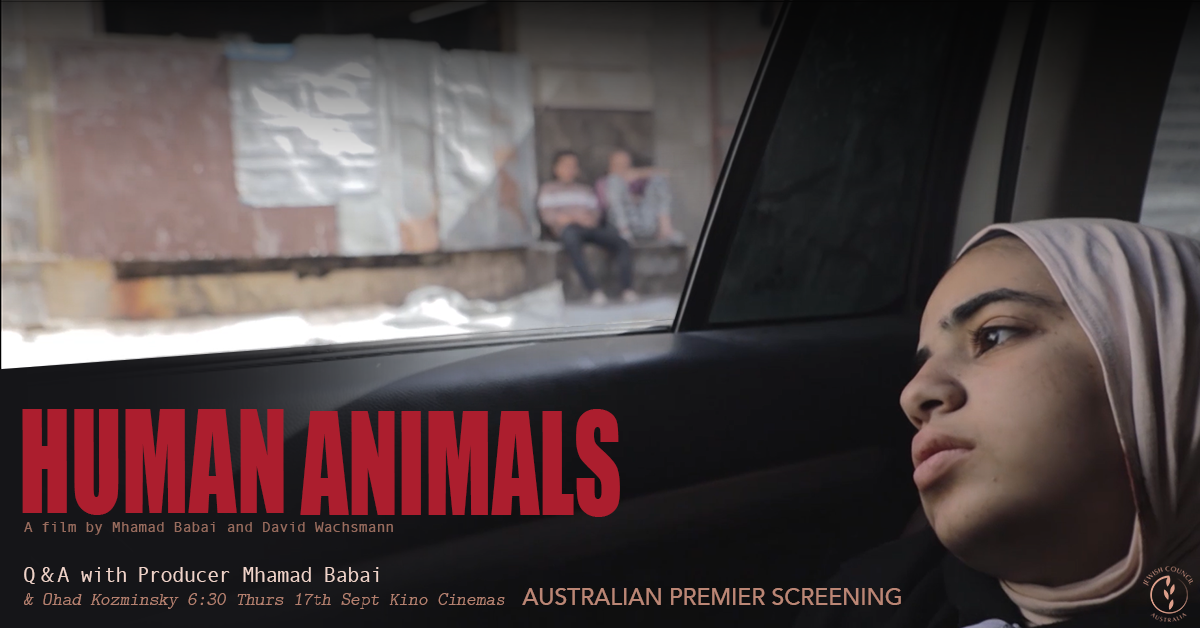
“Former Israeli Minister of Defence Yoav Gallant described the people of Gaza as ‘human animals.’ Behind those words are human beings. Children, parents, families, people with names, memories, fears and dreams. Stories that deserve to be heard. This documentary gives space to the personal stories that are too often reduced to headlines, and examines what makes it possible for them to remain unseen by their closest neighbours.” - Mhamad Babai, producer of Human Animals
The documentary film Human Animals, premiering in Australia on 17th September, is a painful punch to the gut for viewers whose history is bound up with the ongoing dehumanisation of indigenous people. Over a thousand days have passed since Israel’s declaration of total war on Gaza, and all but its allies concur that this has amounted in every way to genocide: the crime of all crimes. Moving between the apocalyptic landscape of the Strip and a sanitised studio in Israel, Human Animals revolves around a fundamental dissonance and asymmetry between Israelis and Palestinians.
We start in Gaza, straight into the ravaged lives of families exiled in 1948, when over 400 villages and 750,000 people were evacuated at gunpoint to make way for a Jewish state. The suffering of those refugees has gone unanswered year after year as Israel holds the entire population in a starved and bombarded open-air prison.
In juxtaposition: a cozy studio. Here we meet a cast of mediocre Israeli patriots: not extremists or fundamentalists, just everyday folks who tell us why they support a total destruction of Gaza. For them, “there are no innocents in Gaza”. Statistics confirm that a majority of Israelis support forced ethnic cleansing of Palestinians and ongoing apartheid. How do they justify Israel’s actions? How can evil be so banal and oblivious?
We switch back to the material reality of Gaza where there is no pain relief or end in sight, as a child tells us that she had already survived eight wars by 2023. And just as easily as Israeli soldiers can leave Gaza for R&R in Tel Aviv, we’re back in the studio, face to face with a chirpy Holocaust expert who proudly declares that Gaza should be flattened and that Israelis must carry out a second and even third Nakba. “No doubt, we are a moral people”, he says.
How can such devastation be carried out by people who were once themselves victims of genocide? Generation after generation, an entire society not only perpetrates an ongoing holocaust on the local population, but also actively denies that this is even happening. Genocide denial is typically the last stage of genocide. The first is classification: us and them. Or more precisely: us or them. This is what Israel is predicated on. Israelis are programmed to consider their nation a miracle of peaceful and moral victims, and any attack on their sovereignty an act of pure animalistic hate (I should know, I am Israeli and a product of the same system). The blood-curdling dehumanisation they convey in their interviews is borne of that mindset. And until one can reckon with this foundational colonial violence, criminals will be crowned moral victors. Where I expected them to show empathy, I was shown a cold heart and self-pity.
Another tension in the film is between the Israeli interviewer and the Israeli cast. You can imagine the level of restraint needed to sit across from people whose self awareness is so limited, who insist on their own morality and precision killing, refusing to acknowledge the pain and suffering they cause. The film gradually shows us that no proximity to Palestinian suffering, and no amount of exposure to it can strip away their denial. And this is something Australian viewers must reflect on as we too live on unceded, occupied land.
The Australian premiere of Human Animals will screen on the 17th of September, at Kino Cinemas in Melbourne, with support from the Jewish Council of Australia. Tickets can be purchased in the link below:
https://www.jewishcouncil.com.au/2026/08/human-animals
Author Bio: Keren Tova Rubinstein was born in Haifa and now lives in Naarm. She holds a PhD in Israel Studies and has taught Hebrew language and literature in Australia, the US and Canada. She translates articles from Hebrew for The Palestine Project, as well as being a visual artist and writer.