
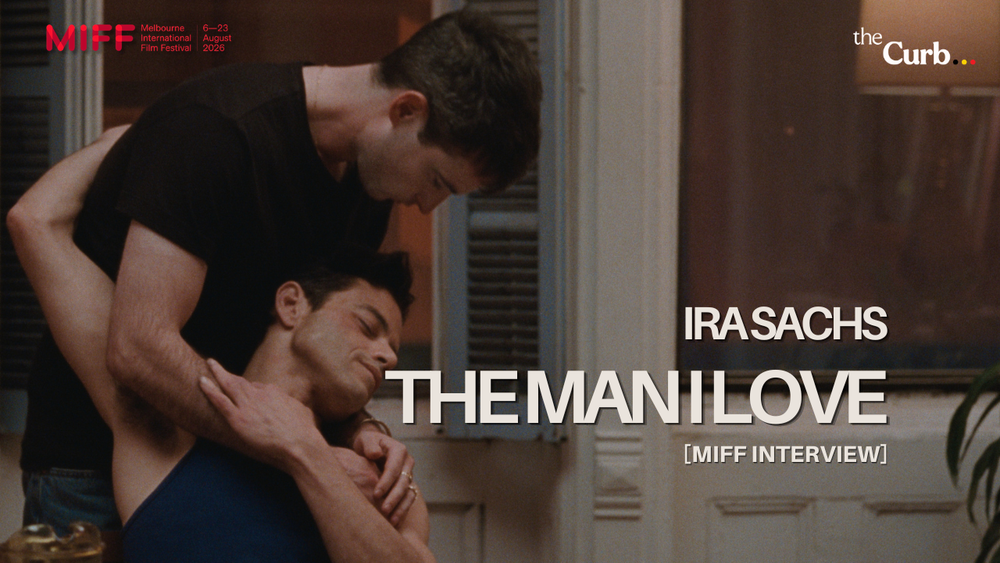
Ira Sachs The Man I Love screens at the Melbourne International Film Festival on 8, 16, & 23 August 2026. Tickets are available here:


With his latest film, the acclaimed American filmmaker looks back to his own coming of age in New York City.
“This island, floating in river water like a diamond iceberg, call it New York, name it whatever you like; the name hardly matters because, entering from the greater reality of elsewhere, one is only in search of a city, a place to hide, to lose or discover oneself, to make a dream wherein you prove that perhaps after all you are not an ugly duckling, but wonderful, and worthy of love.”
When Truman Capote attempted to define the sort of person who comes to New York City to reinvent themselves in Local Color, he could have been writing about Ira Sachs. The term “a New York character” is a loaded one. It is typically bestowed upon people who are direct in their communication, sometimes to the point of seeming impolite to people from other countries, where conversations are filled with pleasantries, caveats and acknowledgements to decorum.
Sachs is a New York character. At least, that was what I was told before we met. Perhaps it is the thrill of being in Cannes, on the rooftop of a five-star hotel and in a fresh navy blue suit, but Sachs is – at least today – softly spoken and relaxed, only occasionally playing with his wedding ring. He may not care whether people like the characters in his films, but he smiles when he hears that a journalist likes his film.
Sachs moved to New York in the mid-1980s and, as he puts it, grew up there. At the time, the city was the heart of the worlds of art, music and theatre. It was also the epicentre of the AIDS epidemic. As people around him grew ill and died, he was shocked, not only by the scale of the tragedy, but by the way it was almost ignored in the mainstream media as it unfolded, leaving those most affected to tell their stories to each other. The Man I Love, which premiered in competition at Cannes in May, is the film he has been circling ever since.
Rami Malek plays Jimmy George, a celebrated downtown theatre actor in late-'80s Manhattan who, after a hospitalisation for AIDS-related pneumonia, decides that what he wants to do with the time he has left is put on a play. Dennis, played by Tom Sturridge, is Jimmy’s boyfriend and caregiver. Luther Ford plays Vincent, the new neighbour who instantly falls for Jimmy and whose adoration invigorates him. Around them a troupe rehearses Michel Tremblay’s Once Upon a Time in the East.
“When I moved to New York, I was young, which already means facing the unknown, but on top of that there was this crisis happening,” he says. “There was an added layer of darkness I was aware of internally, while externally I was trying to embrace the world. I was going to the theatre, going out to clubs, having sex, meeting people, figuring out my life. Maybe I still am. What I wanted was to make a film about what you do with the time that’s left. Specifically, to create images that contain as many of the things I’m going to miss as possible when I’m gone.”
Sachs is wary of calling it a departure from the style of films on which he has made his name. Not long ago he rewatched his first feature, Vaudeville, a backstage drama about people putting on a show, with a love triangle between three men in the middle. “And I thought, well, I guess I’ve just been making one film,” he says, laughing. “Creativity as the driving force in a protagonist’s life has been central to much of my work. The artists I know from downtown New York in the '70s and '80s – and that includes Peter Hujar – are the ones I go to when I feel most alone and afraid.” After fifteen years of working together, he and screenwriter Mauricio Zacharias felt ready. “It’s a story we both experienced very personally, though not autobiographically. Maybe we’d finally had the distance, but also the empathy.”
Jimmy is a fiction, but he has very clear sources of inspiration. Sachs kept returning to three performers of downtown New York who all died of AIDS in the early '90s. Ron Vawter of the Wooster Group, Frank Maya, a comedian on the verge of breaking out when he got sick and Ethyl Eichelberger, of Charles Ludlam’s Ridiculous Theatrical Company. “I knew stories about each of them performing literally until the last moments of their lives,” Sachs says. “And I found that fascinating, and compelling, and also heroic.”
Casting, by his own account, is not something he agonises over. “I have a good eye,” he says, laughing. “I don’t need to see very much to cast somebody.” He had never seen Bohemian Rhapsody, for which Malek won a Best Actor Academy Award, instead casting the Egyptian-American actor off a few minutes of Mr. Robot. “He was so embedded in a world in that show,” Sachs says. Sachs watched around two hundred auditions for Vincent before Luther Ford’s self-tape arrived from London. “Within like 30 seconds I was like, ‘That guy’.” He had seen Sturridge on Broadway opposite Jake Gyllenhaal in 2019, “and he really struck me as having a force, but also a kind of internal quality.”
Sturridge had been waiting for the call. “I have been obsessed with Ira’s cinema for a long time. I think he is one of the most emotionally accurate and delicate and cinematically intimate filmmakers,” he says. Their first meeting happened on Zoom and ran for hours. “We didn’t really talk that much about the project. We just talked about our own lives and shared stories. And slowly, I guess he learned to trust me a bit, and I learned to trust him, and an intimacy was born. A little while after that, he asked me to be in it.”
Sachs’ technique of building the trust first and the performance later carries onto the set where he shoots in wide frames and lets the camera run. “He doesn’t shoot much coverage,” Sturridge says. “It allows for you as an actor to discover things in a way that tight coverage doesn’t. A lot of scenes are allowed to play out in a way that I feel is rare, certainly in American indie cinema. It’s almost like a play. We just begin, and four minutes later you’re still living this moment.”
Sturridge’s introduction to Sachs’ specificity came when he arrived with some costume ideas for Dennis. “I remember a number of occasions walking out and Ira being like, ‘Absolutely not’. That was my first taste of understanding that he always gets what he wants.”
What Sachs wants, in the end, is people rather than parts. “Rami’s character is Rami, ultimately,” he says. “You make a film, you have characters, but then they become people. We create a structure that gives shape to a character, but what you’re seeing is this human being, Rami Malek, who comes through.” The corollary is that relationships have to be built off-camera. Sturridge and Malek met in London before the shoot and set about constructing “a very specific physical language” between the two men. “The way people interact when they’ve given all of themselves over many years is so unique and, ultimately, subtle. So, you need a very strong idea of how that’s going to work, to almost leave it alone.”
Sachs was the cast’s way into the period, too, and here again he prescribed feeling over documentation. “Ira was my guide through that whole world,” Sturridge says. “More than any piece of document or literature or cinema, his own stories were the thing that got us most tangibly there.” The viewing list Sachs assembled had almost nothing to do with New York in the '80s: Chantal Akerman’s Je, tu, il, elle, Maurice Pialat’s Van Gogh, Cassavetes’ Opening Night. “Films which have no literal connection but were just as important in trying to access the truth of the story through the sort of fantasy of cinema,” Sturridge says.
The play at the film’s centre came from the same instinct. Sachs saw André Brassard’s film of Once Upon a Time in the East in 1989 and never shook it. “It is not available. It is nowhere,” he says. “When I saw it, I thought, it’s as if Fassbinder made Nashville. It’s not camp. It’s a deep, emotional film about a bunch of different communities.” Casting Malek, he realised the actor could take the role around which that film is built. “I wanted to bring queerness into the texture of this group, but in a way that wasn’t direct, that was more about a feeling.” He still seems delighted by the audacity of the project. “A hundred people worked on this film, and everybody agreed that we would make a film about the making of a play, which is based on a film, which is based on a play written in 1974 that nobody’s seen. And everyone was like, ‘Sure, that sounds like a great idea’. I kept laughing quietly to myself in the corner, with a sense of devilish power.”
Like the films of Nashville director Robert Altman, Sachs’ films are unusually dense with faces, wallpaper, clutter and half-heard conversations. “It’s like collage. The making of the film is part of the essence of the film, because all these people came together to put on a show, and they come with their own histories.” In the party scene, each guest is a queer artist he has known in New York for years. “They come with incredible stories you’re not going to know, but you’re going to think, ‘That person is compelling’. With Altman there’s always a sense that you should be able to turn the camera and follow anyone out the door and there’d be a whole other story. Everything matters. There’s not a face that doesn’t matter.”
The Man I Love was shot more or less chronologically, which meant Sturridge’s Dennis – the caregiver absorbing Jimmy’s decline – accumulated his grief in real time. “It was very important to constantly be protecting Jimmy from my feelings,” Sturridge says. “I was trying my hardest for him to not have to see what I was going through.” The scene in which that finally gives way is one of the film’s strongest and was shot on his last day of filming. “It had been in me for weeks, and I was ready.”
To create a film this personal was difficult to finance. “I got the right producers,” Sachs says. He found Big Creek, run by David Siegel and Scott McGehee, whom he met some 25 years ago and has been making films alongside ever since. “Homosexuality, particularly within a globalised economy, is really hard for people to fund,” says Sachs. “Let’s put it simply: I was making a film about gay people, sex, death and AIDS.” He laughs. “And here we are,” he gestures to his opulent surrounds.
Sachs invokes the word ‘globalised’ again, describing the late-'80s New York of The Man I Love. “There was a time when people were making art that didn’t need to translate around the world,” he says. “It needed to express something personal that connected with the people next door. That’s what I strive to make – work that is tactilely about what’s here and now. How local can you be?”
He resists the obvious follow-up, which is whether he would like to go back. “I try actively to resist. I don’t actually think I’m making a period film. I think I’m making a film in the present. Everything you see in the film exists in the present. All those people are now.” Downtown New York in the 1980s is not a place he wants to live, but it can offer instructions. “I can look to different periods and different people and be given… courage, that’s the right word. But I could also look at Marcel Proust. I don’t wish to live in that time, but I’m going to be given a lot of direction there.”