
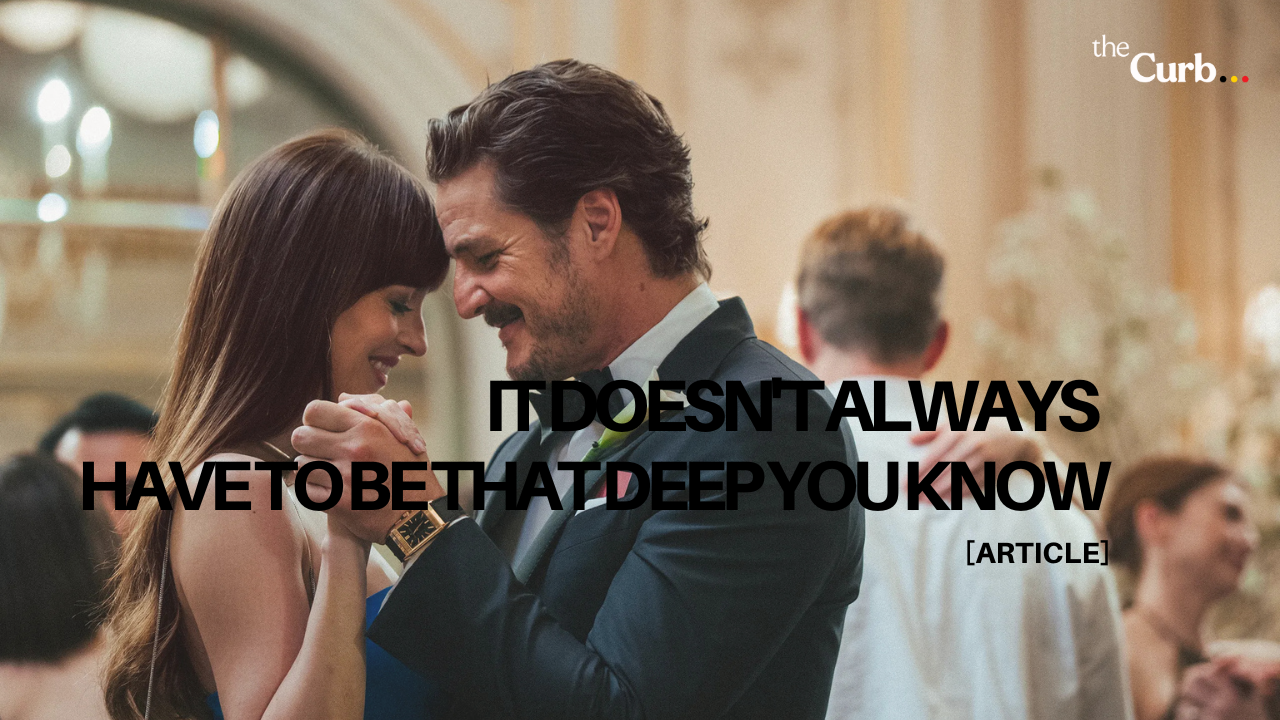
I’ve been thinking about the opening sequence of Materialists, the so-called “romantic comedy” from Celine Song, director of the Oscar-nominated Past Lives. Her follow-up, which stars Dakota Johnson, Pedro Pascal, and Chris Evans, was billed as a return to the rom-com and has made over $100 million worldwide.
In the opening, Johnson monologues about the “first people in love.” We’re shown a dawn of man montage in which a man and woman exchange gifts of flowers. The scene has stuck with me, not because of its beauty, but for how ridiculous the notion is. The first people weren’t exchanging floral tokens of affection, Dakota. They were likely grunting and pillaging and accidentally discovering fire. Romance wasn’t invented yet and neither were floral symbolism.
In our current age of pseudo-intellectualism, the pressure for art to sound important outweighs the need for it to feel honest or real.
Now, everything has to mean something, from indie films to fringe theatre to mainstream pop albums. Art has become obsessed with sounding profound.
Audiences now long for revelations, statements, and messages all in a neat bow they can screenshot and post to their Instagram Stories. It is now no longer enough for a romantic comedy to just be a romantic comedy, now it has to say something, it has to capture a zeitgeist, it has to be profound. The art has to be about power, trauma, identity, family or any other buzzword that sounds good in a press release, and when those themes aren’t genuinely represented? They are manufactured. Like a flatpack Ledamot cabinet from IKEA.
Song’s film billed itself as a return to the rom-com, a genre long dead in Hollywood. However, what Song and her team delivered was a pseudo-intellectual take down of modern dating. It has many flaws, including the total inability to comprehend subtext - at one point Chris Evans, who is somehow playing a struggling actor, says, and I quote, “I’m just pulling your leg because you have money and I don’t.”
Who talks like that?
The real issue here is that as a society, we have become obsessed with meaning for meaning’s sake. We want every piece of art we produce to be about something, preferably something big, aesthetically pleasing, and vague enough to feel profound. To that, I ask: But, why? Can we not just enjoy three objectively gorgeous people falling in and out of love? Isn’t that enough?
I don’t think everyone has something of value to say about everything.
If that makes me unkind, so be it.
I saw a Fringe ad for a theatrical production by a well-meaning twenty-one-year-old who attempts to answer the meaning of life. No disrespect to this twenty-one-year-old, I’m sure they’re talented, but at twenty-one, what answers do you really have? And more importantly: why should I listen to you?
You can’t blame artists for this epidemic, instead, blame the institutions and audiences. Nowadays, if you don’t have a thesis for something, you don’t get to make it. And as such, people start forcing significance onto things that never needed them.
I finally read Sally Rooney’s Conversations with Friends over the weekend, a novel about people cheating on each other. I was half-way through when the novel pivoted into a lite-socialist manifesto.
“Why is this here?” I thought, “Isn’t this book supposed to be about mentally ill people cheating on each other?”
I value intellectualism. Deeply. But it needs to come from knowledge, not necessity. You shouldn’t have to sound smart to be taken seriously. If Rooney decided to write a novel about Karl Marx, then bring on the socialism! But, what do any of the characters in Conversations with Friends know about socialism? They’re bohemians living off their parents’ money.
Back to Materialists: there is an assault storyline and its sole existence in the film is to push our lead character to a conclusion she should've come to herself. The film treats something as serious as sexual assault as nothing but a motive for the lead character to choose between Pedro Pascal and Chris Evans. I sat there in utter disbelief, until I remembered how difficult it is to make art nowadays without a sense of importance and philosophical gravitas. I don’t think Celine Song pitched this storyline in the film, but I do think it was thrust upon her by some development executive who kept asking, “How do we make this movie more important?”
Why are we so obsessed with importance? And yet, despite this longing to matter, a lot of it just ends up saying nothing. I suppose my real conundrum is why are we all so afraid to simply say, “I don’t know?”
Which brings me to a brilliant observation made by the late Norm Macdonald, who criticised modern comics back in 2021 for making ‘self-important’ comedy. He explained that audiences shouldn’t look at stand-ups as modern philosophers, as that’s insulting to “actual modern day philosophers… who exist.”
I think there is enormous power and intellectual value in not knowing something, and being open and vulnerable about that. I don’t know the minutiae of third wave feminism, and that is okay. Instead of half-baking some incorrect take on it, I would rather defer to someone who actually knows what they are talking about! There is power in deferral. And I think truly intelligent people often say less.