
My wonderful colleague Andy Hazel has already written beautifully on James J. Robinson’s First Light. I echo his sentiments but feel the need to explain how transcendent I found the work.
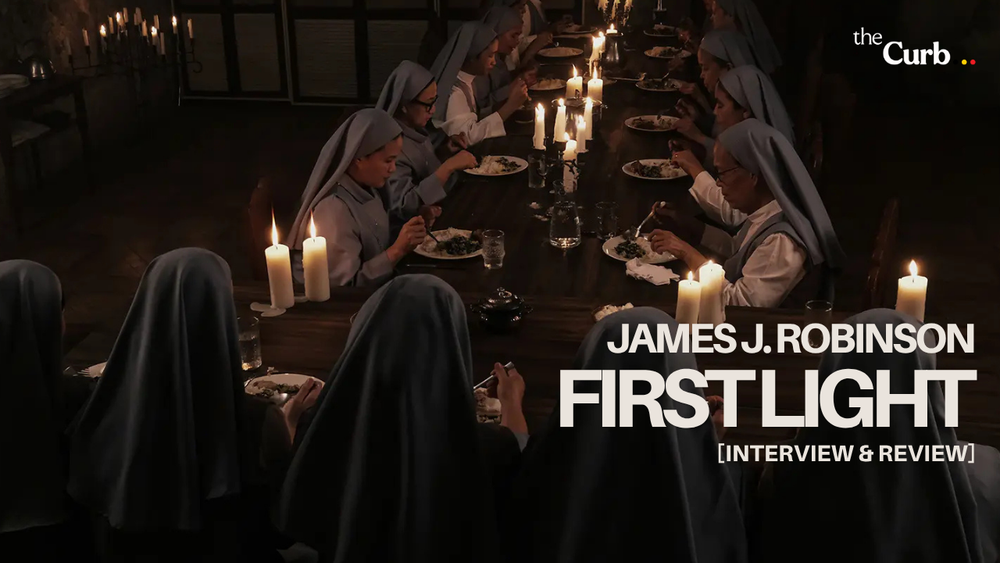
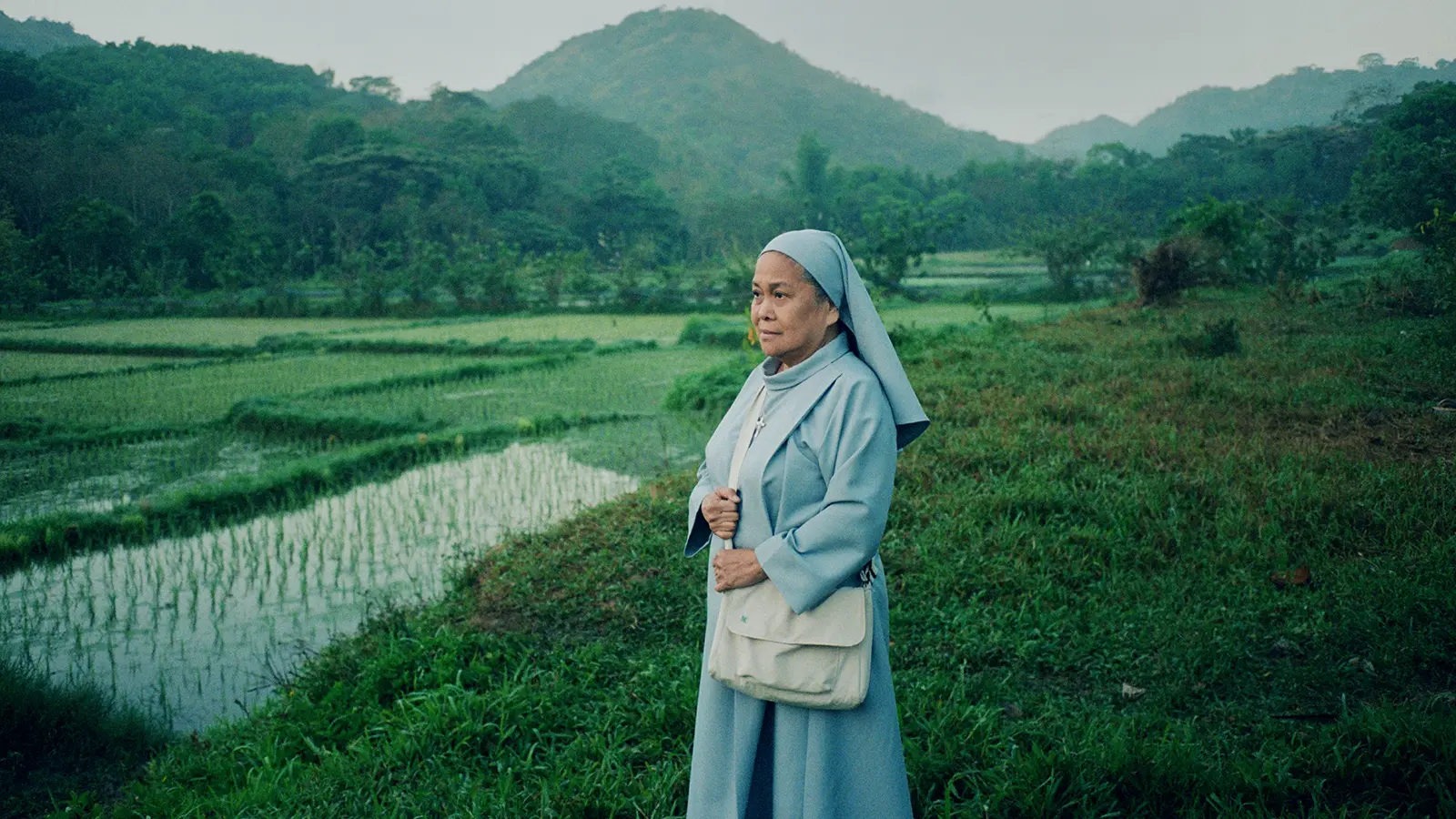
In North Luzon in the Philippines stands a four-hundred-year-old convent. Inside the crumbling building live a community of Catholic nuns whose peaceful sisterhood is reflected in their communal work and gentle respect for each other and their devotion to God. James J. Robinson opens the film with the nuns lighting candles pre-dawn. It’s a dreamlike and meditative image of shared purpose. It could be mistaken for their daily ritual but it’s not. The power is off in the convent (a consistent issue) and as light begins to filter through what we see is the slow wreckage of time taking a toll on the home of the women. One young novitiate is afraid of the bats who have also taken up residence. Sister Arlene (Kare Adea) will later speak to her roommate and supervising elder nun, Sister Yolanda (played by the legendary actress Ruby Ruiz) that she sees such things as omens. Arlene and her brother saw spirits in the forest in her rural southern Philippine town. In her mind they were not craven idols but messengers from God. Sister Yolanda listens carefully and calms Arlene. Sister Yolanda is in essence calming. She’s also encouraging, wise, funny, joyous, and self-sacrificing. Later a man will tell her that she is “Of God, but not of the Church.”
Sister Yolanda is Robinson’s focus character. Rarely does the point of view deviate from hers, and if it does, she is likely to be somewhere nearby. Yolanda is pious but not outwardly judgemental. She is kind, but she’s not entirely naïve. She might have lived most of her life in that convent, although she still dreams of her upbringing with her grandmother on a rice farm, but she has turned her face to the world. Her vows were made in service to others. To her sisters, to her community, to God, and to her church. The last vow is one that will be tested in a heartbreaking and ethical manner.
Almost everyday Sister Yolanda visits the local hospital to visit and care for patients. Usually, after her duties there are complete, she visits the home of Mr. and Mrs. Dela Cruz (Rez Cortez and Marcial Soriano) to look in on Mrs. Dela Cruz’s mother (now on life support) who once knew Yolanda and her grandmother before she joined the convent. The Dela Cruz family is wealthy, the kind of wealthy that means political influence and major government contracts. Edward Dela Cruz is currently building a highway that will bypass certain dangerous areas that often fall to natural disasters. It’s a boon to their area, a step into a more modern and efficient version of the Philippines. It is also a project he and his company are cutting costs with which results in a terrible and morally bankrupt tragedy. A tragedy that everyone from the local government officials, the doctors at the hospital, the police, and the church under Father Claridad (Soliman Cruz) become complicit with allowing to go without investigation.
Sister Yolanda is quietly stubborn. Having held the hand of the dying young man and administered his final blessing, she feels beholden to both his spiritual and mortal welfare. James J. Robinson inserts a mystery thread into the film as Yolanda uncovers the varied levels of corruption surrounding her and the death of the young man; but this mystery is more than the factual events surrounding what happened. It’s a mystery of Sister Yolanda’s soul. So many covenants have been broken between herself, the church, the law, her seeming friends, that she finds herself having to reorient herself and question her duty to those who have not returned the social and religious contract.
Yet, within these weighty topics of the corruption the Catholic church quietly sanctions is a profoundly beautiful and joyous film. Sister Yolanda’s gentle and genuine relationships with those around her rarely falters. Yolanda’s strength comes from her ability to nurture life and people with abundant generosity and care. She is, in every sense, a pillar of her community – an example of goodness who allows herself to be leaned on and uplift. She is the fertile and plentiful ground of the Philippines. Ineffably magnificent, exquisitely bountiful, and without agenda.
James J. Robinson directs with precision and restraint allowing both the landscape and the characters to reveal their secrets. Working in tandem with cinematographer Amy Dellar and production designer Tiffany Dias, Robinson’s vision is immensely rich and, although never forgoing verisimilitude, a study in the art of chiaroscuro and patient revelation. First Light is the kind of film one expects from a master of the cinematic arts: Apichatpong Weerasethakul, Edward Yang, Tsai Ming-liang, Andrei Tarkovsky, Lav Diaz. James J. Robinson joins their pantheon with his first feature.
First Light is a marvel, profound in theme and style. It is immensely satisfying to see Australia back a work of art that is so revelatory and mature. James J. Robinson is a precious and precocious talent that Australia must nurture as he revolutionises what Australian film can be.
I had the absolute pleasure of speaking with James about First Light and although I often found myself a little awestruck as I had been with the film, James gave wonderful and intelligent answers about his process and how personal the film is to him.
Nadine Whitney: I’ve seen First Light twice and I have to say it's one of the most graceful films I've ever encounter in all the possible ways that that word can apply. Sister Yolanda being a person of absolute grace, but also the way you have constructed the film gives this intimate feeling of grace, of something sacred that is beyond what the Catholic church socially and politically can possibly be. I found it extremely moving and gentle and also searing at times.
James J. Robinson: Thank you so much. Thank you, thank you. The grace part was very intentional, so it's so nice to hear someone say that.
I find when I see films of the standard of First Light that I can't get what's in here (my personal resonance) out there without sounding well… ditsy.
You're a photographer first by profession. I wanted to talk to you about the visual composition in itself, because there are lots of very deliberately composed shots. None of the shots are random in the way they are to be read. Can you tell me a bit about how photography led into filmmaking for you?
James J. Robinson: With photography I had to learn how to tell like a story from a single frame, and obviously I'm so intentional about like every single camera angle: such as how high the camera is, to what side it is, like everything. It taught me like a real language around telling character from the very beginning. Abbas Kiarostami made a film, 24 Frames, which is literally just 24 still images. I think that watching that was one of the moments where I really understood the power of cinematography and how that related specifically to my photography work.
With my DOP, Amy Dellar, who I've been working with since university, we were very particular about intent. First Light had major budget constraints, so from the beginning we were trying to figure how to be intentional with our coverage for every scene. We were thinking “Why do we need all these angles, why do we need to cut over this person's shoulder, then why do we need to cut there?” There is so much that we can say with the mise-en-scene of a shot by keeping the camera still and working on how the character can be blocked a certain way, and how the production design can say something, and how the costuming can say something.
A lot of my actors had experience in theatre, and that really interests me, because obviously when you're doing theatre, it's like you must use your whole body to perform, because you're performing to an entire room. You have to project your voice, and we loved the idea of like keeping the shots wide, so that my characters could have their body language to work with. They can be saying one thing, but through the way they're standing, or like holding their hands, they could be saying something else. So that was kind of the decision behind creating the cinematography. From photography, to go from one frame to 24 frames a second to tell a story blew my mind a little bit in how much you could tell.
I think the key word that we kept going back to, honestly, was just restraint. I think the reason we wanted to keep it restrained in every department was ultimately this is the story from the point of view of a nun who's lived a very graceful and pious life, and I think our cinematography should reflect that grace as much as it can.
The space you give Sister Yolanda is so expressive, it says so much about her. It also allows Ruby Ruiz (Sister Yolonda) the chance to fill in meaning with a single look, proving an understanding of what she’s seeing and dealing with psychologically.
As a writer where does First Light come from? You’re young and I’m curious about the inspiration to tell a story about elderly nun in the Philippines.
James: It’s funny when we did our audience test screening, I asked a lot of friends' parents to come and none of them knew what they were coming to watch. coming into the cinema, After the film they were like, "Oh, that's not what we're expecting from a young director at all!” Which I kind of love. I love that people have that response.
I look at a lot of first-time filmmakers who tell like really personal stories, and I think that some people maybe misunderstood that First Light isn’t as deeply personal for me as it possibly can be. It is a really personal story, because every single character within the film is like a part of myself that is kind of in constant argument with itself. Being product of this time, being a product of Filipino and Australian heritage, like being a product with Catholic Church, being product of indigenous Filipino heritage. There are these different points within me that are kind of in constant contention with each other. Internal arguments that I have with myself, basically.
When I was writing the script, I was mapping out what all those different parts of me were. I was like, there's this kind of like capitalist part of me that has been raised in a capitalist world that is like always thinking about like money and making money, and then there's the part of me that I think Sister Yolanda represents the most, which is kind of like this, like younger, like really graceful version of myself that I felt before I started questioning the Catholic Church.
I think when forming the story, I kind of let all these characters like fall into their place with certain backgrounds, certain ages. I went so deep back into all of my Bible studies that I had to do in high school, and also got very deep in like a lot of films and books that have been critical of the Catholic Church, and trying to wonder where this film would sit within, like, a wider canon of art. Andrei Tarkovsky is a big inspiration for me with films such as Andrei Rublev, and books like Noli Me Tángere, which is a Filipino text by José Rizal. Victor Hugo is a big inspiration. All of these great masters who come before me have all been critical of the church in their own unique way. I think I felt with this film I wanted to do that same thing of criticising the church in the way that all these people before me have, but also in a way that felt uniquely Filipino-Australian and unique to my experiences; like being queer and having gone to a Catholic school. There's a lot of depth in there that is inspired by the entire canon before me, and then the characters themselves are really different parts of my own identity.
I see the subtle misogyny that goes on in the Church highlighted in the film. The convent has been there since the Spanish invaded the Philippines. The nuns ask the Priest for buckets because it's going to flood and the Priest declares that the weather will be fine, and buckets aren’t required. Of course, the weather is not fine.
That attitude is endemic in the church. Even though the church is supposed to be nurturing and made out of love, it's more often made out of rules. Rules that are intractable in some places and not so much in others.
James: Totally. I think it was really interesting, the spiritual bypassing that can happen when money becomes involved. I have experience in that in two ways. Having attended an old boys Catholic school that was like quite elitist and noting how like a church connected to it was considered almost to be more holy and more giving than the other churches. The access that that kind of money brings you in the church, it's like you're VIP Christians or something. The same thing in the Philippines happens, the church is so intertwined into absolutely everything there.
In the Philippines you feel the wealth gap, maybe more than anywhere that I've ever felt in any place I've travelled. There the richer get access to kind of like the rock star priests. It’s clear how class systems have invaded the Catholic Church. I think when making the film in needed that to be overt because those class systems are a direct ripple effect of colonisation of the Philippines to begin with.
Class systems that didn’t exist before Europe invaded. Showing that aftermath in the film is very deliberate. Yet, at the same time a lot of people watching this film are probably going to have a lived experience of it and sometimes I don't need to spell it out. l can I can suggest it and I can show it. For the most part I understand my audience is already going to feel in their body, and it's kind of just a case of like making those small suggestions and raising those questions, but never really beating the audience over the head with them.
First Light is one of the most perfectly shot films in terms of chiaroscuro – light and dark. Your opening scene with the candles is something Rembrandt would have applauded. You said you were restricted by budget but that isn’t present in the richness you’ve crafted as the final product we see on the screen. You’ve made something so contained and perfect as your very first film! I feel like I'm talking to a rock star, you know, just before their record goes gold, and then they won't ever talk to me again.
James: Oh my god! (Laughing)
What do you most wish to communicate with First Light? What is it that you would audiences to feel? Immersed, touched, educated, all of the above?
James: There are two sides to it. What the responsibility is to be people making films to begin with? I think that there is a responsibility there in knowing that the way that we consume media affects our worldview and has such a deep emotional effect on people who are watching it. I think that there is a responsibility as someone who's telling stories to be using that gracefully. In this day and age, as well, to have someone's attention for two hours is something I don't take that lightly. I want to be able to use those two hours with as much like intention and beauty as I possibly can.
I was thinking a lot about what I would leave the audiences with, and I think so much of that is just like helping the audience maybe ask questions themselves about like the certain ethical problems that I'm bringing up. I didn't want to provide the answers to all of these problems. I wanted to raise them and then just like ask my audience a question that they can answer within themselves while watching the film.
Ultimately, that feeling that you spoke of earlier of grace was one of the major goals. If anything, I want this film to really hold that character of Yolanda and her grace. Even if you're watching the film and you're not following it, or it's not your type of cinema, or it's just like the pacing isn’t for you. I'm like, at least the sounds of the Philippines, and the cinematography can kind of like hold you and gracefully put you to sleep, if that's what it may be. It’s capturing like senses.
Many slow cinema directors expect audiences fall asleep. Famously, Apichatpong Weerasethakul.
James: I'm almost of that camp of just like, “Whoa, if I can like relax your nervous system to the degree where you can fall asleep in a room full of strangers, like I am doing something right!” I do like that there are the filmmakers like Gaspar Noé and Lars von Trier who like very much like take a visceral like response out of you. That’s one form of filmmaking, but for me, like I think if someone can leave my film feeling calm and relaxed and might I can do that to someone's nervous system. Then that to me is also its own kind of protest in a way. So that was a lot of the intention of when making the film and thinking about audience.
Just to go back to the place where you said you can’t provide answers, there certainly are no definitive answers for the Philippines and how Catholicism works there socially and politically, and it all intersects. It is one of the most predominantly Catholic countries in the world.
James: Yeah, it really is.
Director: James J. Robinson
Cast: Ruby Ruiz, Kare Adea, Maricel Soriano
Writer: James J. Robinson
Producers: Gabrielle Pearson, Jane Pe Aguirre, Christelle Lou Dychangco
Cinematographer: Amy Dellar
Composer: Ana Roxanne Recto
Editor: Geri Docherty
First Light won Best Australian Director at MIFF 2025
First Light is featured at the Sydney Film Festival 2026 with James J. Robinson and Ruby Ruiz in attendance. Screenings on Sunday June 7 and Tuesday June 9th.
Information and bookings can be found here:
https://www.sff.org.au/program/event/first-light/