
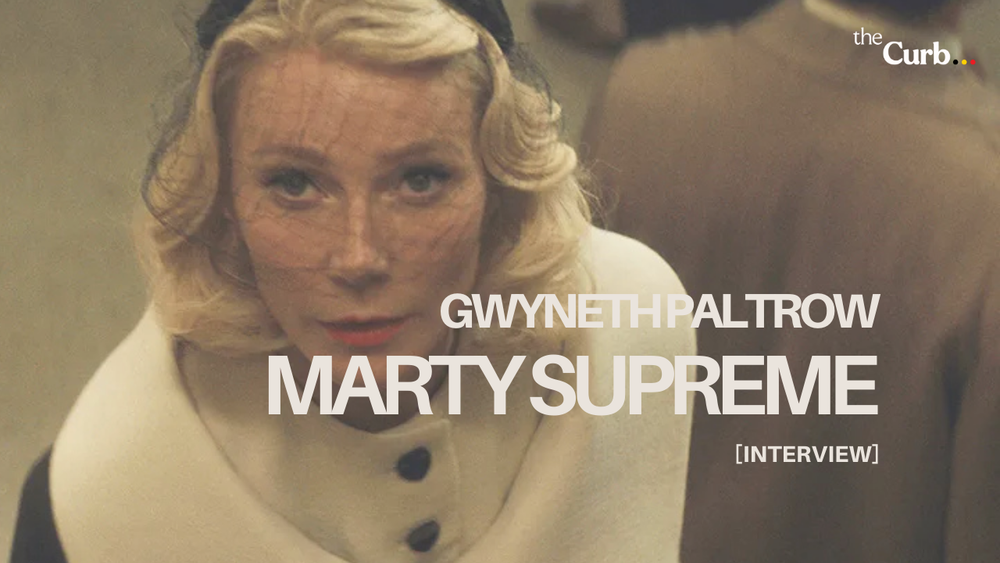
Gwyneth Paltrow returns to the big screen as Kay Stone, a once famous actress now trophy wife to stationery magnate Milton Rockwell (Kevin O’Leary) who is seduced by the sheer audaciousness of the pock faced 23-year-old Marty Mauser (Timothée Chalamet) from Brooklyn whose dream it is to be the best table tennis player in the world.
Ultimately Marty Supreme is about humility and humiliation and Marty’s singlemindedness means that he manages to leave a lot of wreckage in his wake. Yet, for Kay Stone he’s an awakening after the fog of her marriage and the loss of her son. If Marty dreams big then Kay dreams of reigniting her dreams that she once hustled just as hard for.
Nadine Whitney spoke to Gwyneth about her Hollywood star influences and the backstory she created for Kay Stone.
I would like to ask you about some of the women in Hollywood history that you might have drawn on, for example Joan Crawford or Joan Blondell. I did the math and Kay would have been working in the late 1920s and the 1930s in a tough studio system.
Gwyneth Paltrow: I really had in my mind Grace Kelly, because even though she worked later, she had that 50s glamour I think Kay epitomises. Kelly epitomised the 50s in such a specific way. She also quit acting to marry somebody. I think she also experienced – and this, of course, is a fictionalised projection – but I think she experienced some loss and sadness at losing that identity and freedom. In Grace Kelly’s case, she left her country and had quite a tragic end herself. So, she was sort of in the back of my mind a little bit in terms of “why did she make that choice for herself and what would it have looked like if she had continued on?” But you're right in terms of the math of earlier women in the 30s, but in my mind, I was thinking of Grace Kelly.
I think Kay and Marty are cut from the same cloth in the sense that I think she was a hustler too, in her own way. Josh Safdie and I came up with this backstory for Kay that she was from the Midwest and found her way to New York City and was a dancer and I think had a very difficult ascent and then got lucky and became a star. When Kay says to Marty in the dressing room, “I would have stolen from me too” I think we get lot of insight into who she is underneath the glamorous layer. She's a person who's been kicked down and tried to come back and has had a lot of loss and heartbreak in her life.
I think Marty awakens this spark in her that she feels like, ‘oh, maybe I could reconnect with my sexuality and my career as an artist. And unfortunately, it doesn't end very well for either of them in their pursuit of their dream. I think he finds fulfillment in another dream, and I hope that Kay does as well.
I think Kay had a very different kind of hard life. I think she had to do things to get where she was going that weren't great. I think she had to hustle. Marty and Kay are both hustlers. There is a kind of similar almost, I don't want to say amorality, because, of course, they're not amoral people, but they are kind of sublimating their morality in order to get what they want to get.
I think Marty Supreme is really a journey from amorality to morality. You see in Kay that she has shut away a part of herself. I think she has a vulnerability that starts to be brought out through Marty and through the reconnection with her own dream. But game recognises game, and she knows he's a liar, she knows he's a thief. She knows, because she has those things, too, in her past.