
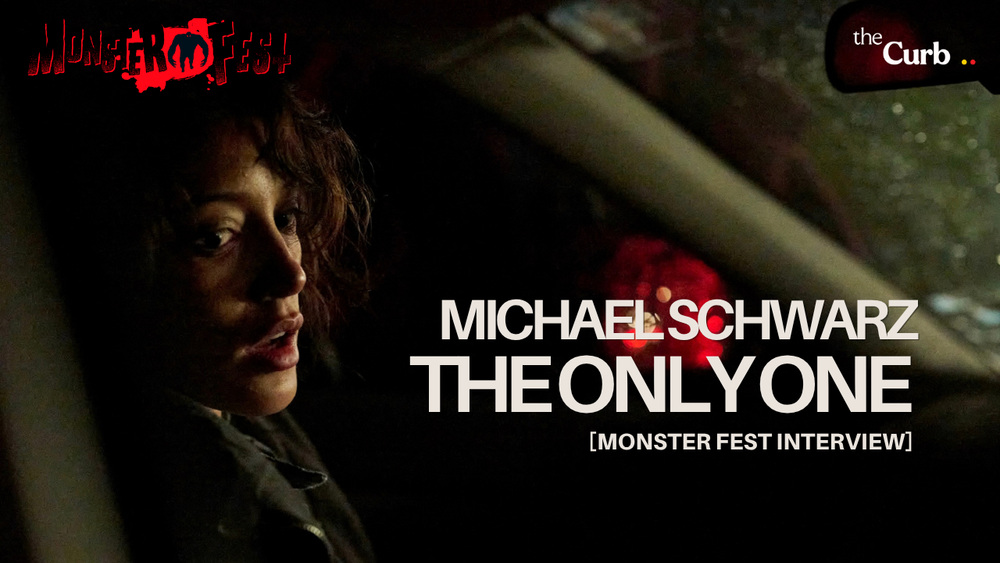
After years away from the small town of Oxley Creek, NSW, Zoe Callahan returns from a not-so-great career as an aspiring actress in Los Angeles. Zoe rushed to find fame in Hollywood and left behind a string of broken hearts. Now, a masked killer is ensuring those hearts stay broken along with the bodies that house them. Someone wants to be the only one that Zoe has.
Nadine Whitney speaks to director Michael Schwarz about being a first-time director, his personal connection to the story, and what he loves about the genre.
The Only One opens Monster Fest 2026 in Melbourne on Friday October 2nd. Tickets and programme at the link below.
The Only One is so much fun. It knows where it sits within the genre of the masked slasher and even has a particularly good beginning reference to a specific series of slashers, which I won't spoil.
Michael Schwarz: Oh, thank you.
When you got Martyn Pedler and Marek Polgar's screenplay, what made you decide “I'm going to make this”?
MS: I'd been trying to make stuff with Marek and Martyn for a while before they sent me this script. I primarily work as a producer. My brother Johnny and I, we've been working nearly 17 years now as producers.
I'd always wanted to be directing. That was always my goal, and I kind of fell into producing, and it sort of sucked me in, and I was sent a sample script from Martyn and Marek that was a completely different one. It was an action film that I thought, “Oh, I love this, I want to have a crack at directing it.” And we got pretty close to getting it going, but it was just that little bit too ambitious, especially for a first-time director.
It was right about the time of the writers' strikes and the actors' strikes, and so everything kind of shut down, and it was getting even harder to make things than it was before. I was having a chat with them, I was like, “Look, the key to what we really need to be focusing on now is something that can be shot a lot more cheaply and doesn't need big stars so we can scrap it together.” And they said, “We've got something we want to share with you, and the option has just become available.”
I just absolutely devoured the script. It's funny that I found it relatable. I didn't find the dating side of it relatable, but I found the character of Zoe relatable in that she's not who she wants to be at that period of her life. She works in the film industry, she's an actor. You know, I was working as a producer, and I knew that feeling of failure that you always have whenever you work in film. No matter what level you are, I think. I really latched onto that. That was sort of my big thing. They wrote it as an American script, so it was supposed to be set in America. The first thing I said, I said, you have to make this Australian. Like, this is an Australian story. I lived in LA for eight years, and I knew so many “Zoes”.
It was an easy thing to make the dialogue and the characters feel that little bit more Australian. In making it Australian created a really special story for me personally that I just loved. I'm already a big slasher fan as well, and it felt perfect for my first film.
I particularly related to the semi-large rural town setting. The worst of the worst, if I'm allowed to say that, of living in suburbia in the middle of nowhere.
MS: It's not that beautiful, rich countryside.
These towns all have a main street, and everything kind of sucks when you become a young adult and see that you have limited options there and wanting to get the hell out. If you dare to go back after years away, there are often fractures with those who stayed. There's always a certain resentment.
MS: I found that very relatable. I'm from a town like that as well. I moved back to my hometown as a middle-aged guy as well, so, I straddle those worlds and I know that feeling all too well. I really wanted to capture that.
You’ve got a great cast Mel Jarnson as Zoe Callahan is fantastic. How was working with Mel? Because she's usually more involved in the action side of filmmaking.
MS: I've worked with her before, on a television series I produced called Caught. That was the first time I met her. The thing about Mel is she's a lot like Zoe in a lot of ways, where everyone falls in love with her.
She’s not just gorgeous. She's really warm, and she's really funny. She's really kind. So, she just disarms you. We're not used to someone with that gorgeous facade being so warm and kind and makes everyone feel really good about themselves. You watch everyone fall for her. You can literally see her just talking to people, and you can watch them falling in love with her. It felt like such a natural fit for her to play Zoe.
As a first-time director, as someone who's been producing for a while, but is directing for the first time, I knew I had to surround myself with people that were really gonna help me along the way. She was one of the people that I had sent the script to in the earliest days.
Mel auditioned for the part and obviously she nailed it. It really fun to sort of see a side of her that I hadn't seen. Like you said, she is known more for the action things. She typically gets cast to play really cold characters and sort of really mean.
I told her from the start, “I just want to see your warmth.” I've never seen it on screen before, no one's ever tapped into that, or I've never seen anyone tap into that
With a lot of the cast, a lot of the actors that are in it, they're people that I've worked with before. Aaron Glenane, Lincoln Younes, and Ben O'Toole were people that I called and said, “You have to be in my film. I can't make this film if you guys aren't in it.”
As a first-time director, I guess you've got to do a lot of jumping through hoops. You'd know that as a producer. Do you have any advice for aspiring filmmakers out there?
MS: Oh, as far as advice goes, it's that things always happen in strange ways that you're never able to replicate. We were able to find the right sort of partners that believed in the film and believed in how commercially viable it is. I was able to bring a vision, but also, like, as a first-time director, I was able to bring a lot of production experience, so it was not taking the same risks that you would normally be taking with a first-time director. I'm bringing really experienced crew with me across the board. First time director with the cheat code, essentially.
The big thing that I would always say to people, and it plays into what I was saying about the crew, is the thing that the best thing you can do, I think, in film is to build a film family.
So, it's the DPs, it's the production designers, all the people that you're going to work with, because working on film is not something you do by yourself. You have to do it with a crew, and the best crews are the ones that you know first-hand, and they trust you, and you trust them.
When you go through all the tribulations of a film and you come out of the other side of it together, you've made something. It's so hard to let go of that. So, I always keep everyone together, and we move on to the next thing.
I think that's something you can do at any stage like, say, you're at film school, or say that you're just trying to make things with your friends. Find that crew. You find that sort of that film family and nurture it. Encourage each other and help each other and work on everyone's strengths. And that's the best way to do it, I think.
One thing that made me giggle is how right the movie is in that there's at least one goth in every town.
MS: I think that's Martyn. Martyn understands that really well. That's usually him.
Plus, The Oubliette is the name of the bar, an Oubliette being a circular underground prison.
MS: Yeah, the wooden door on the floor that leads to it, yeah.
The film is incredible witty and droll. Clever. The cinematic knowledge that's gone into the slasher genre, but also just how funny and cutting it is with some great lines It's smartly filmed, and I think what a lot of people will vibe with is the clever use of tropes.
There are slashers, which are just pure violent slashers, they don't have much going on at least at first glance except people dying in horrible ways. But The Only One has quite a bit on its mind, especially with how Zoe is being punished.
You have the core needs for a slasher film and the post-postmodern irony too. It’s smart on so many levels, but also, a lot of people get killed in extra-gruesome ways.
MS: Thank you. It was important that when the characters used recognisable references like Scooby Doo or Agatha Christie that they didn't talk about horror films or slasher films. to me. Better was a cop show with an aging rapper playing a sex crimes detective. It's not trying to be obvious Wes Craven self-referential horror.
The Only One is opening Monster Fest 2026. How would you like audiences to open up for the film? What would you like the audience to experience?
MS: One of my favourite genres is slasher films, and there's a certain joy that I get when I watch them. It's even the ones that aren't necessarily great, to me they're hangout films. You hang out with a bunch of characters, hopefully you like them, sometimes you don't. It's fine if you don't, because they're gonna get killed in a few scenes later anyway, but it's best when you do like them.
I enjoy the experience of hanging out with them before the mayhem starts. It's a real joy that I feel. I’m really attached to the tropes. I enjoy the tropes, like, some people like the tropes of romantic comedies, I like the tropes of slasher films.
I was constantly, through every stage, trying to convey that feeling I get when I watch these movies to, first of all, the crew and everyone around me, and now I want to convey it to the audiences. So, what I really want from the audience is for them just to have a really good time and feel those feelings that I've always got when I've watched these movies. That’s purely my intention. Just to give the audience a really good time, and for them to understand a little part of my own psyche.
I do think it's heaps of fun. I was gurgling with laughter at some points and I really don't want to give away any of the points where I really was gurgling, but I can say that the opening scene just had me in stitches.
MS: The way I look at slasher films, and Giallo films as well, is they're different to a traditional mystery story, where the whole crux of that story is the whodunit, who is the killer, and the red herrings, and everything.
I find, particularly Giallo films, but the slasher films that go into them, it kind of doesn't matter. Like, because you're not following detectives, you're following normal people trying to figure out what's happening. If you look at Argento's Giallo films, it's often that.
It’s not some clue that gives away the killer. It’s not detective work and trying to solve a mystery. That’s not the satisfying part of the film. I want people to enjoy it. Just as long as it makes emotional sense is all I really care about.
A realistic depiction of a murder scene is not why we're watching a slasher film. We're not here for a police procedural. So, the little choices you make, and you know what? I don't need to show that. Let's just focus on the things we need to.
I think that's, that's where your trope awareness comes in as a viewer and also as a creative. We understand the shortcuts.
Let's talk about the soundtrack, because I was extremely impressed. I was like, “Hang on, that's Pseudo Echo. Hang on, that's Lee Hazelwood. Oh, come on, you got MEATLOAF!?”
Your music supervisor was so spot on. It was great. And it really pumps up the film.
MS: Oh, yeah, I was really lucky where I had partners who that sometimes it is worth spending the money on the songs. They do elevate. That is production value. It brings so much to the movie if you choose the right song in the right moment, it can just elevate it to such a high level.
It was really about being very specific, like, targeting the right songs for where you needed it, and then choosing. My music supervisor, Andrew Katako is really great at getting good deals, for starters, but what he's also really good at finding good catalogue music that costs just a few hundred bucks.
And so it was, like, looking at the scene, saying, is this scene, is the whole movie improved if we have Pseudo Echo here, or Lee Hazelwood, or Meatloaf? And the answer will be yes. The movie is so much better because that song is in there, so it's like, there's a conversation to be had with the producers, and it's like, okay, we can figure it out.
Then there was another band that I'm just a fan of. A Sydney band called Magic Machine. I was able to get in contact with them and say, “Hey, can I use a couple of your songs in scenes? like, three of their songs throughout the film. They gave me a really good deal. So, it was just being very specific about, does this movie, does this song make the movie better? And if it did, then let's have a conversation about paying for it.
[The interview has been edited for length and clarity]
The Only One opens Monster Fest 2026 in Melbourne on Friday October 2nd. Tickets and programme at the link below.