
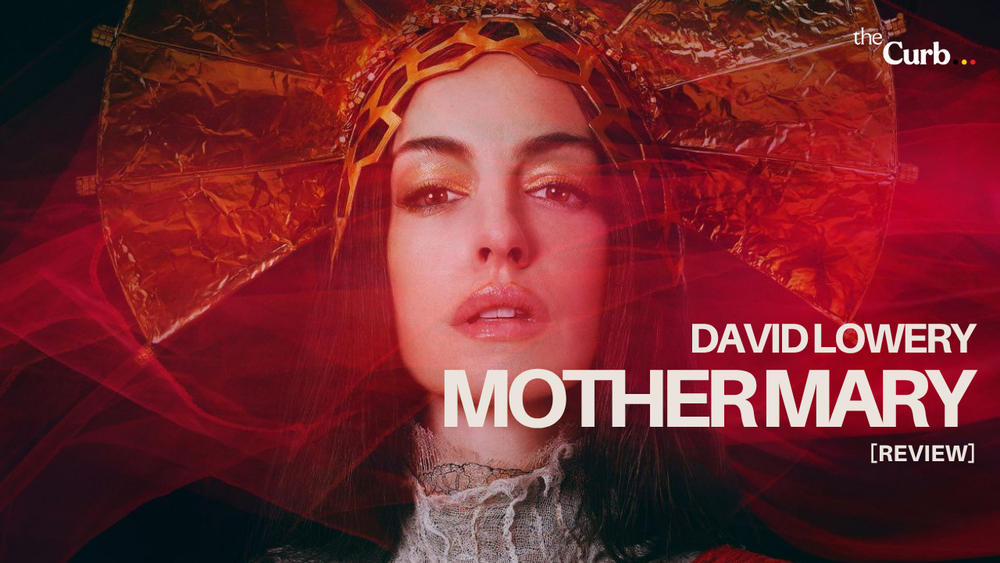
“You are a carcinogen.” Sam Anselm (Michaela Cole) says bitterly of her former friend and music icon Mother Mary (Anne Hathaway). Mary isn’t there to hear Sam’s words but she’s coming. Sam can feel her approach. The woman she shared an intense creative bond with beginning 25 years ago needs something from Sam despite dropping her as her designer and stylist ten years previously. Wet, exhausted, and humbled, Mary enters Sam’s almost Gothic atelier outside of London. Mary needs a dress, something that will represent her and the only person she can turn to is the woman who helped create the “her” that people worship. Sam’s filled with bitterness and betrayal. She will make the dress but only if Mary submits to her rules and vision (and recriminations). The dress Mary is asking for will require a miracle as there are only a few days until she will wear it on stage when she debuts her new song “Spooky Dance” – the best song she’s ever written… nay, one of the best songs ever written.
David Lowery’s Mother Mary is both straightforward and elusive. The concept of two erstwhile creative partners having to deal with the ashen-mouthed acrimony of a reckoning ten years in the making isn’t a difficult conceit, but Lowery isn’t interested in a straightforward story of forgiveness and regret. Just as Sam’s long monologues twist themselves into a strange poetry, Lowery is depending on metaphors to express how an essential creative act and bond can never be fully explained, nor can it be completely abandoned. There is a residue, a tether, a space that belongs to the other that cannot be erased. When Sam first designed a halo for Mary she created a silhouette that defined a signature look (and mood) for the performer. “We did it together,” she tells Mary who has been continuing (at least consciously) without Sam becoming one of the biggest stars in the business.
“This is not a ghost story” is one of the taglines of Mother Mary. It’s true that it isn’t a ghost story, but it about a haunting. A shared haunting which began when they were in harmony and became treacherous once they split. Mother Mary is a true sensation filling stadiums with her beguiling live show and her goth-pop numbers that bring crowds to an ecstatic kind of worship. There is something that makes Mother Mary ineffable but also recognisable as a woman who can channel pain, adoration, and psychological mirroring for her many fans. Her songs are lyrically dark but delivered with an emotional elegance which makes her stage name lacking in irony. Mother Mary is a 21st century idol. It is natural that Sam feels the need to cut her music out of her life because she’s been so damaged by abandonment by a woman who is so present for hundreds of thousands of strangers.
Lowery’s set up is almost a chamber piece between the two characters as they negotiate the past in Sam’s cavernous workshop. Yet, interspersed with the present dance they do around each other is Mother Mary’s stage shows where Lowery gives his creative team the task of making Anne Hathaway into a credible sensation. Choreographer Dani Vitale along with production designer Francesca Di Mottola make magic happen with the songs written by Jake Antonoff, Charlie XCX, and FKA Twigs. Hathaway looks (thanks to Bina Daigeler’s magnificent costumes) sounds (she sings the leading vocals) every bit the superstar. Those scenes contrast with the fragile Mary standing before Sam, but as the audience sees more of Mother Mary and the sheer physical and emotional toll performing takes on her it is clearer why she has returned to Sam who has known her as fallible and fantastic and as a friend.
Mother Mary considers the terror and elation of creation and gives it a supernatural twist. It takes pain to be iconic and groundbreaking. It costs when personal stories are proffered for consumption and passion is commodified. Mary says she’s looking for “clarity” but before she reaches that word, Sam suggests “authenticity.” Mary is authentic but she’s also allowed herself to take credit for Sam’s art and personal stories. One of the first big stories on Mother Mary appeared in Vogue where she claimed (or the article claimed) that her Joan of Arc costume was something she’d come up with, when in fact a lot of the details of the look belonged to Sam’s history and experience. Sam’s ownership of her art is not solely hers as Mary was the one who wore the pieces. Just as Mother Mary would have been far from the idol she is without Sam’s styling and talent. The interplay between their respective talents might have been lost during their separation; but the desire, ache, and connection stayed as something palpable – a third presence both beautiful and terrifying.
Mother Mary is not an easy sell despite truly excellent performance by Cole (absolutely luminous) and Hathaway. It’s a mysterious and beguiling film, but also one that can over explain itself in some areas and leave others undercooked. Yet, even with some narrative and thematic dips, Mother Mary is never not fascinating and has a brilliant soundtrack and glorious costumes. Lowery has created a stunning piece of cinema about the difficulties inherent in a kind of art that’s all consuming, and to reject it out of hand as too strange and alienating is perhaps something Lowery allows for and encourages. Mother Mary can be a negative or a transcendent experience, but either way it is certainly an immersive one.
Director: David Lowery
Starring: Anne Hathaway, Michaela Cole, Hunter Schafer, FKA Twigs
Writer: David Lowery
Costumes: Bina Daigeler
Cinematography: Andrew Droz Palermo and Rina Yang