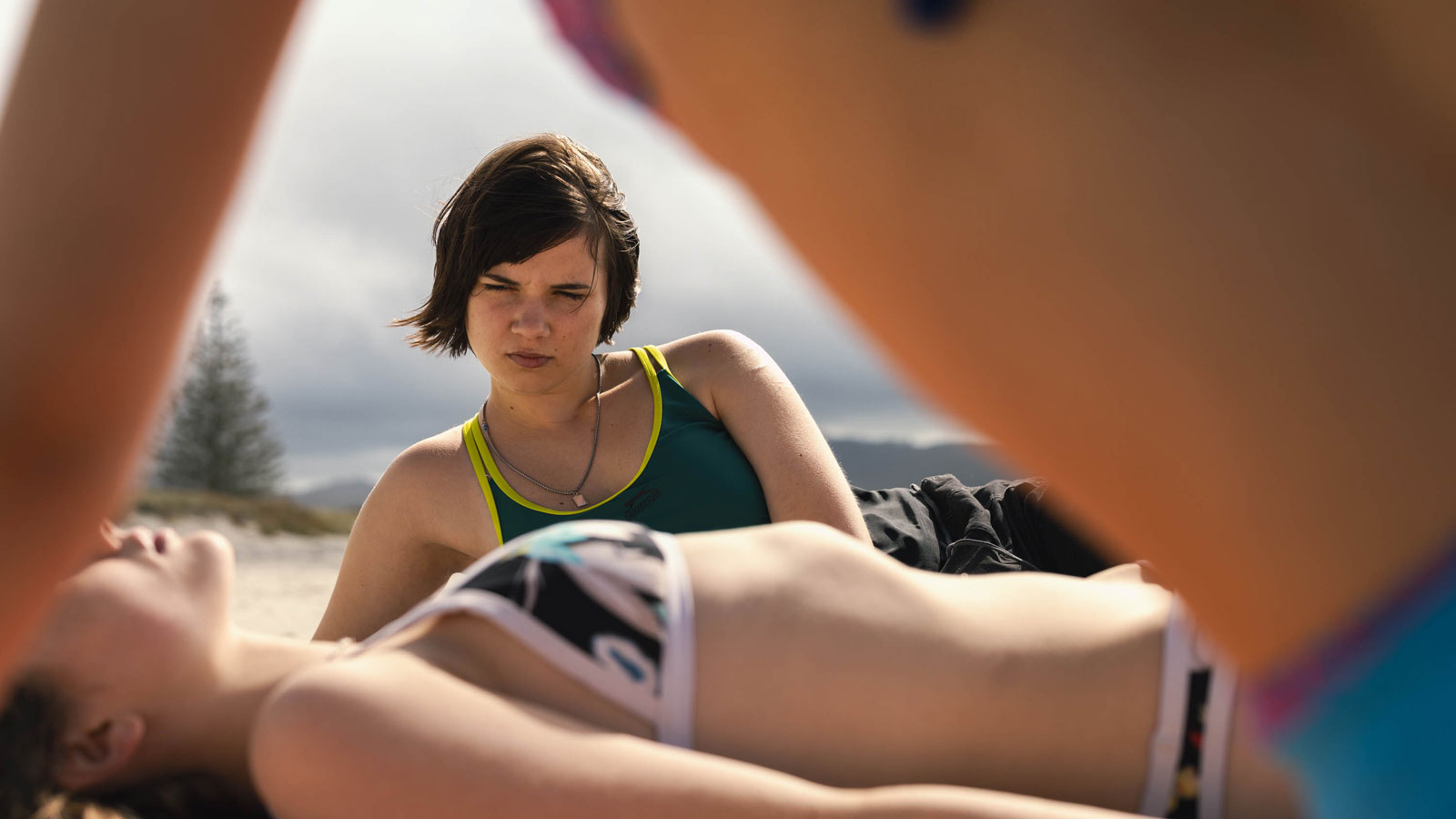
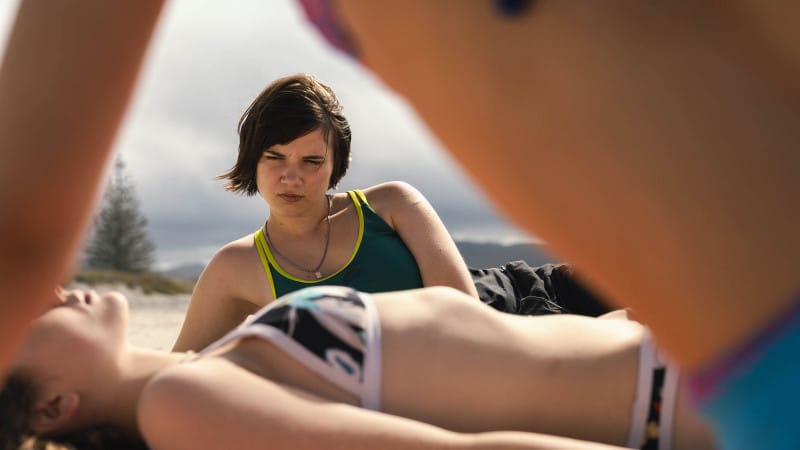
Paloma Schneideman’s fantastic Kiwi coming-of-age film begins with the siren song of a dial-up modem. It’s 2006 and Sid Bookman (Ani Palmer) is determined to have a summer holiday to remember. Among the Paul Frank phone decals and MSN chats is the story of a girl no one really notices trying to navigate becoming part of the “in-crowd” by telling lies and pretending to be more experienced than she is. Sid’s world does change when her older sister Adele (Tara Canton) brings Freya (Rain Spencer) her American university friend to stay on their rural property. Sid ends up as a kind of silent third with the two “pretty mean girls” from her school who grab the attention of Auckland blow-ins.
Big Girls Don’t Cry is a trace memory of that awkward and formative time when young people are trying to figure out how to act and who they actually are during a confusing time where almost everyone else seems to understand the things they’re missing.
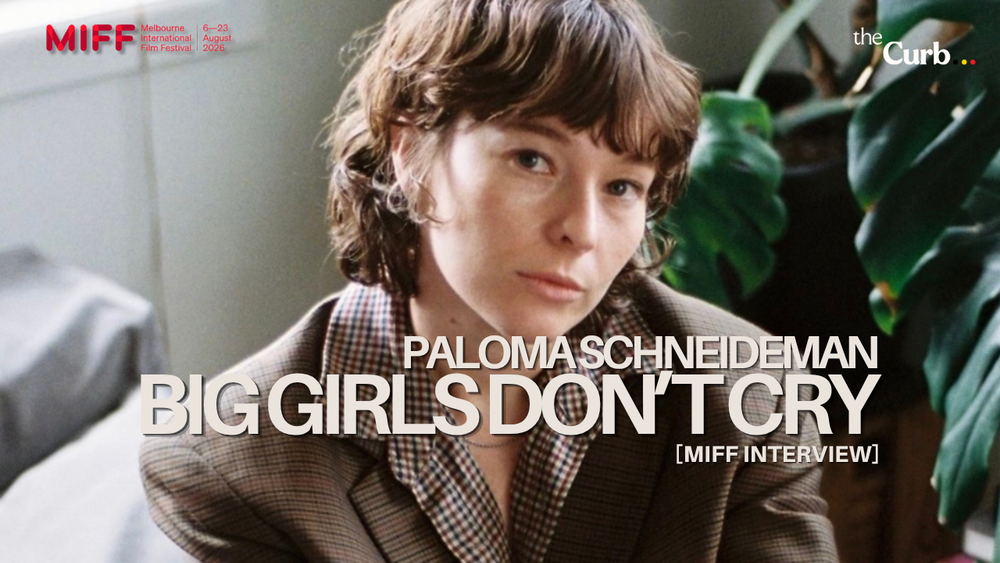
Nadine Whitney spoke to Paloma about her film which is currently featured as one of the Bright Horizons strand at Melbourne International Film Festival 2026.
Good morning, Paloma. I just finished Big Girls Don't Cry, and my goodness, what a powerfully, relatable piece of cinema. I'm writing a book about coming-of-age stories in film. I’m still putting together the idea of what coming of age is. I've kind of narrowed it down to the point between innocence and experience. Would you say that applies to Big Girls Don’t Cry.
Paloma Schneideman: Definitely, definitely. I think the interesting thing is, or what I've learned, is that I think we're always coming of age. I don't think you stop coming of age. I even feel it within myself, having just made this film. I feel still growing pains now of moving into another space, and maybe there is still a space between innocence and experience, even now as a 33-year-old woman. Maybe more in a career aspect. I’m finally achieving these dreams and goals, and there was an innocence and naivety around that, and I have the experience now. I guess this is all to say, yes, that is very true. I think it just goes on forever, though.
You're right. I think we're always learning new things and becoming new people. Not essentially changing our core personality but becoming new people as we go along.
Can you tell me a little bit about the casting? Because Ani Palmer is just spectacular, as Sid.
PS: Ani's pretty special. I'm a firm believer that directing is 80% casting. We did extensive casting and we took our time, which was really cool because Sid is in every scene in the film; she is the heartbeat of it. I knew we needed a performer that the audience still kind of needs to be able to back her and root for her even as does these quite shitty things. I think that was about finding an actor that could hold both a naive innocence and a wise dreamer. Someone that you inherently want to protect, and I felt that from as soon as I met Ani in the rehearsal room. She was very insightful. I loved to watch the way she listened, which I think is a really telling sign. It's like what is behind someone's eyes, and in a film where she's kind of struggling to speak anything truthful for the most part of it. Ani had to be very compelling to watch, even in the most mundane moments. I wanted to keep her safe and knew that she would hold all the duality of Sid’s character.
Yes, she does shitty things, but she's 14, and she's trying to catch up to people who appear older, but they aren't, and people who are older. She’s so lost and she’s also working out her sexuality. She has no one she can really talk to about that. I found these internal pressures mounting and her trying to save face was just so relatable.
PS: Yeah, we've all been there, or we know someone that has. We've all tried on different versions of ourselves, and it takes a while to figure out which one is the real one at that time. Because it changes. I feel like growing up is just an exercise in shedding skin, right, and getting closer to who you really are.
There's also you know an exercise of putting on skin, of learning a toughness too you have to project, and that can be very confusing.
Did you end up shooting in Ōmaha where a lot of it is set?
PS: Yeah, for the most part, we shot in Ōmaha, and we shot out in Helensville, which is 30 minutes out of Auckland as the rural area, and a little bit sprinkled around various other Auckland locations. It was funny because we scouted the whole country. I grew up in Ōmaha, and I think part of me thought it had developed too much to recreate the 2000s there, and also part of me wanted to keep that distance from my story and the story that it had become, which is not just my story anymore. And then after scouting the whole country, I realised we had to come back to the spiritual home. Like all my instincts were just so much stronger when we were in Ōmaha, and we had to go back.
You just said that you were trying to separate it from your personal biography and the film version. So, I'm assuming that there are obviously then biographical elements within the film.
PS: Yeah, for sure. Like it's definitely not like my life, but those pillars of the story, like rural upbringing, against a backdrop of quite a changing technological cultural atmosphere; that was the era I grew up, so that part is true. Having the city folk come and take over your town for summer, that happened to us. We were all very excited about the prospect of reinventing ourselves for a new group of people. The queer elements in the film are all pretty true to my experience.
But then, a lot of it was communal storytelling. When I found my friends in my core community in my 20s, we’d share these stories about coming of age, we kind of didn't share with anyone before then. There is this kind of universal shame, so you lock up those experiences, and then and then as you talk to people finally about it, you start to realise you haven't ever had an original experience in your life! Everyone else has experienced a version of those times. I was interested in working out why aren't we talking about it. That’s where a lot of the film came from as well.
Sid really doesn't know who to talk to at all. Leo, her dad (played by the legendary Noah Taylor) starts quite aggressively about himself. Everything is about him and his disappointments. Her older sister is back, but she has stuff to do. She’s in university and brings her university friend Freya which means she’s not there to entertain Sid.
Freya is, I think, the projection of what Sid wants to be or wants to be, who wants to be with.
PS: Definitely. I think that's the that's the queer thing for me in this film. The queerness isn't necessarily about her sexuality; it's like more about a fluidity and curiosity. And as you articulated with the Freya character, she doesn't know if she wants to be with her or be like her, or if she’s a maternal figure. Sid’s just attracted to the warmth, I think her the way we see Freya is through Sid's eyes, and I don't even know if it's reliable, really, because it's kind of about how it's about fantasy and how she remembers this person.
I think that is universal as well. We always kind of had like a person often that like was our catalyst in questioning things about ourselves. It’s always the visitor that that sparks crazy things.
Freya is so completely different, she's American. She’s more emotionally open than other people around Sid.
PS: Yeah, she’s comfortable in her own skin and comfortable with her own desire. Well, she appears to be whether she actually is or not. That's a whole other question.
That's a question only you can answer.
PS: I’ll be leaving that one to interpretation.
How was it directing your first feature? What were some of the challenges?
PS: That's a good question. I mean, everything was challenging. It's fucking hard to make a film, but also really joyful. I had an amazing crew and cast. There were lots of moments of play and discovery and laughter, so that was cool.
I think in the grand scheme of things as a first-time filmmaker, negotiating the space between experience, like someone else's experience, and your own instincts, can be quite challenging. Sometimes you're met with a lot of, “well, this is just how things are done,” or “you're going to want this, trust me,” or “you'll want to spend more time here than there.”
Instinctually, you know what you know. No one really knows the film better than you. I mean, there are logistical things that people know better, and there are technical things that people know better. But there's no one who knows the chain of importance around the storytelling better than yourself.
You have to stay really attuned to your instincts because you can succumb to fear when people are saying trust this experience. So, I think that's a big one for me: and doubling down if I'm pinging an instinct or something that feels really important, just to honour that. So that was that was challenging but good. And then, I think honestly, the most practical challenge was shooting a summer film in the middle of a tropical cyclone.
I did notice that. The lack of that summer sunshine sheen.
PS: Like, I mean, sometimes in New Zealand you get really scorching summers, and honestly, the more climate change is happening, the sunnier they get. But it all ties into this disappointment around summer. We have these grand expectations, and more often than not, you know, you're oscillating between like excitement and thrill and total boredom.
I think actually, even though it was difficult, and it wasn't intentional to have a summer film that was kind of grey and overcast and rainy, I'm really glad it worked out that way because I think it just heightened some of the interior experiences this Sid was having of these disappointments around her expectations.