
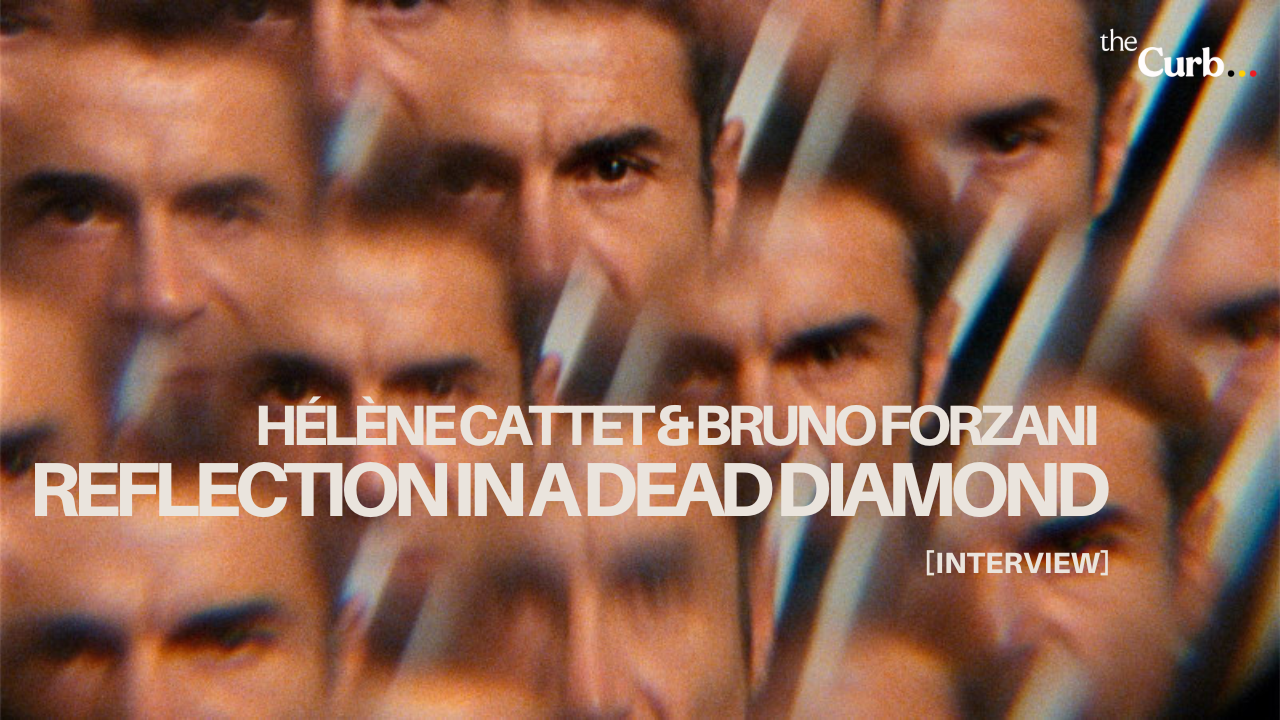
Hélène Cattet and Bruno Forzani are French writers and directors based in Belgium. They have made four films together: Amer, The Strange Colour of Your Body’s Tears, Let the Corpses Tan, and now the visual and heady Reflection in a Dead Diamond.
Reflection in a Dead Diamond concerns an ageing actor, John Diman (Fabio Testi) or perhaps and ageing spy, who is staying in a luxury resort on the Côte de Azur. John D’s identity is beginning to collapse as he can no longer tell what is memory, movie, or reality. Hélène Cattet and Bruno Forzani weave the story of the young John D (Yannick Renier) and his role/missions playing the Bond-like spy. Plus, his nemesis Serpentik (played by a series of different actresses) who is perhaps still close to him and trying to finally put him to rest.
The film is a wonderful paean to 1960’s Eurospy thrillers and exploitation films where desire, delusion, and delirium overtake the psyche of an old man in what are perhaps his final days. The film is replete with stylised visceral violence, unforgettably stunning imagery, and a sense of the phantasms of a fantasy world that never existed.
Nadine Whitney spoke to Hélène Cattet and Bruno Forzani about their work which she first saw at Melbourne International Film Festival and is now streaming on Shudder.
Screening or Streaming Availability from JustWatch:
Hi Bruno and Hélène. Thank you for what is now my fourth film with you as directors at the helm. Reflection in a Dead Diamond reflects your continued interest in giallo, but also, a very specific form of giallo, the kind of Eurospy exploitation. like Danger Diabolik and Bond films. Also, the interchangeability of both the protagonist and the women involved in the in the films generally. Can you talk to me a little bit about what made you interested in in taking on this subject and so beautifully as well?
Bruno Foranzi: Thank you. Well, there are a lot of subjects in the movie when you talk about the character who change faces. For me, it's more linked to Hélène and me, because we have worked together for a long time, and we try each time to know what is in the head of the other. We have realised that in all our movies the characters were always to trying to enter the head of the other, to enter the body, and to see what the mystery is of the other.
And after the idea we had was about a statement we had in our life where we try to change the world from when we were little. When you are child you think you are hero, you are going to save the world. And we try our best every day in our life, but in fact, it's complicated. We don’t really achieve it, even if we do our best. And so, as the like the spectator we can't. We don't manage to be the actor. To express that, the best character for us was James Bond, this super spy. The character of John D who has been trying to save the world for decades but destroys it.
Serpentik (one version of her) says to John D essentially you were my greatest enemy. Because no matter what my plans were, my evil plans, you did more damage. These spy characters are actually upholding the order of a broken world and corrupt world even when there's so much set in fantasy. They are personifications of regressive governments and regressive regimes.
Tell me a bit about building up the visual language of the film, because it's very Mario Bava in in a lot of ways. I know that you are fans of certain Italian directors, because I've seen it in your other work. Can you tell me about drawing the line between homage and creating something new for yourself.
Hélène Cattet: We are very attached to that way of working like Mario Bava, because it was very crafted. And in our film, Reflection in a Dead Diamond the dead diamond could be several things. It could be, in a way, a certain kind of cinema that existed in the 60s, that was very artisanal and crafted, that doesn't exist anymore. For instance, this Eurospy, this James Bond spoof. They were made with little crews like four people were traveling around the world, and each time they go in a country, and there is someone inside this country with them, and you know, it was a unique way to make cinema. It doesn't exist anymore, and it's a way to make cinema without money, with a very little budget. That's why we are inspired by that kind of movie, because it's more like our situation.
BF: Yeah, we are not into blockbusters. And these movies, the Eurospies, they represented the world as very candy coloured, you know, very pop, very psychedelic. And when you watch them, you have a fake image of the past. Like, there was abundance, you can have what you want, you can do what you want. It was a fake image of the world. So, and to have this universe, it contrasts with today's world. It was interesting for us to have this starting point.
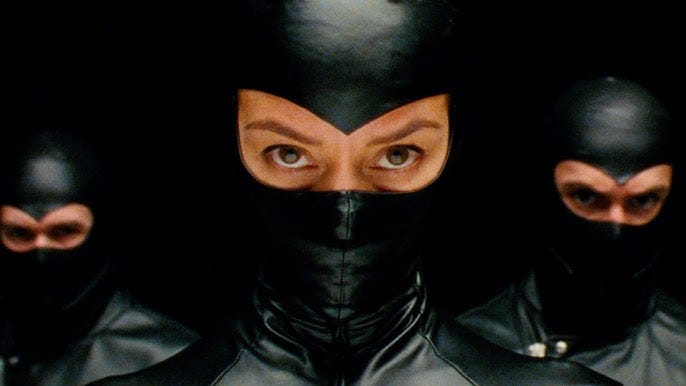

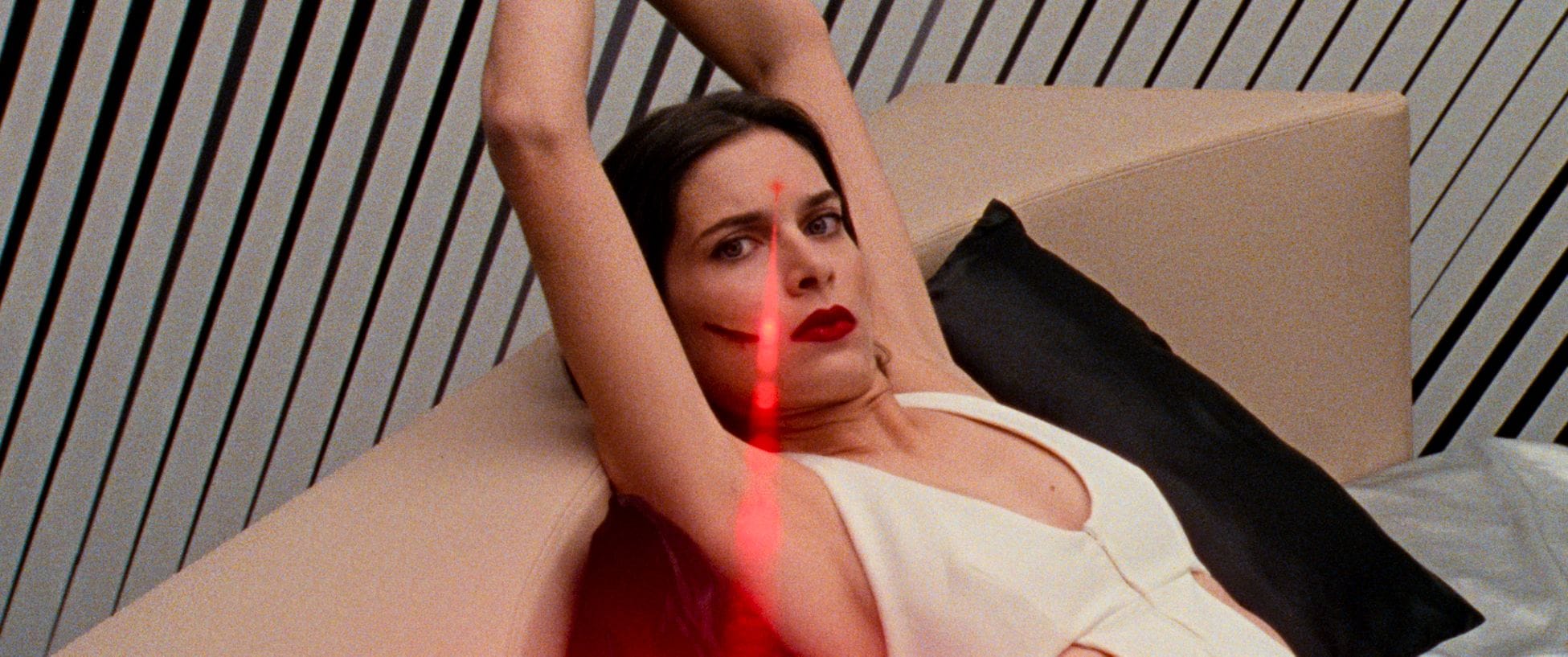
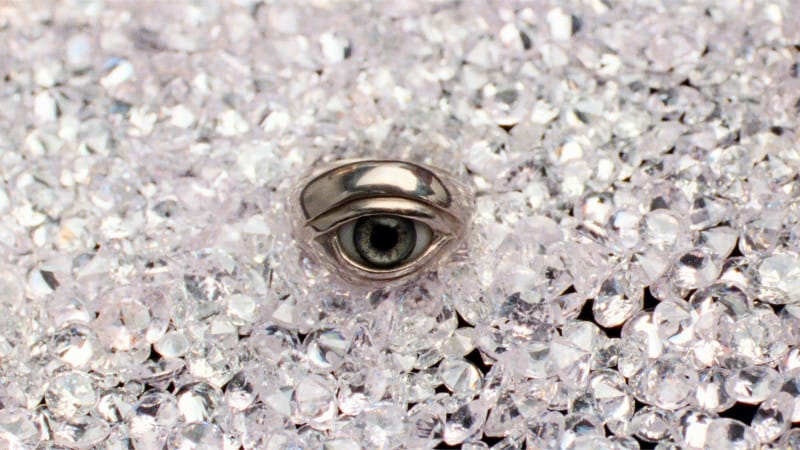
The film looks so beautiful. I said to my friend after I saw it in the cinema, “This is why people make movies, it’s why cinema exists,” because it is just such a luscious and incredible piece and breaks down the mechanics of cinema itself. It looks so good. How do you make things look so amazing?
HC: The subject of the movie is the illusion, and that's why we that's what we use to have out imagery. Because, in fact, when you don't have a lot of budget, and you want to do James Bond movie, you have to be really creative,
When we write the script we want to tell the story not through dialogue but through all the cinematic and cinematographic tools we have at our disposal. Because what is great with the cinematographic language is it's a universal language, and you don't have to lead the story just with dialogue, with lines, you can lead the story with the image, sound, the lights, the editing, the costumes. So, for us, every detail is very, very important, because we want to give them a meaning to tell our story. To speak about the character not in a didactic way, but in a very intuitive way, subjective way. To speak to the audience’s intuition, to the sensual body. We try to have, a very physical experience. And I think you can have it in the theatre because you have a big image and the sound you is very loud and enters your body.
It is such a sensual film in in all the versions of what that word can imply. It has that sexuality and sensuality of the time, but also it is a feast for the senses. You were talking about the editing within the editing you are placing images upon images upon images. But each of those images I found had meaning. So, from the pulp comics through to the images of making the original films, to the original films themselves, and then to the memories of John D and what could be his reality at now.
BF: Thank you so much. It has been a lot of work to do it and thank you for your feedback. It was very intense to make. I think it maybe it's because of the sound too, because I think the sound is 50% of the movie, because we really work on for almost six months because we shot without direct sounds on the set. So, it's like an animation movie. It’s in post-production that we recreate everything with the foley guy and with the sound designer. We are really precise, and we really try to be sensorial, because it plays really with the subconscious. You know, you can replace a sound. When you touch a wall, you can put a sound of skin, and the audience doesn’t realise it, but it makes something very unconscious and sensorial.
Bava and other Italian greats did make films with post sound.
BF: Exactly. We're working exactly the same way.
Reflections in a Dead Diamond has a plot that's immediately logical. John Diman is here and now. But we don’t know exactly what's happening to him. It's all something you've created by mood.
Is there anything you'd like to tell me about your experiences of making film? I see you have Maria de Medeiros in it, and she's been an actresses who I've just always wanted to see more of. Can you tell me about working with her?
BF: She’s so charismatic. She really has a presence which is very strong and very timeless. Maria was really perfect, because she's mysterious. We really wanted for this character. She was very nice, very sweet. And, yes, great to work with
She’s a beauty. She is such a beauty. It's like Elina Löwensohn, who you've worked with as well. These incredibly beautiful and enigmatic women through all the ages of their lives.
How did you prepare your actors to take on these very fractured roles?
HC: When we write the script, each character or each element can have several meanings, several way to be for the actors, we explained them what they could be inside a sequence. They could be severe, or gentle.
We explained to Maria she can be several characters. Maria, for instance, with each take we would say this take it's for this meaning, this meaning, this take, it's for the other meaning, and things like that. And after the editing, we mix all these meanings to try to build the mystery.
BF: As we don't shoot with direct sounds we can talk to the to the actor during the shooting, and it's like, if they were like under hypnosis, you can talk to them, there is light, there is a special atmosphere, and it's, it's great to for them, I think they like it.
Perhaps you are versions of the super villain who hypnotises to make a person think they're in a film, and you won't know until it says, “The End” [Fin].