Cinema Reborn is the brainchild of the venerable critic and programmer Geoffrey Gardener which has over the past few years become a must-see retrospective film festival taking place in Melbourne and Sydney. The Cinema Reborn team gets larger and more enthusiastic every year and provides a window into the underseen and the masterpieces of world cinema.
The 2026 program includes feature films from Satyajit Ray, Catherine Briellat, Marcel Carné, Todd Solondz, Charles Burnett, Luis Buñuel, Barbara Kopple, Tsui Hark, Howard Hawks, Ernst Lubitsch, Miklós Jancsó, Michael Mann, and many more.
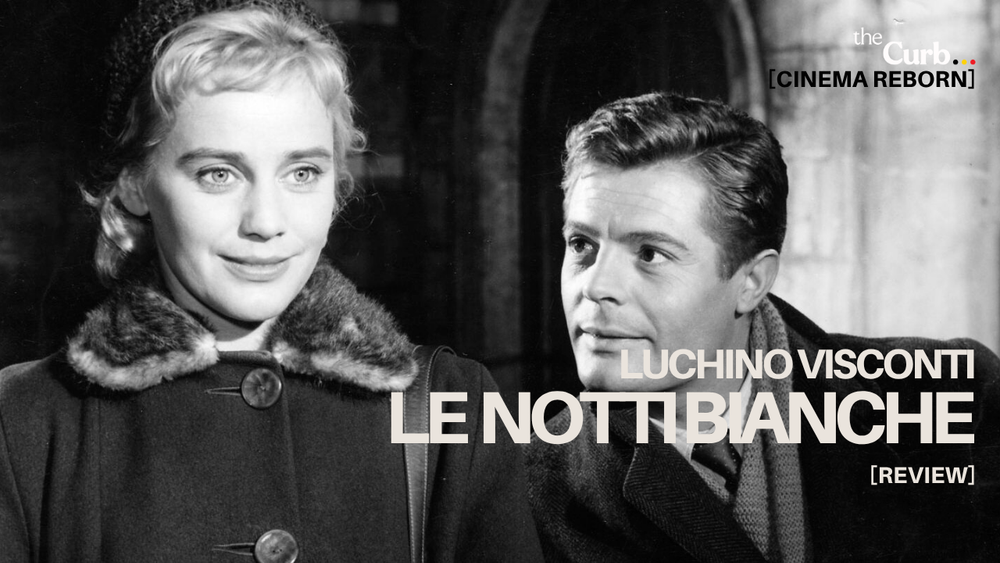
Nadine Whitney picks a few of her favourite films in the line-up to write on beginning with Le Notti Bianche (White Nights) from 1957 directed by Luchino Visconti.
Luchino Visconti found himself at a cinematic crossroads in the mid-1950s. The left-wing neorealism of his earlier films no longer held as strong an intellectual hold in the contemporary political climate within Europe. His audience was disappointed by the Garabaldi-era Senso (1954) which used the tropes of historic melodrama in Technicolor. Although now acknowledged as one of Visconti’s finest films contemporary audiences were less enamoured and he was restricted from distributing the film in territories such as the United States because of his membership and history with the communist party. Despite winning awards and being nominated for the Golden Lion at Venice, Senso was widely considered a flop.
Despite the muted response to Senso Visconti was finding success on the stage and especially with opera. However, when it came to what would be his next film there were expectations for a “return to neorealism” which Visconti defied when he made the fairy tale like romantic melodrama Le Notti Bianche set in what was an artificial stage-built version of Livorno. Le Notti Bianche is an adaptation of Fyodor Dostoyevsky’s 1848 romance story Belye nochi set in the summer in St Petersburg. Visconti, along with writer Suso Cecchi d'Amico transposed Dostoyevsky’s work to an Italian winter and the 1950s – allowing for some social commentary to peek through the light fantastic elements of the film.
Mario (Marcello Mastroianni) is a lonely white-collar worker who has recently been transferred to Livorno. At nights he has the habit of wondering around the cafes and over the bridges near his boarding house room. One night he witnesses a waifish young woman (German actor Maria Schell) standing alone on one of the bridges. At his approach she flees and is almost hit by a motorcyclist whose group start harassing her. Mario intervenes and is struck almost immediately with grand romantic impulses towards the bright-eyed but fragile blonde. That evening he does everything he can to convince her he is trustworthy and only wants to gallantly accompany her to her home and enjoy the small amount of time he has with her while carrying that out. The young woman, whose name we later find out is Natalia, reluctantly eventually accepts and the two find a rhythm of conversation. She accepts his proposal that they meet the next night to walk around once more before she must go to an appointment. Thus begins Mario’s brief but intense one-sided romance for a woman who promised to wait for another.
Le Notti Bianche is a stunningly beautiful story of yearning and loving beyond what outsiders would deem reasonable. Natalia who lives with her blind grandmother mending rugs fell in love with a nameless lodger in her grandmother’s house played by the inimitable Jean Marais. The older and urbane man returned her love but mysteriously had to leave Livorno for a year but made the promise that he would return for her as soon as he could. Natalia braves the cold waiting for him in the spot they chose and night after night he doesn’t come despite his being back in Livorno. Could the down-to-earth Mario be the man who brings her into reality with present devotion?
Visconti’s film is one of the first times he found his key collaborators. The lauded cinematographer Giuseppe Rotunno who would later work with Visconti on Rocco and His Brothers and The Leopard (and have a solid working relationship with Frederico Fellini and a career in Hollywood) shot the majestically lit and composed soundstage. Production designers Mario Chiari and Mario Garbuglia brought to life a beguiling “metaphysical Livorno” which seemed to bisect on the bridge where Mario and Natalia met. On one side there is a street filled with neon signs, bars and cafes. On the other is the space of hidden doorways and underpasses where Natalia lives. To enter Natalia’s side is akin to walking inside something almost untouched by modernity, whereas Mario’s side is a representation of contemporary life with crowded streets with people taking advantage of a vivid nightlife.
Visconti works with this bifurcation to question whether Natalia’s dreams are delusions that can’t exist in the modern world. A promise for a lover to return although he didn’t contact her for a year seems unlikely to be fulfilled. When Natalia enters Mario’s world she is enchanted by experiences she hasn’t considered for herself: dancing with a group of young people to Bill Hayley and his Comets, being accepted and appreciated by people of a similar age to herself, having a guide who honestly would do anything to make her happy.
Visconti also doesn’t forget that at the intersection of both worlds is poverty. Under the bridges people sleep rough. A lonely and disenchanted streetwalker (Clara Calamai, who played the protagonist in Ossessione). Violence and disenfranchisement aren’t erased even by the unexpected snow falling while Natalia and Mario borrow a boat and float down the waterways.
The tension between reality and romantic ideal is the engine of Le Notti Bianche and both Natalia and Mario have their moments of clarity and their moments of fantasy with the greatest fantasy being that Natalia will grow to love Mario as much as he does her after she concedes that perhaps the lodger will never come.
Some might consider Le Notti Bianche a minor Visconti when making the comparison to The Leopard, Death in Venice, The Damned and other more recognised masterpieces. However, Visconti is able to back up what at first blush seems like a slight story with brilliant performances by Maria Schell and Marcello Mastroianni, who was not yet the quintessential Italian actor and was second on the bill to Schell. Of course, Jean Marais, the leonine beauty of Jean Cocteau’s films and an intoxicating leading man, only need stand in a room for his presence to be lauded. Visconti masters atmosphere, with the artificial set becoming a heightened idea of a place for the lonely and lovelorn. The film also won the Silver Bear in Venice proving that Visconti could switch modes and remain a cinematic visionary.
Le Notti Bianche is more than a bridging film filling in a gap between one filmic style and another. It is melancholy and magical, uncovering the inner lives of those who love without reserve and connect with the desire for perfect happiness. A profoundly romantic classic.
Director: Lucino Visconti
Starring: Maria Schell, Marcello Mastroianni, Jean Marais
Writers: Fyodor Dostoyevsky (source story), Lucino Visconti, Suso Cecchi d'Amico
Cinematographer: Giuseppe Rotunno
Score: Nino Rota