
Although Dateline NBC’s ‘To Catch a Predator’ only ran segments for three years, Chris Hansen became a phenomenon in the reality television world. ‘To Catch a Predator’ set up sting operations in conjunction with an online watchdog organisation Perverted-Justice and with local police to bait and film potential paedophiles (predators) as they arrived for assignations organised through internet chats with children they believed were as young as twelve or thirteen. Cancelled in 2008 after the suicide of one of the targets, the series had a second life when it was uploaded to online platforms.
In his first fiction film Lance Oppenheim creates a character study of Chris Hansen as he vies for premium primetime status. Primetime is a suffocating journey through a glass darkly as he chronicles Chris Hansen’s (Robert Pattinson) ambition, recklessness, and his belief that he was fighting evil incarnate. The ends justify the means for Hansen and his tough-as-nails producer Andie Bender (Merritt Weaver); yet the ends by 2006 seem more to be about ratings than actual justice and convictions for the predators of the title.
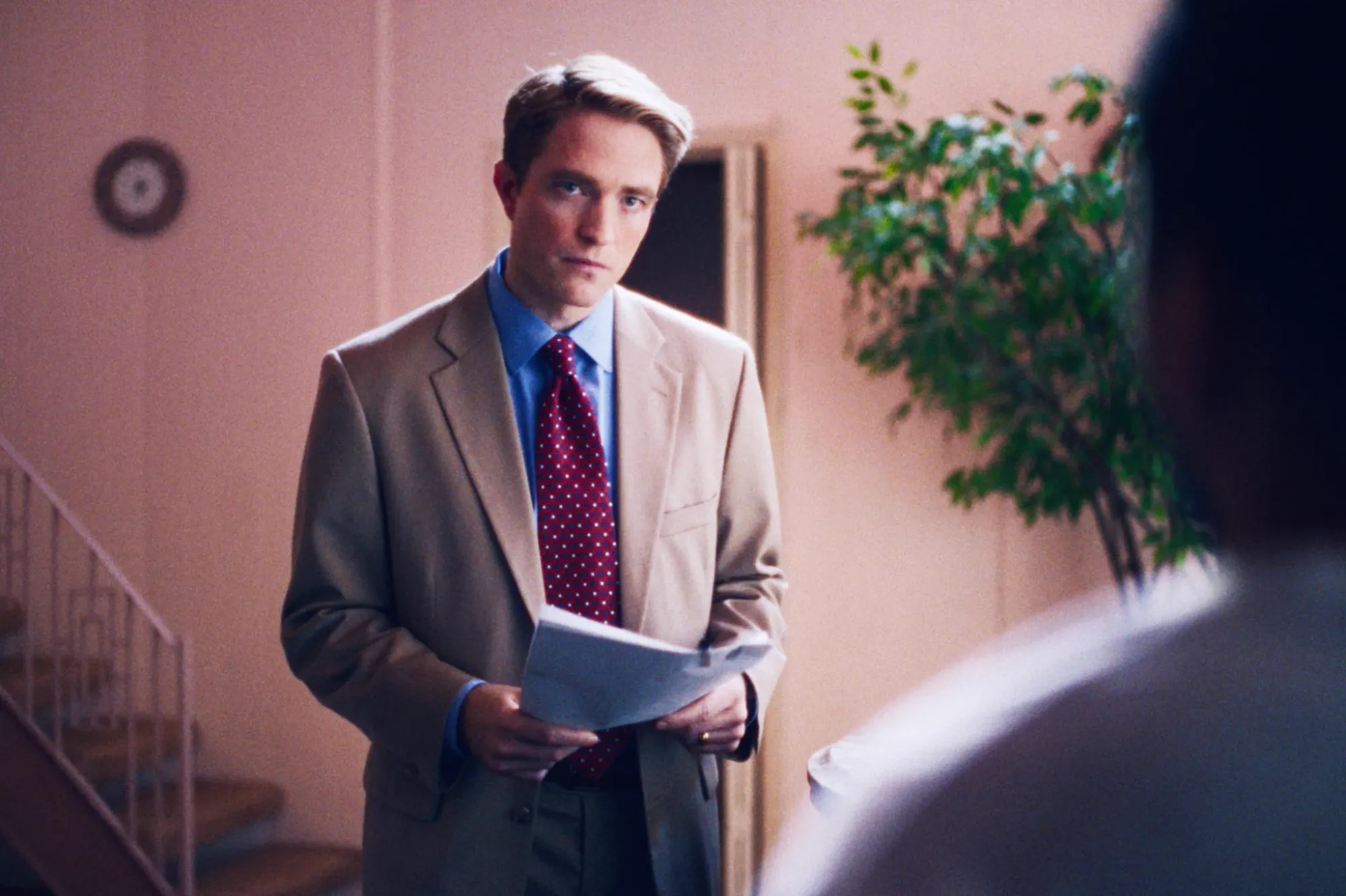
In what is already an unsettling story, the makers of Primetime lean in to what it takes to connect with hungry audiences in the States who want their crime and punishment meted out on their television sets. Cinematographer David Bolen utilises a series of different film and video formats. Extreme close-ups on Hansen as he practices the lines he will read out from chat transcripts with the predators. Canted angles, neons, the glow of a television set as Hansen wakes his two young sons to watch one of his episodes. Cameras looking down cameras. A hall of mirrors where good and bad become unstable funhouse reflections.
The point of view shifts to a young actor, Dan Plum (Skyler Gisondo) whose boyish looks make him perfect to play one of the decoys who invite a potential predator into the rented homes that act as the set for ‘To Catch a Predator.’ Naïve and easily led, Dan the Decoy becomes a sounding board for Hansen’s musings. Dan didn‘t know what exactly he signed on for — mostly he just wanted enough credits to get a SAG card — and he becomes swept up in Hansen’s righteousness. His co-decoy Del Harvey (Phoebe Bridgers) was already a part of the Perverted-Justice group led by Xavier Von Erck (Matthew Maher) but as the show becomes more about Chris Hansen and his need to find bigger predators to take down, the young woman feels that justice is becoming entertainment and bound to ratings.
Dan, still in thrall to the idea that he’s helping Hansen defeat ”an ancient evil” is pliable: but as Hansen’s journalistic ethics retreat and a cult-of-personality takes over he becomes less of a person and more of a puppet until ultimately tragedy strikes and he’s haunted by his wide-eyed seduction into exploitation.
Primetime could not exist without Robert Pattinson’s uncanny transformation into Chris Hansen. There’s no sense of mimicry in Pattinson’s performance, rather he is the dark reflection of vaunting ambition coupled with an almost evangelical belief that he’s saving children. Pattinson‘s work is a tour-de-force that implicates not only Chris Hansen in ushering in the voyeurism of true-crime reality television, but the audience who waited for the charming, calm, all-American man to deliver his catchphrases and deliver men to the police.
In retrospect it might be easy to put a distance between yourself and Chris Hansen, but Lance Oppenheim complicates distance by creating a sense of claustrophobia. Of course no one wants paedophiles and predators finding new ways to exploit and harm teens — the justification for what Hansen and his team did rely on that fact. But did you watch them? Did you think it was right? Primetime asks the uncomfortable question, “Did you get what you wanted?”
Nadine Whitney speaks to Robert Pattinson about Primetime and Chris Hansen
Nadine Whitney:
I wanted to ask about your version of Chris Hansen. He doesn't seem to know when to stop performing. In a lot of ways, he's performing for Dan — in some ways seducing Dan into that world. Do you see your version of Chris as a seducer and manipulator as well?
Robert Pattinson:
I don't think so. You want to be a hero, and you want to cast yourself as the hero. You can work really hard, but every single hero in history, there's been a ton of people who said, "You're not a hero, you're an asshole." What I found interesting in the story is that you're trying to do the right thing and you don't understand why you get criticised, because you think, “I'm doing the right thing, so I should be somewhat protected from judgment” I think that's born out of insecurity a little bit as well, which is why a lot of people are drawn to being on camera.
Even when you break down what he's (Chris) actually doing in the movie, nothing he does, I don't think anyway, is particularly bad. On a macro level, he's doing what he's supposed to be doing. He's thinking, I'm supposed to be making a TV show — that was my remit. That's what the network told me to do. I'm supposed to be making a hit show. I am a TV presenter. And suddenly the basis of your job shifts into a totally different area where you're being judged on a totally different set of rules, so you're scrambling to figure out what the new rules are. At the same time, you're thinking, I've won the game I was playing before — I've made a hit show — but suddenly this massive amount of other problems have opened up, and you wonder, is this what happens when you get a hit show? Suddenly it's way harder to live your life, like everyone's against you.
In some ways I was trying to play a naivety to what he's doing. Even with the scene with his kids, in some ways it's really dark, but in some ways there's an innocence to it. He's just really excited about showing the show. And I was trying to play it so that it's sort of funny — in the same way that in the original show, when Chris comes in and does a one-liner, I don't think he's trying to be glib. He's probably doing it for his crew and the audience, thinking, I think this would make good TV.
There's an innocence to it, which, when it's looked at in a different context, suddenly someone says, oh, that's somewhat nefarious, and then he has to respond to those accusations, and you mutate yourself in your intentions. You think, I didn't intend to do something bad, but now everyone's saying I did something bad anyway, so now I've got to constantly redirect myself. I found that really interesting.
But I think his manipulation is the same with Dan. Dan wants to be on TV, and in some ways when he's saying, "You remind me of my son," I think he does. I think all of this is like saying “you're honest in the moment.” And I think he's that kind of guy.
In some ways there are exaggerated versions, but it's an odd performance. As we were researching the script, what I became fascinated by was the fan base of the show — why they focused on individual lines and moments, and what it was about these things that elevated them into having iconic status, when I'm sure Chris Hansen himself did not intend for them to be big moments that people would be watching 20 years later. So I'm trying to play the fans' interpretation of him, if that makes sense. It's not really a caricature, but it's also not fully real life. It's a portrait, I guess, of multiple different perspectives on the same person at a moment in time.
The strange thing about the show originally is that people watch the same episodes tons and tons of times, and people quote the lines and know these moments as if it's a movie. That's really unusual, and really unique to this show in particular. But I don't think they felt necessarily better about themselves. It's like anything that makes good TV — you'll never be able to see that kind of raw human emotion in an extremely short period of time. You see someone come in wanting to do a sick thing, and in a second it's completely turned around on them and they're caught in a trap, and you see the fear and them trying to do anything to get out of it. In terms of dramatic stakes, I can see why it's a huge hit TV show.
But it's one thing watching one episode; when you watch a bunch in a row, I don't know if anyone in an audience will feel good about themselves. It makes you feel crazy, watching it again and again. You start to question, is this what reality is? It's such an odd feeling. After a while, the entertainment value starts to rub off, and it goes full circle, and you're like, why am I watching this?
Director: Lance Oppenheim
Screenplay: Arjon Singh based on an article by Luke Dittrich
Cast: Robert Pattinson, Merritt Weaver, Skyler Gisondo, Phoebe Bridgers, Alex Winter
Cinematography: David Bolen
Editor: Daniel Gerber