
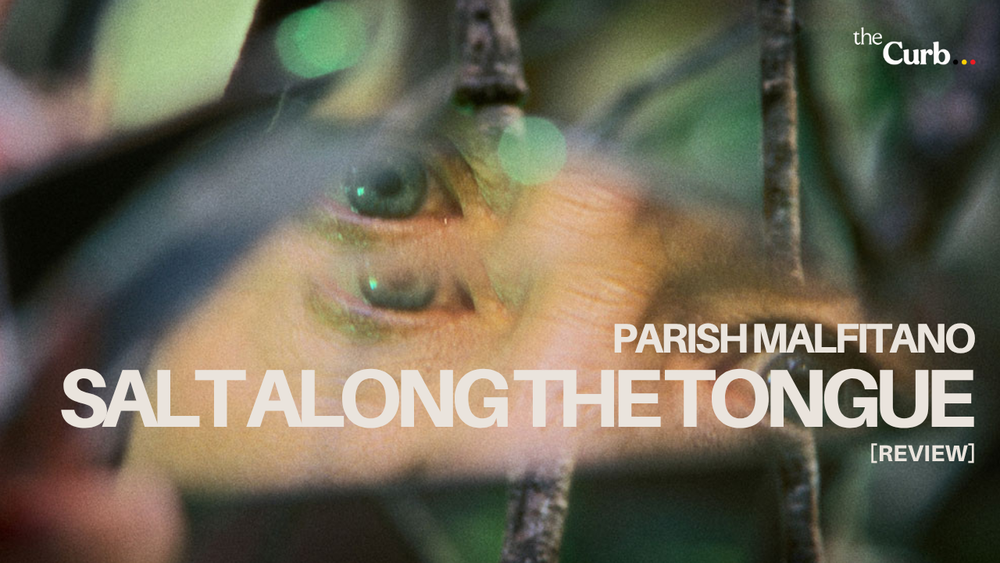
Parish Malfitano’s horror/melodrama Salt Along the Tongue is made in Australia but its bones are European. Specifically, the bones are primarily Italian, but Malfitano extends the film to the many nationalities who inhabit modern Australia and bring with them traditions and beliefs. A sensorial dreamscape that’s rooted in the body through curses that rot and desecrate the feminine. Corporeality is vulnerability for people who birth, bleed, and are penetrable by malign intent. Such bodies are more at risk when they are positioned on the fringes of the social order with their otherness defining their identity. Yet, the otherness means a community of similarly placed persons who might bond and form a coven celebrating difference and defiance against the dominant order.
Mina (Dina Panozzo) and her teenaged daughter Mattia (Laneikka Denne) live contained lives. Mattia is a target for school bullies and Mina makes a small living by selling fig preserves on a roadside stall. Other than a heavily pregnant Japanese-Australian home economics teacher Yuma (Mayu Iwasaki) they appear to have no friends nor support. Mina tenderly cares for her daughter who presents as much younger and more fragile than she is. Mattia comes to life around her mother in a way she can’t in public. When Mina dies suddenly (hiding blistered legs and a dangerous amount of bleeding) Mattia is claimed by Mina’s estranged twin sister Carol (also Panozzo) and taken to live at the family home outside of the city. Mattia’s arrival is watched by strange eyes that stalk her around the house. Something is disturbed by her presence and whatever it is does not wish her kindness.
Carol is a very different woman to Mina. She’s brash and bossy with her partner Anika (Caroline Levien) and central to the ‘coven’ of queer women who film her cooking show “Cooking with Love.” Carol houses Mattia in the bedroom she used to share with Mina and brings the shy teen on to the cooking show where she discusses the symbiotic relationship between the wasp and the fig – a relationship that is accidentally ingested by Mattia when Carol gives her a spoonful of a fig jam made in honour of her mother. The twisting of Mina’s legacy and the legacy of the house where she grew up will have repercussions on Mattia who becomes a locus for hidden trauma.
Salt Along the Tongue is a spellbinding genre piece about the necessity for truth to exorcise the darkness. Although the film wears the skin of a ghost story, a possession story, and a tactile witchcraft tale using the Italian Folk Catholic belief in the maloccio (the evil eye), it is at its heart a story about mothers and daughters. Malfitano certainly has a canny eye for the horrific and leans into the hazy and richly coloured world of Italian horror maestros Bava and Argento. Here there be witches who make spells out of hair, salt, oil, and garlic. The witchcraft of the garden and the kitchen practiced by Nonna Rosia (Maria de Marco) who has violently defended herself from the curses of jealousy and envy. The kitchen in the film is a space of nourishment and of tradition, but it is also a place where connection can become sour and competitive.
Parish Malfitano has brought together an astonishingly accomplished crew with Susan Lumsdon’s camera capturing a rich palette of colour and expression that makes the film seem distinctly European despite its Australian setting. Ola Turkiewicz’s disorientingly beautiful score beguiles the audience and opens further the sensual nature of Malfitano’s world. Characters eat together sharing cultures and sometimes synthesising the act of eating as one of immediate connection. Comfort, care, and community exist in tandem with the bitterness of truths denied and swallowed down. It’s a dizzying concoction of symbolism and feminine spaces where the intrusion of something that stops the tongue becomes a blight.
Salt Along the Tongue is elusive. Some connections become weighted with significance that only appears on a second viewing. It’s a puzzle that refuses to simply give up all its parts. Yet, even with the feeling that we haven’t recognised all the film is telling us, there remains a strong core of the familiar. A heady and frightening coming of age story that lingers and whispers.
Director: Parish Maltifino
Cast: Laneikka Denne, Dina Panozzo, Mayu Iwasaki
Writers: Parish Malfitano
Cinematographer: Susan Lumsdon
Composer: Ola Turkiewicz