
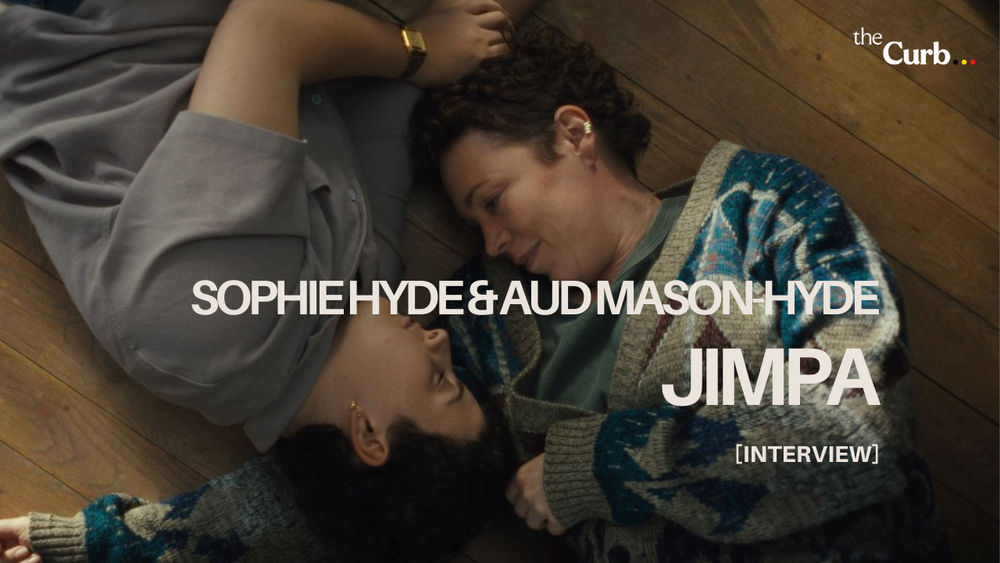
Sophie Hyde's films have often explored identity, self-realisation, and the path to finding your place in this messy, mucked up world. 52 Tuesdays sees a child growing to understand the gender transition that one of her parents is going through, while Good Luck to You, Leo Grande sees Emma Thompson's 55-year-old Nancy reclaim her sexuality.
In Jimpa, Sophie's finest and most mature film yet, we follow Aud Mason-Hyde's Frances, child to Olivia Colman's Hannah and Daniel Henshall's Harry. Frances is finding their place in the world as a nonbinary queer kid, eager to push out of the restrictive boundaries of Adelaide and engage with queer culture that they feel part of and as if they can grow within. A trip to Amsterdam to meet Hannah's father, Jim (John Lithgow), has Frances feeling that his proudly gay lifestyle and advocacy for gay rights would make for a suitable place for them to spend a gap year, growing, learning, and studying.
While on the surface the narrative for Jimpa feels like a familiar coming-of-age story, the end result is quite different. In Sophie Hyde's direction, time and history is compressed and then expanded, like a relaxed exhale, as we experience Jim's history and Frances' future. Through glimpses into the past, we're invited to see the youth of Jim, his fellow gay advocates and friends, and other characters that we meet along the way. In these moments, we see that history is not a linear journey, but rather something that plays out like a kaleidoscope, shifting and bursting with beauty, brilliance, and divine glory all at once, (go on, throw that one on the poster), while equally so, harsh images flit forward, hinting at oppression and the loss that many gay folks experienced during the peak of the AIDS crisis.
Jimpa isn't a film that wishes to explain gay history or lesbian history or trans history or nonbinary history to you. It's not a history lesson of a film. It assumes that you have an understanding of the various fights for equality and rights that have occurred over the decades, and in that understanding, there's a communication between groups that fall under the rainbow banner. Gay rights gives way to trans rights which gives way to nonbinary people feeling more comfortable in letting people know what their pronouns are. Yet, underpinning that is an acknowledgement of the pain from fighting that people like Jim went through to secure gay rights, and allow the rest of their queer siblings to be accepted as proud individuals.
There's a subplot within Jimpa which sees Hannah exploring the possibility of creating a film without conflict; a narrative without drama if you will. Jimpa attempts to get to that point of being a narrative without conflict, but along its path it encounters history and the way that time doesn't change everyone. Or, rather, time doesn't give everyone a chance to change enough for them to keep up with a rapidly changing world. In an early moment, Jim challenges his gay friends and Frances that bisexuality doesn't exist. The friction that Frances experiences then shows them that their grandfather, or as they call Jim, Jimpa, isn't a perfect being. He is human after all.
There's a tender beauty to this film, one that I'm so grateful I was invited to give myself over to. Performances across the board are impressive, with Olivia Colman giving Aud Mason-Hyde the space to grow and explore their character on screen. There are moments in this film that, in reflection, move me so immensely and deeply, and they're moments that are driven by a parents desire for their child to feel safe and accepted in this world. That this film is a collaboration between said parent, Sophie, and said child, Aud, is a testament to their strength and abilities as a family to be free and open and supportive of one another.
In the following interview with Sophie and Aud, we talk about that kaleidoscopic nature of the film, what it's like to grow up with a parent like Sophie Hyde, and finally, what it's like to have a story captured on screen by the stunning cinematography of Matthew Chuang.
the Curb is a completely independent and ad free website that lives on the support of listeners and readers just like you. Visit our subscription page where you can support our work from $2 a month. Paid subscribers get access to our monthly competitions, exclusive interviews and articles, and more. Follow us on Instagram, Facebook, and Bluesky.
Screening or Streaming Availability from JustWatch: