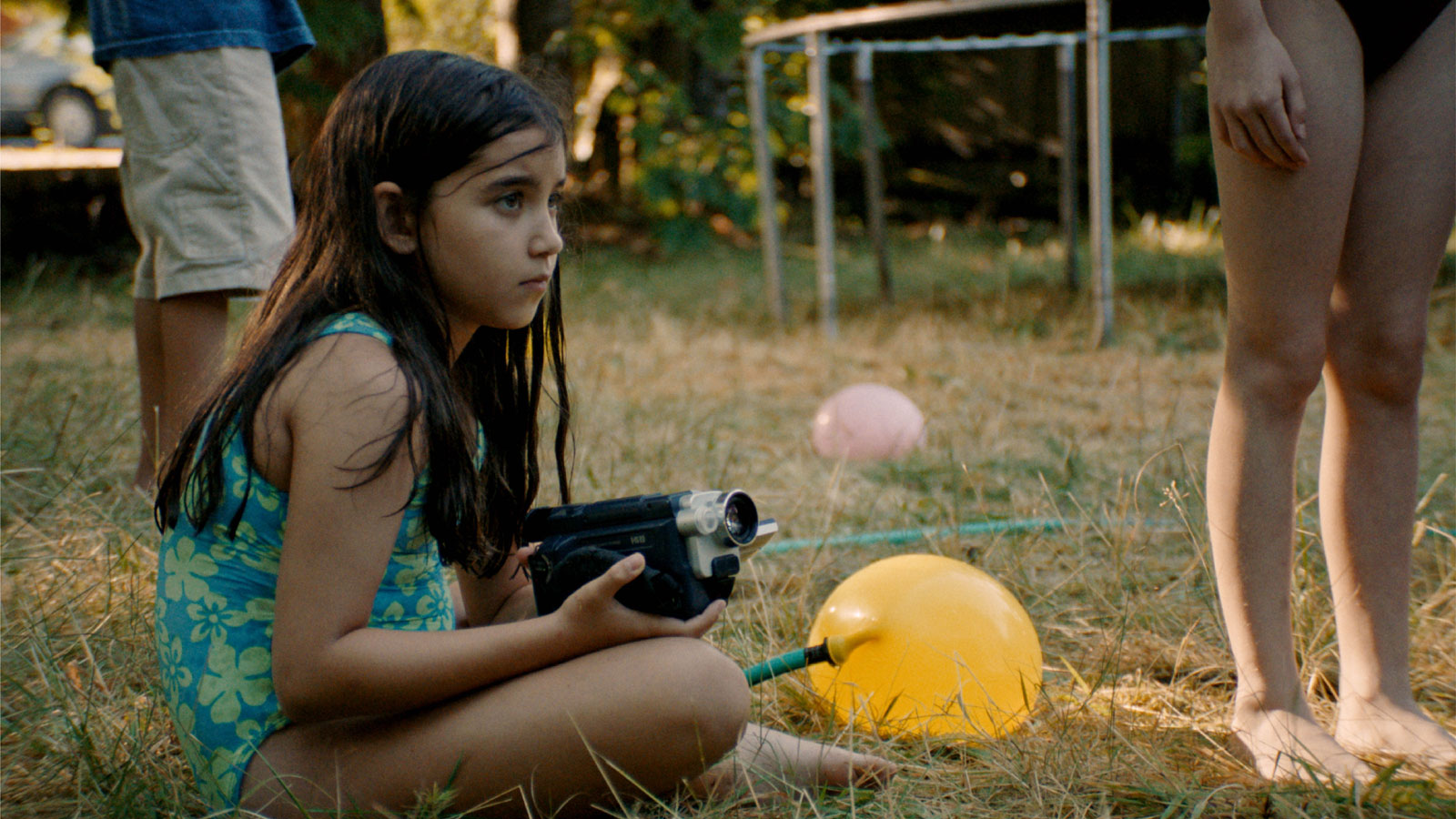
Blue Heron is a tribute, a confessional, and a reckoning with Sophy Romvari’s childhood experience watching her parents trying to cope with her eldest brother and his strange and antisocial behaviour. Split between two time periods we are introduced to Sasha at the age of eight and then Sasha as an adult attempting to make a documentary about her brother Jeremy and his essential unknowability. If you have seen Sophy’s short documentary Still Processing you will be aware of how much of the film pulls from her experience as a child on Vancouver Island and her complicated grief surrounding unthinkable losses for herself and her parents. Even if you are unaware of how much of Sophy’s memories form the narrative of Blue Heron, it is an undeniably moving and raw experience – a pieces that pulls at the halo of memory and the hopelessness to act.
Nadine Whitney spoke with Sophy about Blue Heron which is part of MIFF 2026 and in competition in the Bright Horizons category.
I don't even know if I need to add my congratulations to you for the film because it has been so thoroughly embraced by audiences and the critical community. Everyone I've spoken to is very moved by Blue Heron watching an impossibly tangled situation witnessed through the eyes of a child that even when she comes back as an adult realises the inevitability of what occurred. I have seen Still Processing, so I was kind of aware of the intensity of what was happening, but to see it in action is something else.
Because a lot of your work has been documentary in nature what made you decide to work this story as a fiction film?
Sophy Romvari: First of all, thank you so much. That's such a kind introduction. I'll just jump in. The documentary form and the fiction form for me are quite integrated. I don't really differentiate between them that much. I find they're just different approaches to getting different results, and so for me, the fiction format for this film felt important because it was the film ultimately became about the limitations of trying to depict somebody that really existed, and there's no there's no way for me to do that in documentary filmmaking. I find it's all a construction, and so all of it is a bit of an admission of the failure to be able to do that.
I think fiction is a better format for that because it allows you to admit those limitations but still create something that is very vivid and relatable for people to actually witness and experience. I had I had worked in sort of more documentary leaning approaches before, you know, when I'm often present in those films, and I felt I had explored that already. Fiction felt like a more significant way to untangle some of those ideas I had cinematically.
You’re taking it from the point of view, essentially of an eight-year-old, and then as an adult coming back. When you're talking about limitations that of depicting a person who existed, a child is not going to quite understand the enormity of what is happening around her. So, can you tell me a bit about how you created young Sasha’s point of view?
SR: It was important for me to have the point of view be from someone who was an unreliable narrator, but was still impacted by the surroundings, and I think that's many people's experience. You know, we're all as adults trying to understand what shapes us and how to learn from that and how to best grow from that, and I think some of that some of that is really helpful, but some of it is also accepting the limitations of not being able to understand everything.
I think I was curious about using film as a way to uncover that trajectory, and I think I've seen many films that tell this story from the perspective of the Jeremy character or of the parents, but I had never seen it from the perspective of sort of a bystander and how that impact still looms in a person's adulthood.
Trying to focus on that was a challenge because it's not the traditional perspective, and it and as you pointed out, it's sort of unreliable in a way. That was an interesting challenge for me, and I and I'm glad that it was something that I felt strongly about. Because now I think there's there is it makes me feel there is room for those kinds of perspectives where that are a little bit more untraditional in film.
The immensity of what Sasha is experiencing is mixed up with just her everyday being. So, you know, there are times when you know Jeremy does something very dangerous, like it's walking on the roof, and Sasha's experience is, “Yeah, this is stuff that happens.” I think she's of bouncing off the feelings of her parents more than anything else.
Can you tell me about casting the parents because you are from a Hungarian family who moved to Canada. What was it like bringing actors of a Hungarian background into the work?
SR: I think I think what you just said is so accurate that Sasha is reacting to how her parents feel, and I think that that was an important element for me to show that what she's experiencing is normal to her because this is her environment and as a kid anything becomes normal if that's your environment. It’s only in retrospect that you start to understand things as an adult and so that the adult perspective in the film, the parents were really, practically speaking, carrying the load of the performance of the dialogue and such.
I knew that I needed actors that could tackle the nuance of the language elements, they had to be fluent in both Hungarian and English. They have a lot of complicated emotional stakes to show without it being very expository. So, Iringó Réti and Ádám Tompa deliver really delicate performances that I'm so proud of.
I cast the parents out of Hungary because that's where I was able to find those performers and the nuance, and I think it really elevates the film and the realism of the film as well. I'm really glad that I was I was allowed to have like the whole world to cast from.
The casting is incredible. The young actor who plays Jeremy (Edik Beddows) is just extraordinary because you don't know what is really happening with him. He stands apart from the family so often. and I imagine there’s Sasha's experience but also the experience of the parents who are trying to find an answer and trying to find help and saying, "Look, we're good parents, but we don't know what to do. How can we help our child?
SR: I think I wanted to have the film feel like it came from the perspective of the child, but then also doesn't really necessarily blame anyone for the scenario, including Jeremy and what he's going through and how he feels. And the social workers provide like a social commentary, but they're also not the villains in the story.
I think that I was really trying to create a story that reveals that there are certain things in life that are more complicated than we would care to admit. That doesn't mean that some people are beyond help and that we should just give up on them. It's just that we are faced in society with people that are not going to fit within the norms of what we expect, and people want there to be easy answers. I think that it can frustrate people that there isn't one. There isn't an easy answer for the reality of these characters or of people in real life.
You did a wonderful job of humanising Jeremy as a sibling, not just with you know the smiles and games, and the small gifts that he leaves for Sasha, but also those maps, those incredible maps show he’s taking in a lot of information and processing it through the maps. Can you tell me a bit about that?
SR: It's funny because the maps themselves are of places that don't exist, you know, they're fictional spaces. They're completely imaginary, and that's part of what I love about them. And they are they are my brother's (Jonathan) real maps. I think phenomenal works of art and insight. It felt completely in line with what I was trying to say in the film. Someone can have this entire internal logic that we don't have access to, and it's a beautiful thing. I wanted to give him as a character that sort of interiority that we still can't access, but it's his. It's entirely his own.
How difficult was it for you to kind of recreate the period of the 90s? Especially on a small like island setting where the physical differences are hard to hide.
SR: I was working with a quite a small budget, and so it really became about being intelligent about what we don't show as much as what we do show. I purposefully didn't include scenes that showed more than one car at a time. We had the one car, and we were able to try to isolate the car in the scenarios that we had it in. Or the computer, of course, that does a lot of heavy lifting for setting the tone.
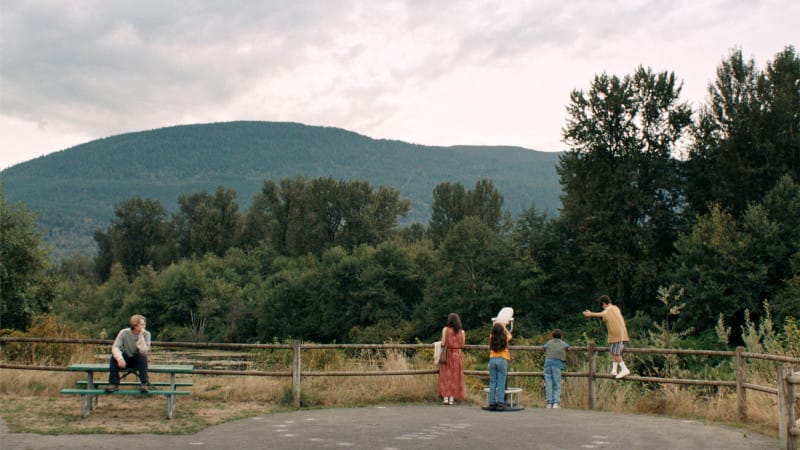
I was working with how do I limit the frame so that I'm not exposing the [contemporary] world around us, but undertaking to still make it feel like there's a real scope to the space that we're in. You don't want to just have like a shallow depth of field and only show very small areas of landscape because the landscape is very important to this film and Vancouver Island where I grew up and where the film is set, has this very stuck in time quality to it. When you go to the beaches and things like that, it really it could be any time. The costumes also do a significant amount of the work to land the period, and the music itself.
Everything is so detail oriented from every department, and every department really had to work together to make sure that everyone was on the same page about what we were trying to depict. And it's it was such a joy that by the end we were sad to leave that era and come back to reality.
Were you anticipating at all the kind of reaction the film has garnered?
SR: Definitely not. No. I wanted to make the film something that people could relate to and access, and you know, I want it to be the kind of film that someone can understand, even if they're not a cinephile or they don't have a background in film. I want it to be accessible, but also still challenging the audience a little bit with the form and the structure. But I really expected there to be more people who found that structure to be, you know, challenging in a way that took them out, or I was I was worried about those things.
Ultimately, it seems like every everyone really seems to be willing to go on the journey of the film, which is such a gift and such a validation, because I feel like I put my trust in the audience for that, but then they gave it back. So, it's you never know. You really, you really never know.
There is a beautiful reciprocity in it. You're being you know extremely honest, and the audience is accepting what you're saying and understanding the two versions: the adult version and the child version, and why the adult version wants to relitigate the past.
What would you like to say about the film? What is something you haven't said that you'd like to?
SR: It's a great question. I mean, I guess I had such a profoundly joyful experience making this film, and when I talk to other filmmakers, young filmmakers, independent filmmakers, so much of what we talk about is how do you make a film? Especially one that feels like the kind of film you want to make. I think it's such a challenge to do that because we're working with such limitations.
But I really I feel very strongly that we are when you are given the opportunity to make a film, you get to build your own world around it, and you get to build the environment that you shoot in, and I think I feel that I think that because I did that, it impacted the outcome of the film. Everyone enjoyed the process making this film. It was a very joyful and loving experience.
I am just glad that the film is being received as it is because it proves to me that you don't need millions of dollars. Like, if you're if you're smart about the budget and things, you can still do things ethically. You can do things with joy, and you can do things that are in line with your own vision. As long as you accept the limitations and allow yourself to work with people that are are bringing their own talent and their own expertise, it's such a gift. I just feel so privileged that I got to make this film exactly as I wanted to make it.