
There’s a moment in Sorry, Baby that lodged itself deep in my chest and hasn’t left. Agnes—played with aching restraint by Eva Victor—sits in the bathtub, alone. Her arms are crossed like armor. Her voice stays even, too even. Her eyes never beg, and the words she speaks come out hesitant, halved, almost afraid to land. It’s not a confession. It’s a quiet surrender. Watching her, I didn’t feel like a viewer. I felt like a witness. I knew that silence. I’ve lived in that stillness, too.
Sorry, Baby isn’t a film that “understands” its subject so much as one that sits beside it. It doesn’t dramatize or explain trauma; it traces its outlines. It doesn’t aim to resolve; it observes. And in doing so, it manages something rare: it mirrors the quiet, circular, often invisible ways pain lodges itself inside a person. Not in grand gestures, but in glances. In awkward silences. In what isn’t said.
The story isn’t about the event, but the wake it leaves behind. Agnes, a once-promising academic, now lives in the same sleepy New England town where the Bad Thing happened. The film never shouts what occurred—because real life rarely does. But slowly, through elliptical fragments and gently placed clues, we learn: her advisor, a man once held in esteem, crossed a line. Maybe more than one. And as is so often the case, the world kept turning.
The institution offered no resolution. The man stepped down quietly. The college shrugged. The medical system failed to hold space for her. Even the language meant to protect her became a cage—sterile, indifferent, bureaucratic.
So she did what so many survivors do: she stayed.
She stayed in the place where her life cracked open. She stayed in the apartment that used to feel safe. She stayed teaching in the halls where it happened. Haunted not by him, but by the erasure. The absurd, infuriating absence of accountability. The silence after the scream.
And yet Sorry, Baby is not a film made of rage. It’s far more devastating than that—it’s made of longing. For understanding. For comfort. For the world to just acknowledge what happened and how much it still hurts. In one scene, Agnes’ best friend Lydie (played with understated grace by Naomi Ackie) visits, and they fall into that old rhythm of best friendship: teasing, laughter, intimacy. But it’s also clear that even Lydie can’t always reach Agnes. There’s an invisible wall between them now, a fracture neither wants to name.
That’s the power of the film. It doesn’t turn Agnes into a symbol or a warning. She is not a walking trauma narrative. She’s funny. She’s guarded. She’s a bit of a mess. She panics over jury duty. She flirts awkwardly with her neighbor. She kills a mouse and spirals existentially. She is, in all ways, frustratingly and beautifully human. And in this full, flawed humanity, the film says something rare and important: surviving doesn’t make you a saint. It just makes you someone still here.
The structure of the film is fragmented, nonlinear, and all the more honest for it. Healing, after all, is rarely a straight line. The chapters mark time not by plot points, but by emotional plateaus—years pass in Agnes’ life, and yet everything seems suspended. Memory loops. Pain echoes. She tries to move on, but there is no clear path to closure, because no one ever really acknowledged there was something to close.
Even when she seeks help, she’s met with indifference. A doctor scolds her for not going to the ER. The college can’t do anything since the perpetrator resigned. She doesn’t press charges—he has a kid. And perhaps more tellingly, she knows what happens to women who report. The system makes you pay twice: once for surviving, and once for speaking.
So she keeps surviving quietly. And Victor, as writer-director, captures that unspectacular endurance with profound clarity. The film understands how trauma lingers not in breakdowns, but in the mundane. In the way Agnes locks her door. In the way her body recoils from touch. In how she shrinks, not all at once, but gradually—until you realize she’s disappeared a little.
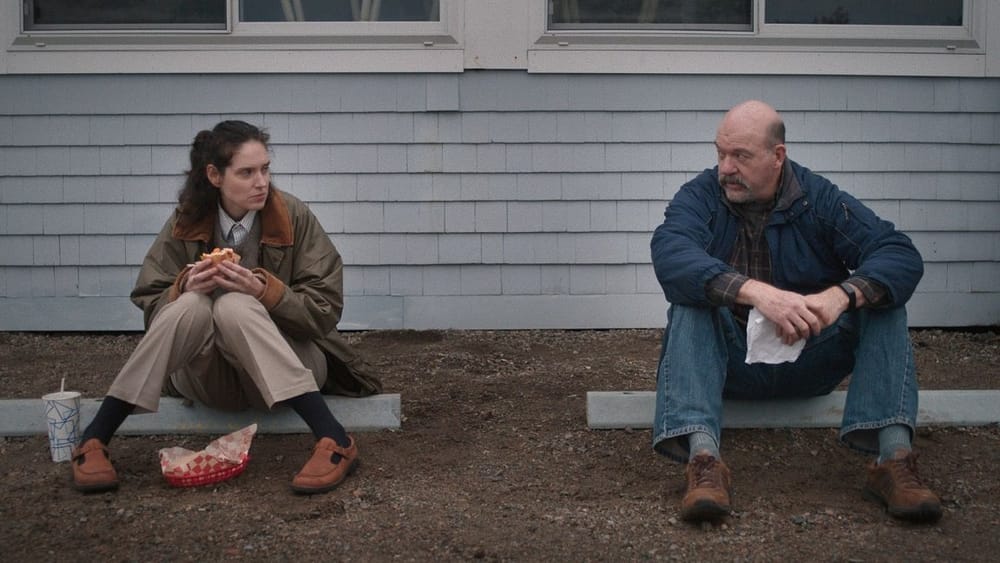
But there is light in the fog. Flecks of gold, as small kindnesses surface. Her neighbor Gavin (Lucas Hedges) offers her soup, then space, then something like gentle affection. A gruff sandwich shop owner helps her breathe through a panic attack. Lydie holds her, even when she doesn’t fully understand. And Agnes’ cat—rescued shortly after the assault—offers silent, unjudging companionship. These moments don’t erase the pain. They don’t fix anything. But they make survival feel less lonely. They tether Agnes, however lightly, to a version of life that might one day feel like living again.
There’s a particular scene—unscored, quiet—that may be the soul of the film. Agnes walks to the house where her advisor now lives. She stands outside. We don’t see what happens inside. We don’t hear a confrontation. We don’t even get closure. What we see is the sky shifting from day to dusk to dark. And then she leaves. That’s all. And somehow, it’s everything. Because sometimes the most powerful act isn’t rage—it’s simply standing in the presence of what hurt you and saying, “I’m still here.”
In the final act, Agnes utters the words “Sorry, baby.” Not to her attacker. Not to the world. But to herself. To the younger version of her who didn’t see it coming. To the self who stayed too long. To the friends she pulled away from. To the parts of her that she silenced. It’s not a neat apology. But it feels like the truth. Like a benediction for all the pieces of herself she’s still trying to gather.
There are so many films about trauma now, especially in the wake of #MeToo. But few feel as honest as this. Because Sorry, Baby refuses spectacle. It refuses to conform to the rules of narrative catharsis. There is no trial. No vindication. No monologue to camera. Just a woman, slowly, unevenly, coming back to herself.
And that’s what makes the film so powerful. It doesn’t offer answers, but it does offer companionship. It doesn’t save you. But it sits beside you while you sift through the wreckage. It’s a film that understands how shame can bind you, how systems fail you, and how healing, when it comes, is often imperceptible.
With Sorry, Baby, Eva Victor has crafted a monumental debut—subtle, shattering, and deeply human. It’s the kind of first feature that doesn’t just impress; it lingers. She’s now firmly on my list of favorite new directors, and I can’t wait to see what she creates next.
I walked out of Sorry, Baby with the phrase still ringing in my head—“Sorry, baby.” Like a lullaby for all the versions of myself I’ve tried to leave behind. Like an embrace for the quiet griefs we carry. Not all films change your life. But some remind you that you're not the only one living in the after. And sometimes, that’s enough.
Director: Eva Victor
Cast: Eva Victor, Naomi Ackie, Kelly McCormack
Writer: Eva Victor
Producers: Mark Ceryak, Barry Jenkins, Adele Romanski
Composer: Lia Ouyang Rusli
Cinematographer: Mia Cioffi Henry
Editors: Randi Atkins, Alex O'Flinn
Screening or Streaming Availability:
