
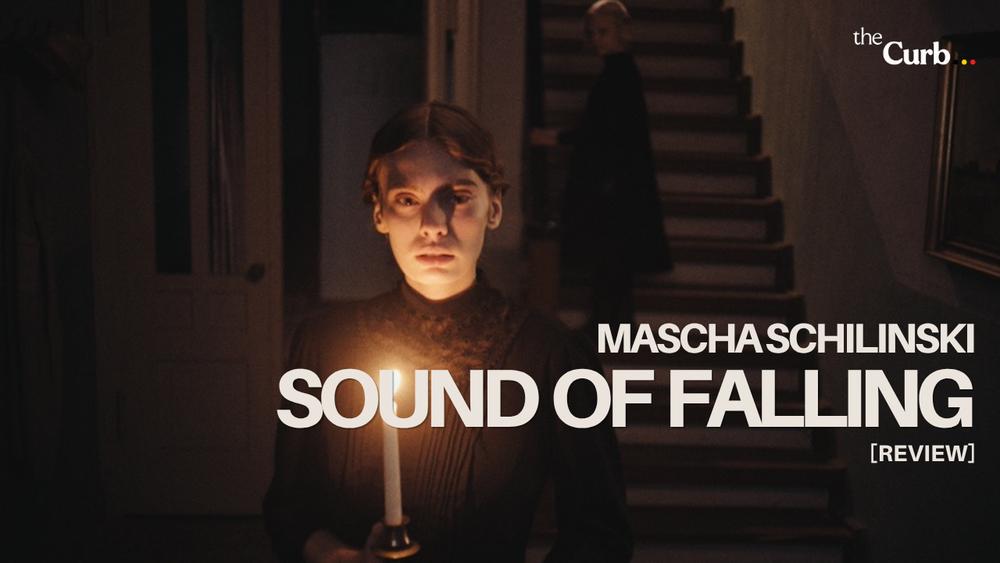
For the four women at the centre of Mascha Schilinski’s inter-generational drama, the spectre of death and the spirit of desires are explored beyond a hundred years of history (1910 – 2020). The narrative anchor is the one location: a hay strewn farmstead in the Altmark region of Germany. Constructed carefully between the dreamlike form of roving memories and the more tangible tradition of clear character arcs, Sound of Falling manages the impressive task of imitating the non-linear depiction of interconnected psyches, whilst maintaining enough storytelling muscle to avoid the pitfalls of leaving its audience with little reality to hold on to.
For seven-year-old Alma (a delicately captivating Hanna Heckt), her farmhouse in 1910 may be heavy with mortality, but it’s neither without mystery nor humour. Her older brother, Fritz, a recent leg amputee, can be heard groaning with phantom pain (and the occasional bit of pleasure) from his slightly ajar bedroom door; the seams of his above-knee injury a point of fascination for a young child still processing the cause of such a ‘work accident.’ Death and injury are serious, yet they’re also occasionally funny. Alma and her sisters nail a maid’s shoes to the floor, only for the maid to feign death until she has her chance to pounce; a keen reminder that tragedy and comedy are close siblings. Here, memories can change in a single shot – as her sisters exit the frame in giggles and screams, young Alma is left to wander the farmhouse’s quiet two-toned corridors and witness her mother mourn the death of a child through a keyhole. Time and place always enamoured with the reverberations of history.
The framing in Sound of Falling is regularly impeccable – so often the children see accumulating trauma through small gaps in doorways, the slim spaces between barn doors. At a sideboard containing photographs of the dead, Alma’s story slips into gothic horror as she looks to the image of her doppelgänger (a deceased child also called Alma), who is posed post-mortem next to a doll, her head caressed by a ghostly figure with a distorted face, a moment engineered to induce existential dread in a child split between life and death. Bathed in the amber tones of candlelight and oil lamps, Fabian Gamper’s grainy cinematography doesn’t feel so much an imitation of history as it feels close to history itself. His modified lenses and square frames replicate the eccentricities of early still photography, embracing flaws, flares, and low light with convincing visual acuity.
If regularly switching between time periods and characters sounds potentially unfocused, Schilinski’s counterargument is ensuring each period remains arresting due to the enormous empathy for the women it depicts and the subtle connections they carry. For 12-year-old Lenka (Laeni Geiseler), 2020’s modernity may feel kinder on the surface, but as her parents renovate the aforementioned farmstead into a new era, her mix of depression, isolation, and envy pushes her to imitate the very body of another: the free-spirited and forthright young Kaya (Ninel Geiger), who personifies a confident sense of self that captivates Lenka’s lost soul. Elsewhere, for teenage Angelika (Lena Urzendowsky) the 1980s are a time of sexual liberation and provocation, but when presents a more experienced and mature version of herself to a father and son who covet her beauty, she risks giving away the last of her innocence to those who most desire taking advantage of it. To Angelika, being an object of love and lust pulls at her seams in tyrannical ways, boiling over into a moment of attempted arson – for her, it’s logical that to escape the world, one must first destroy it.
The small, internalised moments in Sound of Falling are consistently surprising with their authenticity. Observing Lenka quietly pose her bare feet identically to her new and fascinating friend; the silent sexualisation of Angelika’s body by her admirers on the riverside, and her own awareness of this act giving her a sense of private power. Like a short story collection by Amy Hempel or Flannery O’Connor, the dark interiors of women under societal oppression are expressed both in quiet and searing ways. It will be difficult to forget the pained laughter of Alma’s mother Emma (Susanne Wuest) as her legs fail to carry her or the careful sowing open of a woman’s eyes before her final family photograph is taken.
The gift of Schilinski’s empathy delivers charged characters that are complex, insightful, and hypnotically demand attention. There’s also much left unsaid to consider – between a disappearance and a climactic act of unprompted demise, we’re asked not only bear the patterns of oppression but also deal with the mystery that some people simply vanish from our lives. For some stories, the shape is clear, but for others there is no conclusion to draw. It’s a testament to Schilinski’s talent that for all the darkness her and Louise Peter’s script supplies, Sound of Falling never feels hopeless and at times revels in the power of having experienced a taste of life.
Director: Mascha Schilinski
Writers: Mascha Schilinski, Louise Peter
Cast: Hanna Heckt, Lena Urzendowsky, Laeni Geiseler, Lea Drinda, Luise Heyer
Cinematography: Fabian Gamper
Production Design: Cosima Vellenzer, Maike Kiefer