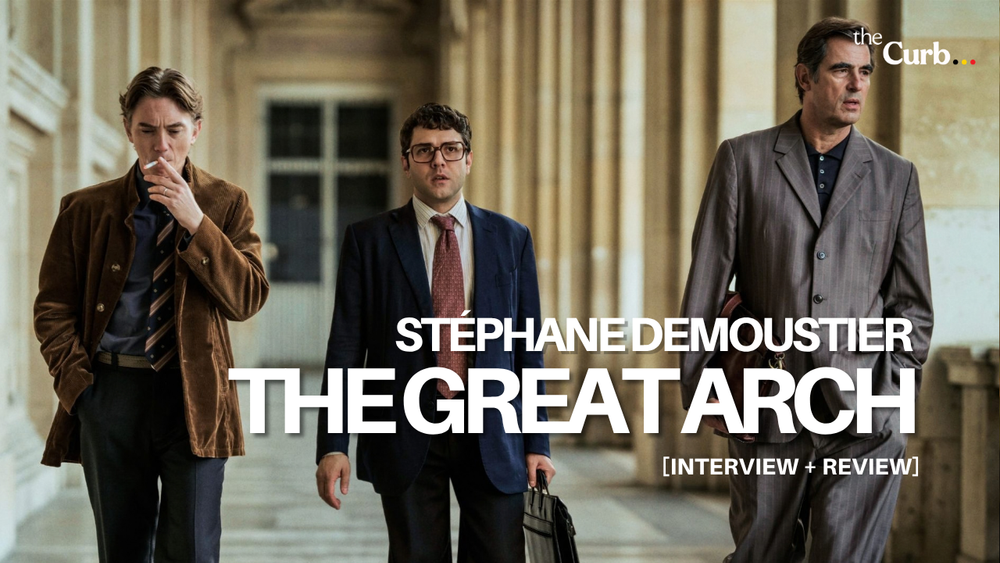
In the early 1980s President François Mitterrand had a bold vision for Paris. It was his intention to create a new artistic epoch that would be as new and as hopeful as his election as the first left-wing leader of the Fifth Republic. Part of his vision was the Grandes Opérations d'Architecture et d'Urbanisme. Amongst these projects were the Louvre Pyramid, the Musée d'Orsay, Opéra Bastille, and La Grande Arche de la Défense — the building of which is the subject of Stéphane Demoustier’s partially fictional film The Great Arch.
I recall a quip a friend of mine once told me: “Do you know who architects hate the most? The people who use their buildings.” Although I think it was an exaggeration by my friend, I thought of it during a scene where a basically unknown Danish architect, Johan Otto von Spreckelsen (Claes Bang) argues with Paul Andreu (Swann Arlaud) and experienced French architect brought on the Great Arch project about the need to be opening windows in the offices the arch would be housing. Andreu points out the design can’t accommodate that as a feature because the gap between the offices and the external parts of the arch would create unsustainable temperatures for the workers. von Spreckelsen rebukes Andreu for his past work occurring in the Middle East and France not being that hot. von Spreckelsen is provably incorrect, but by this point of the film he’s become and almost immovable object who refuses to allow one (marble) tile of his grand design to be changed.
Johan Otto von Spreckelsen won a design competition set up by Mitterrand to build what he saw as a monument of peace. His dream project. And despite his resume as a working architect was near minuscule (he was an academic teaching architecture) his intractability was astounding. His “cube” was, in his mind, inviolable. President Mitterrand (Michel Fau) approved of his design and therefore anyone trying to be pragmatic about the building of the cube was, in some manner, an enemy. What von Spreckelsen didn’t see was how much people he saw as figureheads of bureaucracy such as Jean-Louis Subileau (an excellent Xavier Dolan) were doing everything they could to get the monument built. Especially after an election brought in a conservative party as the cabinet who wanted to undermine the Socialist President’s policies.
The Great Arch is in many ways a tragicomedy that leans more into the tragedy as the film progresses. von Spreckelsen not only barely spoke French, he had no understanding of the French as a culture, or its various strata of governance and regulations. Demoustier deftly handles both the comedy of the situation and the immense frustration experienced by von Spreckelsen, Subileau, and Andreu as they clash with reality, each other, and the necessary concessions that need to be understood to make a collectively managed project.
The Great Arch doesn’t require a lesson in French history to resonate with anyone who has ever worked on a group project with people who have forceful opinions. Claes Bang is amusing, infuriating, brilliant, and ultimately quite tragic as von Spreckelsen. He was a man totally out of his depth but with a vision of supreme beauty. That kind of ambition and belief can drive a person mad when that vision is eventually no longer solely controlled. The Great Arch is both surprisingly relatable and a fascinating character study of the men and women who built the past with an eye to the future.
Director: Stéphane Demoustier
Screenplay: Stéphane Demoustier based on the novel by Laurence Cossé
Cast: Claes Bang, Swann Arlaud, Sidse Babbett Knudsen, Xavier Dolan
Nadine Whitney spoke to Stéphane Demoustier about The Great Arch and how it reflects the collective arts.
the Curb... is a completely independent and ad free website that lives on the support of listeners and readers just like you. Visit thecurb.com.au/subscribe, where you can support our work from $2 a month. Paid subscribers get access to our monthly competitions, exclusive interviews and articles, and more.
 the Curb