
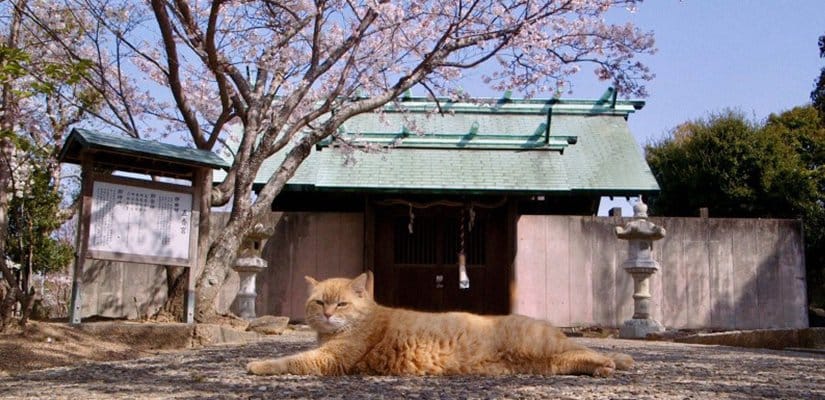
In the sun-dappled town of Ushimado, a small revolution is unfolding—one that takes place not in bustling streets or grand arenas, but in the quiet corners of a sacred shrine. Kazuhiro Soda’s The Cats of Gokogu Shrine (五香宮の猫) invites us to witness a delicate balance of life, where the fragile harmony between humans and nature is both beautiful and heartbreaking. Through his lens, we are drawn into the world of stray cats who, like the humans around them, navigate survival amidst the quiet pull of time.
At first glance, the shrine appears to be a peaceful haven for the cats, their forms lounging lazily in the golden sun, paws tucked beneath them in soft contentment. Their slow movements seem effortless, as if they have all the time in the world. But this isn’t a fairy tale of fluffy kittens and carefree lives. These are strays, living on the edges of society. Every pawstep, every flick of their tails, tells a story of survival, of unseen battles fought for food, shelter, and space. The cats do not simply exist—they endure. And in their quiet perseverance, they reflect a deeper truth about life itself.
The film’s beauty lies in its ability to show the mundane, turning it into something extraordinary. Soda’s observational style brings the everyday struggles of these feline inhabitants into sharp focus, without ever needing to anthropomorphize them. These aren’t the adorable, Instagram-worthy cats we’re so used to seeing—they are fully realized creatures with their own personalities and complexities. From Dusty Cat, who lazily shakes off the dirt of his nap like an unwilling laundry pile, to Boss Cat, whose round, almost comical shape makes him seem like a feline monarch, each cat carries its own identity. But perhaps the most poignant character is Gori-chan, the injured warrior, scarred by the harshness of life, yet resolutely carrying on. There is a tenderness in observing them—an understanding that beneath their hardened exteriors, they are simply living, just like us.
However, the film doesn’t shy away from exploring the tension that arises between humans and cats. The town of Ushimado is struggling to keep its equilibrium as the cat population grows. The people, too, face their own struggles—tending to the shrine, maintaining order, and trying to balance their affection for the animals with the practicalities of life. The issue of neutering is brought up repeatedly, reflecting the growing concerns about the long-term impact of the cats on the community. This is not a simple, one-sided story of love and companionship. It is a complex narrative where affection and frustration coexist in a quiet dance.
What makes The Cats of Gokogu Shrine so captivating is how it mirrors the delicate tensions that exist in every community. The cats are not merely cute creatures—they are part of a much larger ecosystem, just as humans are part of the web of life that surrounds them. There is an understanding that survival often comes with compromise. A fisherman may toss fish to the cats, only to watch them snatch up the prize and scamper away to feed their kittens. An elderly gardener might struggle with the weight of the past while tending to the shrine’s overgrown steps, yet he continues to serve with a quiet grace. These small, seemingly insignificant moments form the backbone of Soda’s narrative—an unspoken acknowledgment that nothing is ever purely one thing or another.
The town of Ushimado, like the cats who roam its sacred grounds, is at a crossroads. As time passes, the community changes, just as the lives of the cats will inevitably evolve. There is a melancholy sweetness to this realization, captured with the same quiet precision as the scenes of rainstorms and sunrises. Soda’s lens never rushes—every shot lingers just long enough to allow us to reflect, to breathe in the beauty of what is happening before us. It is a meditation on time itself—the slow, inexorable passage of seasons, of generations, of lives. In a world that often seems frantic and chaotic, this film offers a pause—a moment of serenity that feels like a quiet embrace.
Yet, the final moments of the film offer a bittersweet reminder of life’s fragility. The cat population is being reduced, and some of the older residents, both human and feline, are no longer with us. The end credits serve as a final, poignant farewell to those who have passed away, a reminder that nothing lasts forever. Time moves on, and with it, the world of Gokogu Shrine slowly changes.
But this is not a tale of despair. Rather, it is a testament to the enduring power of coexistence—of finding a way to share space, to live together despite our differences. Through the simple, everyday interactions between humans and cats, Soda reminds us that there is beauty in patience, in compromise, and in the quiet moments of connection. In a world that often feels divided, The Cats of Gokogu Shrine offers a gentle, hopeful vision of a world where we can find harmony amidst the chaos, simply by learning to share and care for what we have, no matter how fleeting it may be.
Director: Kazuhiro Sôda
Featuring: Dusty Cat, Boss Cat, Gori-chan
Producers: Kazuhiro Sôda, Kiyoko Kashiwagi
Cinematography: Kazuhiro Sôda