
“Together our future is bright.”
Acclaimed political documentarian Joshua Oppenheimer segueing into fiction filmmaking via a post apocalyptic musical isn’t as strange a proposition as it might first appear. Oppenheimer’s unforgettable The Act of Killing (2012) featured ageing Indonesian paramilitary leaders who had in 1965-1966 killed over a million people they claimed were communists. Often, they recreated the killings while singing and dancing or staging the killings as films. Anwar Congo is a charismatic, sanguine, monster who occasionally displays a sense of conscience before finding a way to justify his actions. In The End set twenty-five years after a worldwide environmental disaster partially caused by former energy baron Father (Michael Shannon), a family and ‘found family’ of servants/friends sings their way through the deluxe bunker living of the billionaire elite.
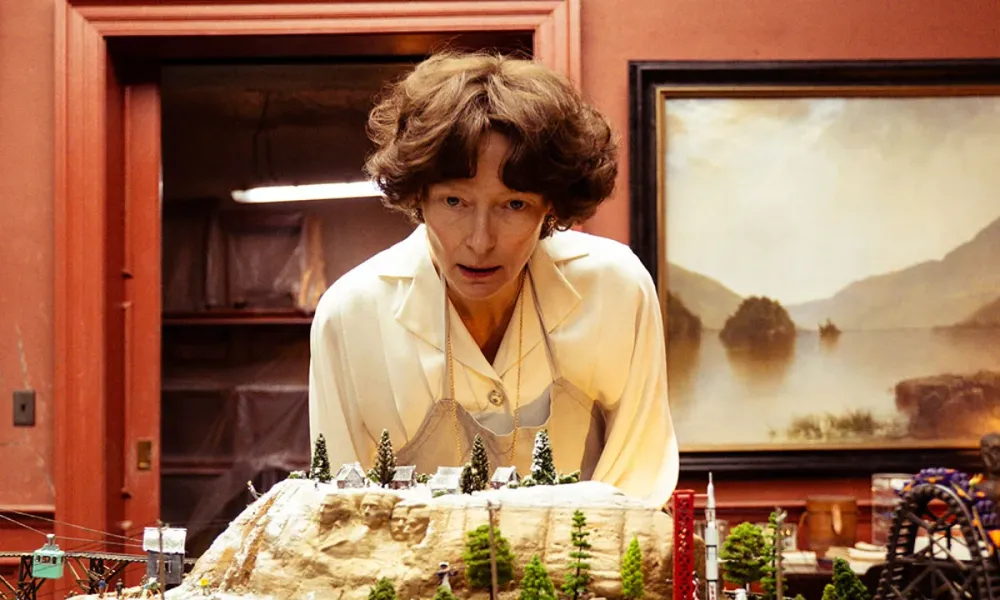
An underground tunnel somewhere in Massachusetts reveals disused cars covered in dust. The construction must have been an immense undertaking. There is something almost uncannily beautiful about it as Oppenheimer overlays the scene with some of the most remarkable landscape painting of the eighteenth and nineteenth centuries. The paintings are in the home of Father, Mother (Tilda Swinton), and Son (George MacKay) who is working on his diorama of the outside world he has never seen. He sings of the beauty of the morning, the pleasure of the day, and the endless possibilities of his happy life. In pride of place on his diorama is the Hollywood sign. Oppenheimer signals The End is taking its cues from a cynicism free era of musicals. The music written by Joshua Schmidt and lyrics by Oppenheimer has an aching familiarity to it; it is a language well understood in cinema.
Other members of the household include Friend (Bronagh Gallagher) a lifelong friend of Mother’s who was also a renowned chef. Butler (Tim McInnery) who it appears was Father’s head of security in the past. And Doctor (Lennie James) who barely contains his disdain for Son. Father seems a benign and benevolent presence, immensely proud of his son. “To think, this all ends with you, only you!” he says to Son as if knowing the destruction of the planet and presumably most of humanity is irrelevant if his scion is there to inherit the permanent la vie belle inside the home furnished with priceless and mostly benign art and endless supplies of high-end cuisine and an enviable cellar.
Mother is having bad dreams. She is fragile and seemingly neurotic. She adores and frets over Son who also adores her and does whatever he can to please her. It is time for the house to be redecorated for spring. She regards Monet’s ‘The Stroll’ showing a woman and her son in a beautiful field and claims it “trashy.” She also thinks that the shade of the room is wrong. She notices small cracks. “It’s up to me to notice the subtle changes and stop things from falling apart,” she tells Friend when Friend suggests it will be covered up by a painting anyway. Mother’s haunted eyes avoid what she cannot bear to see.
The fact they are in an artificially created shelter is emphasised by the emergency drills Doctor makes Son undertake to rescue his parents if the hermetic environment is breached. He fails to save both even after years of training. “You Father is dead. Congratulations your Mother is dead, and it’s your fault,” Doctor hectors him. Father says that there is no need to be so hard on Son for a mistake, everyone makes mistakes.
Son’s job is as the author of his father’s memoirs. “It’s my way of giving back to the world,” Father says. It’s also his way of indoctrinating Son and cleaning his reputation, pretending he didn’t order the slaughter of third world villagers via militias so he could steal their resources. Butler made the mistake of supplying Son with media clippings of an Indonesian incident – “Those are lies, Son. Lies.” He encourages him to think of the love and hope he offered people.
Son is on tenterhooks with both of his parents because the pressure for him to be the living embodiment of their respective successes – hers as a ballet dancer and cultural elite, his as a mogul. He often retreats to Friend’s room where she lets him sleep on the floor and tells him stories of her deceased son, Tommy and the cancer he fought valiantly through with humour and bravery. Friend has known Son since birth and acts like his aunt. When Doctor finds Son in her room, he warns him to stay out her bed and away from her collapsed uterus. His ugly insinuations have could have an element of truth to them in that Son is now a man and has never met anyone his age, so his psychosexual development might be a bit twisted especially with the legendary beauty of Mother.
Everything is about to change on that front as Girl (Moses Ingram) is found in the tunnels. She is weak, starving, and has no idea how she got there. She doesn’t represent the threat of the many who first tried to get into the compound when Son was a child (resulting in Butler being shot). Girl is alone. She says there is no one, no one left with all the fire seasons and people turning on each other for resources. Father, Friend, and Doctor ensure she is tended to outside the house, but Mother says she will have to leave. Father protests that it has been twenty years since anyone tried to get it. Doctor agrees with Mother. “It’s why we have protocols.”
Girl isn’t ejected from the tunnels at once and in being in her proximity, Son begins to have complicated feelings about his rights and inheritance. “The shining city on the hill is mine alone,” he sings. It is the only place he has lived or known. Why should strangers come and ask to share. But what does it mean to be alone?
Girl’s expulsion doesn’t go to plan as she runs back inside the house knocking over priceless artworks and avoiding her pursuers, including Son. Father finally puts a halt to it, saying that it is ridiculous. Girl can stay.
Mother has long been paranoid about strangers, but the inclusion of girl in the house is a wrecking ball against her tranquillised state. With her decorum, taste, and willowy elegance she could pretend her isolation is everything she wanted. Mother is safe and happy with her family: “Home where I belong, their love keeps me strong” she sings. No one else is to be trusted. Girl, like so many others, just wants what her family has – or at least that is the narrative she has let control her. Girl staying reminds her of those Father would not allow her to invite.
The End is working on many levels – some a little too surface to require the reiteration Oppenheimer invests into them. It’s a clear parable about capitalism, self-interest, information control, propaganda, and the lies people tell themselves and others to justify their part in the system. “We do what we do to survive, and no one can blame us for that,” is not an absolute.
Girl leaving her family on one side of a river and not going back for them haunts her, and she doesn’t know how to forget or to forgive herself. Yet, even when she is aware she is in the home of the man who ensured environmental apocalypse, she barely bites back only sometimes speaking with Son gently asking if he’s sure of the history he’s been taught. Girl also slots herself into Mother’s orbit as unobtrusively as she can and making herself of service to Mother’s fastidious requests is a survival tactic while Mother resents her presence.
Girl survives and, in the house, she even manages to thrive. Son is besotted with her, and she with him. Mother and Father both come to approve of her. She is accepted as ‘family’. But on New Year’s Eve, when speaks of the guilt she feels about her family, “I have this knot in my stomach it’s always there. Don’t you? And I ask myself why am I still living?” A question when spoken aloud forces Mother to reckon with what she accepted from Father to be kept in several gilded cages.
The End is a battle for Son’s mind and soul. He is reading aloud the fictions Father wants written about him like a public relations manager. “You only dug for fossil fuels because you were really scouting the area for renewable energy, irrigation, hope!” he says. “None of it is true.” Father’s defence is that “Other companies were worse. At least I cared. I still care.” But does it matter if Son walks away now, where is he going to go? In time Son will understand stories can be told and retold, stolen, forgotten, made true even if untrue. Does Father remember where he met Mother? Was it at a Bolshoi recital where she was dancing? What if she never danced with the Bolshoi?
Son’s mind and soul only matter within the space of the house. That’s Oppenheimer’s grace note. The parable is ultimately worthless within its own parameters as the world is over. Mother saved (stole) priceless artworks for who? Father’s memoirs and archives are going to be found by who? Father’s reputation for not being the worst of his ilk is meaningless. It’s all smoke and mirrors like celebrating the seasons in a permanently temperature-controlled environment where the seasons themselves no longer exist.
“Sometimes I wonder if I did more harm than good. Did I even care?” Father muses to Girl. Joshua Oppenheimer’s The End is a dour satire and doesn’t bother with subtly. It is a strange concoction of genres that jaggedly don’t quite fit, yet therein is the strength of the work. It is a stage where people are singing and dancing denying the death inside and outside.
The End is a haunting and horrifying look at the world in microcosm. What we give up in late-stage capitalism. How we pretend that chipping off bits of our conscience, memories, resistance to propaganda, lies, and constant manipulation in an era that’s already lacking “a clear blue sky tomorrow” leaves us insulated, but only leaves us inured.
Director: Joshua Oppenheimer
Cast: Tilda Swinton, Michael Shannon, George MacKay
Writers: Rasmus Heisterberg, Joshua Oppenheimer
Producers: Tilda Swinton, Joshua Oppenheimer, Signe Byrge Sørensen
Music: Marius De Vries, Josh Schmidt
Cinematography: Mikhail Krichman
Editor: Nils Pagh Andersen
Streaming Availability: