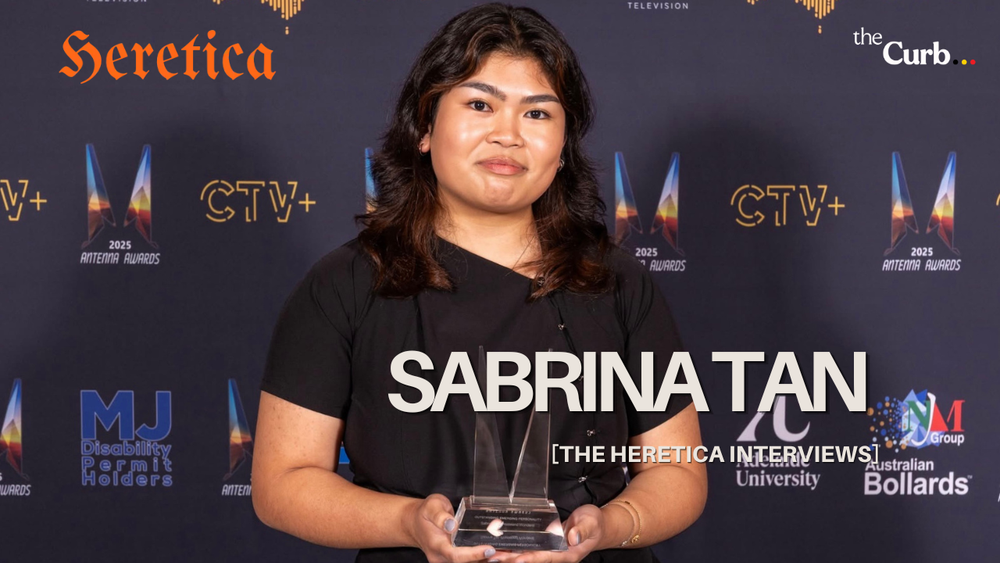
Sabrina Tan (Chinese: 陈姝颖) (she/her) is a Singaporean filmmaker based in Naarm-Melbourne. Sabrina is a multidisciplinary filmmaker who works in directing, production design, and graphic design. She is also the host of the award winning post-apocalyptic lifestyle series Wasteland Wonders, with Sabrina taking home the Outstanding Emerging Personality of the Year award at the 2025 Antenna Awards.
In the below interview, recorded as part of The Heretica Interview series, Sabrina talks about her journey from Singapore to Naarm-Melbourne, finding space in a creative community, and about her directorial debut short film Counting Sheep, which screened as part of the REELise Film Festival.
Heretica is a platform for discovering and hiring Female and Non-Binary film crew and creatives currently working today.
To find out more about Sabrina, find her Instagram profile here or to work with her, visit her Heretica profile here:


Where did your interest in filmmaking and storytelling on screen come from?
Sabrina Tan: I think it began with realising how interesting people are. I grew up surrounded by so much diversity in Singapore, and then when I moved to Melbourne, I realised there was even more to discover. I was meeting all these different people with completely different experiences and stories to tell, and I realised I had stories of my own as well. Through film, animation, and all kinds of media, I started seeing how much life could be captured and expressed on screen. That was something I really wanted to be a part of.
I understand that Singaporean cinema is not a very active film scene, is it? What's that like coming from Singapore into Australia where there is an active film scene?
ST: I actually think Singapore’s film scene is more active than people sometimes assume. But especially over the past five years, I think there’s been a really exciting increase in independent filmmaking. For example, Amoeba, directed by Tan Siyou, has been doing incredibly well on the festival circuit over the past year. I haven’t had the chance to see it yet, but everything I've read and seen about it has been really inspiring. I think there’s something so special about seeing a film centred on the rebelliousness and experiences of young girls in an all-girls school in Singapore.
I would love to see more aspiring filmmakers in Singapore go out and make the things they want to make. I completely understand the challenges because there can be a real lack of resources, opportunities, and sometimes even recognition. But seeing this rise in independent filmmaking, even through social media, is incredibly exciting to me.
In comparison, the presence and growing success of Australian cinema was a major reason I chose to pursue filmmaking in Melbourne. There’s such a rich community of filmmakers here, and I feel very fortunate to have learned from, participated in, and contributed to it. I’m excited to keep going, meeting people, and collaborating with filmmakers here.
Your interest is in different styles of storytelling; writing, directing, production design. Did you start off as being a writer or a director and then grow from there?
ST: It’s actually a bit of a long story. I’m enrolled in a Bachelor of Arts (Psychology), majoring in Film and Television. When I first came to Australia as an international student, I was only 17, so I felt like I had this huge world in front of me. It took quite a lot of time, and honestly a lot of courage during that first year of university, to realise that filmmaking was something I genuinely wanted to pursue.
The first major turning point for me was taking a TV studio production class at Deakin. Because I wasn’t enrolled in the full Film, Television, and Animation course, when it came to choosing production roles, I stepped away from the more technical positions because I didn’t want to take those opportunities from people who were studying those areas full-time. At that point, I also had no real expectation that filmmaking could become a career for me. I had no prior experience, and growing up, it never really felt like this was something I could realistically do. But being in Melbourne made me realise that it was possible.
I ended up becoming the host of our student television production, and strangely enough, stepping away from those technical roles allowed me to observe everything. I had this bird’s eye view of how the entire production worked. It was the first time I really understood what all these different roles did and how they came together. That student project titled Wasteland Wonders eventually became a six-episode series that aired on Channel 31 Melbourne in 2024. We then received three nominations at the 2025 Antenna Awards: Best New Program and Program of the Year, while I was nominated for and ultimately won, Outstanding Emerging Personality.
Within that whole journey, I was able to explore writing, directing, production design, and graphics as well. Because it was a student production, there was so much freedom to jump in wherever you had an interest and contribute. I had an interest in almost everything, so I took on every opportunity that came my way. It’s funny because I originally stepped away thinking I would be less involved, and somehow that decision led to me becoming more involved than I ever could have imagined.
Winning an award as well early in your career is really impressive. Was that a big confidence boost for you to feel like you’re heading the right direction? How did you feel after winning that award?
ST: Oh, it honestly felt ridiculous even being nominated because we made the show during our first year in 2024. By the time the nominations were announced, we were already working together again on our second-year productions.
It was largely the same crew because we had gelled so well. Just getting the original show produced was already such a huge achievement for us. We were incredibly proud that we had finished six episodes, that they were airing weekly, and that everything had actually come together. We were already trying to take that accomplishment in our stride, so receiving three Antenna Award nominations on top of that felt completely unfathomable.
It definitely gave us this enormous morale boost going into our second year. It made us feel like maybe we really were heading in the right direction. I also have to credit Sarah Herzina, the producer I’ve continued working with since that first television show. She’s absolutely incredible. Producing student work is different from working professionally, but it’s still such a multi-dimensional role. You have to take on so much, and at the same time you’re learning constantly.
The fact that Sarah and I have been able to keep learning and growing alongside each other is something I never anticipated when I started university, and I’m unbelievably grateful for it. So winning the award was exciting, but I think what meant even more was realising that we had found this group of people we could continue creating with.
I can imagine. It's something to be able to step behind a camera or in front of a camera even and run something is impressive, but learning how to collaborate and tell a story is so vitally important. Can you talk about learning about collaboration and what it means on a creative level? How did you find navigating working with teams or people who you might not be completely familiar with, and then how did you build that rapport with them?
ST: I think I was slightly more prepared for the collaborative side of university because I arrived here quite young and had already become fairly independent. One thing I realised very quickly was that, as nervous as I might be about approaching someone or starting a conversation, there was a good chance they were just as nervous about approaching me.
Making that first move is usually the hardest part, so I learned to just do it. Even now, a lot of people I approached first have told me they were grateful that someone started the conversation, because everything starts flowing naturally from there.
I think collaboration itself is quite delicate because getting along personally and working well professionally are two entirely different things. Sometimes you can be great friends with someone but struggle to work together, and sometimes you can work incredibly well with someone you might not otherwise be close with.
Learning that balance has definitely been its own journey. But one of my favourite things about filmmaking is that there’s almost an unlimited number of people you can meet throughout your career. People are constantly changing. You never really know who you’re going to work with next, or where those collaborations might lead. I think there’s something quite beautiful about that uncertainty.
Part of the reason I ask is that when you're making a show or a film, you all need to come together for the collaborative vision to work. Communication is key. Which is a way of asking about your vision and what kind of work you want to make as a creative person? What's the Sabrina Tan story that you want to put into the world?
ST: I think I keep coming back to human connection. The ways we support and love one another, how complicated that can become, and how important those connections remain despite that complexity. It also relates to what you were saying about achieving a shared creative vision. The people I met on that very first production are still some of my close friends today. I think developing those friendships before we moved into making our second-year short film really helped us creatively.
There was already trust there. We knew we could rely on one another, communicate honestly, collaborate, and compromise when we needed to. That became incredibly important to the way I approached directing as well.
So I think the stories I’m drawn to and the way I want to make them are actually quite connected. Both are ultimately about relationships between people and what happens when we genuinely try to understand each other.
That leads into talking about Heretica. This is about changing the industry and giving people who have often been denied the chance to tell their own stories the opportunity to tell them. What do you want the industry to look like? How do you want to help influence the change of the industry?
ST: I would love to see greater openness towards emotional storytelling. I think emotion can sometimes be difficult to confront, particularly when stories come from people whose experiences traditionally haven’t been given space on screen. Those stories might involve pain, struggle, identity, family, or adversity that audiences aren’t used to seeing, but I think allowing those emotions onto the screen is incredibly important.
I also think audiences are becoming increasingly receptive to those kinds of films. A recent example that really resonated with me was Sentimental Value. I love that film. Seeing so many people, including people who aren’t necessarily film enthusiasts, watch the film and appreciate it for its beauty and emotion in storytelling is really special.
My current project really embodies what I hope that the future can look like. For the Family is my graduate short film that I’ve had the privilege of directing. The film was written and produced by Sarah Herzina. It’s a 1997 Slovenian-Australian family drama about three generations of women: a grandmother, a mother, and a daughter.
When I first read the script, I was so incredibly moved. Sarah and I have worked together for the past three years, so there’s a level of trust between us that has developed quite naturally. But there’s something incredibly significant about somebody writing something so personal and then handing it to another person to direct. That requires a huge amount of trust, sensitivity, and grace from both sides, and navigating that has been challenging but also incredibly rewarding.
For the Family feels special because both the writer-producer and director are women. And in this year’s film cohort at Deakin, there are eleven films and nine of them are directed by women, which I think is absolutely fantastic. When I think about what that final screening is going to look like, seeing all of these stories together, that’s what makes me feel incredibly optimistic about the future of filmmaking. How could I not?
Heretica is a great initiative. As a creative person going through your graduate process and knowing that something like this will exist, what does that mean for you?
ST: It’s given me something tangible to contribute to. We talk a lot about representation and visibility, but for a long time I wasn’t always sure where that conversation actually led. There are film festivals and communities that you can seek out yourself, but having a dedicated platform and a community of women that you can look up to, learn from, collaborate with, and eventually contribute back to is something really special.
For a while, filmmaking felt like this path where you simply had to keep pushing forward for however many years it took until you somehow found your place in the industry. Having something like Heretica makes that future feel much more tangible. The fact that Madison has created this space is beautiful because it shows that things are really changing. For someone who’s at the beginning of their career, it’s hopeful to feel like there’s already a community out there that I can contribute something meaningful to.
What you would like to mention as a closing thought?
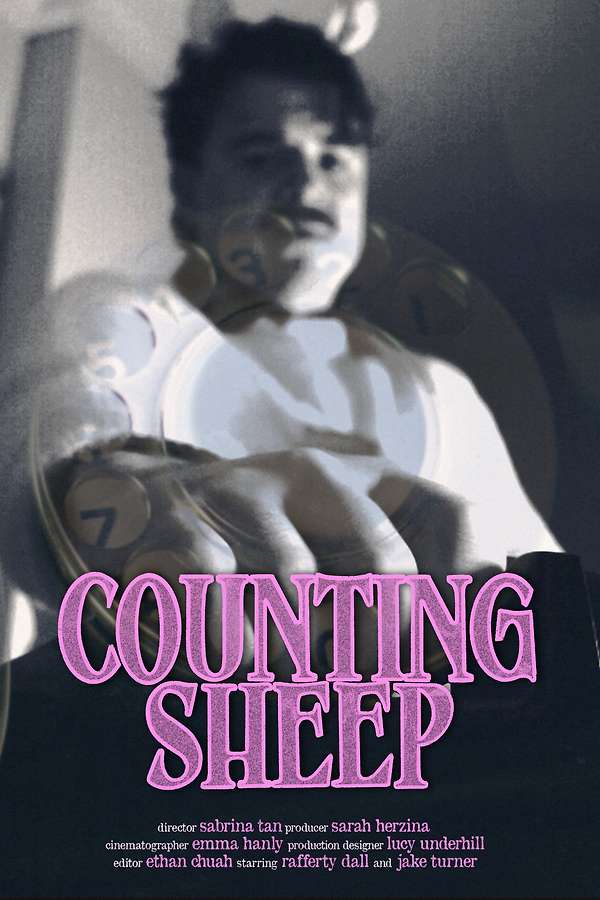
ST: I’d like to mention my second-year short film, Counting Sheep. The film was made with a predominantly women-led crew. Aside from our editor, every position was held by a woman. Looking back, I think it’s quite incredible that we managed to create something like that in our second year when most of us still had very little filmmaking experience.
I consider Counting Sheep my directorial debut because it was the first time I was really able to step into that position and understand what directing meant to me. But I could only do that successfully because of the crew around me. They were collaborators, but they’re also my friends. Having that trust made an experience that could have been incredibly overwhelming feel much more manageable, and I recognise how fortunate I was to have that around me on my first film as a director.
The film has already gone much further than I expected it to. Counting Sheep has been selected as a finalist in the 2026 REELise Film Festival in Sydney, where we won Best Film in the senior division, and is an official selection in the 2026 Young Australian Film Festival, where we are a part of two fantastic screenings coming up in September.
More than anything, I think that experience reinforced what I’ve learned throughout all this: filmmaking is never really something you accomplish alone. Everything I’m proud of so far has come from the people I’ve been fortunate enough to create alongside.
To work with Sabrina Tan, visit her Heretica profile here: