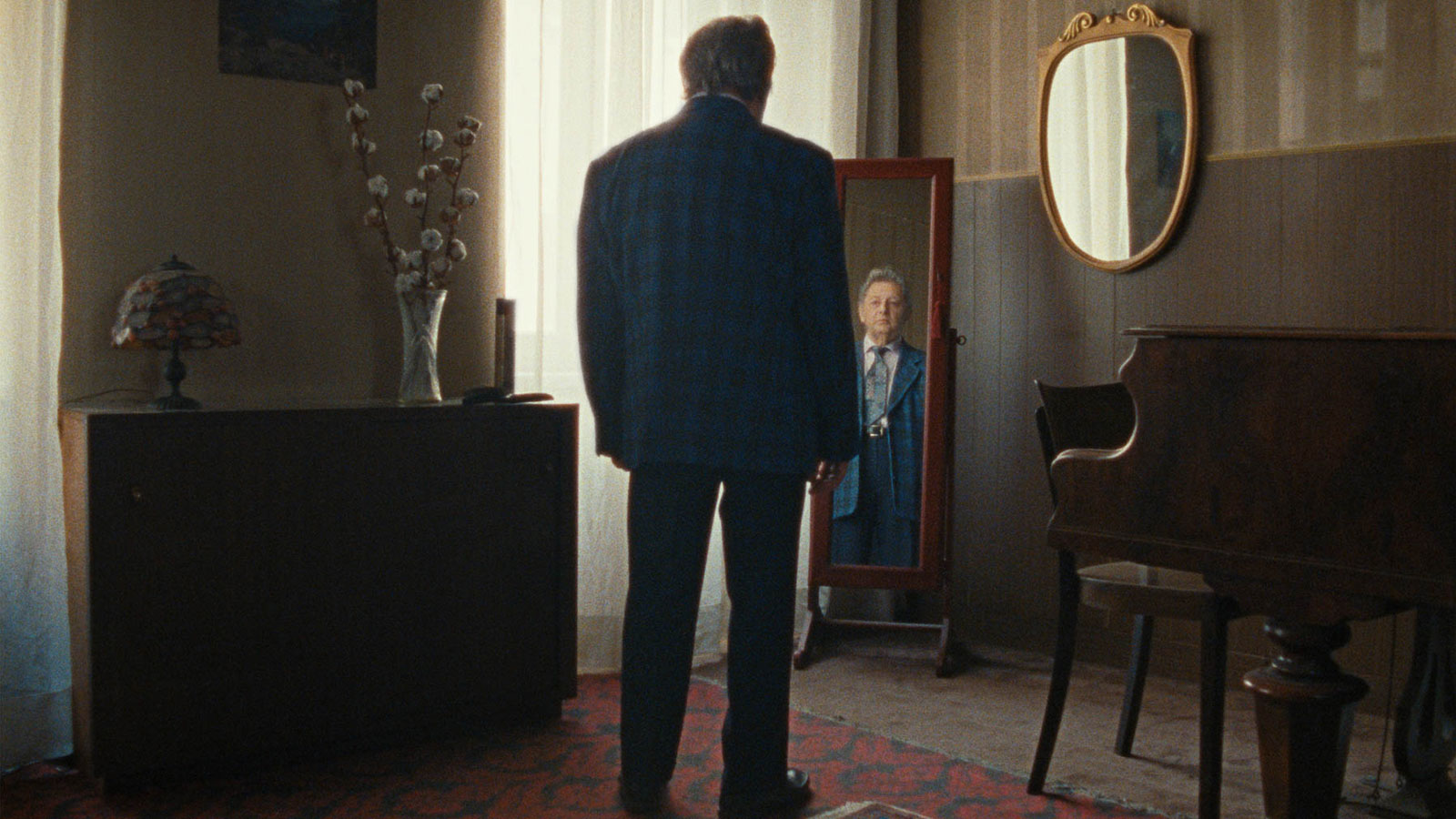

Tizza Covi and Rainer Fimmel are unique filmmakers. Their previous feature, Vera (2022) was a heightened version of actress Vera Gemma’s life. There were certainly sections that were entirely fictional, but there was so much of the real Vera in the film, it’s easy to find the fictional aspect true to the woman. The Loneliest Man in Town takes a similar approach. If Austrian bluesman Al Cook wasn’t real, Aki Kaurismäki or Jim Jarmusch would have made him up. He’s so intensely a character because he’s moving against the currents that pull others along in their older years.
Alois Koch (stage name Al Cook) dreams of the Mississippi Delta and bayous but has only seen the Danube. At eighty he’s still singing barrelhouse blues wearing slightly too-tight stage wear. His hair is still perfectly coiffed in a quiff, and he wears his Levis with the cuffs rolled up. When we first meet him he is dragging his Tannenbaum up the stairs of his 19th Century apartment block. Widowed, childless, and with friends who are long dead, his Christmas Eve seems like a sad affair; but he has put effort in decorating the tree, getting dressed up, and making a dinner for himself. He’s alone, but he’s learned to make something of the days. His electricity goes out in his memorabilia cluttered but scrupulously apartment. When he calls the electricity provider they tell him no-one will be able to fix the issue until after the holidays. They might have placed the outing as a higher priority except for the fact he is the only one living in the building with all the neighbours forced out by a venal real estate developer (ironically using the phrase ‘Building New Values’) who plans on knocking the whole block down.
Nevertheless, Alois picks up his guitar and in candlelight plays a blues-tinged version of “Silent Night.” Soon after he is visited by some goons who offer him money to leave. The alternative is that more services will be turned off and he will have no peace. He plans on fighting them as his “whole life” is in that apartment. But when one of the goons decides he’s going to take up residence in Alois’ home (water now turned off) and turn it into a dump, he decides to sign the papers and leave.
With the money he goes to a travel agent to book a flight to the States. Particularly Tennessee, Alabama, and the Mississippi Delta south which was where his idols found inspiration for their music. It’s a one-way ticket as he plans on setting up a recording business there for blues musicians and perhaps he will finally break into the American market. It’s a dream destined for disappointment because Alois can’t acknowledge that he is romanticising a past that was the background for the Blues as a protest to the poverty in which his heroes like Ma Rainey and Robert Johnson lived. Alois wants to play juke joints when he gets to America. Later, an American woman buys two statues from him and tells him that America is terrible and expensive. He doesn’t argue, nor does he sway from his decision.
Tizza Covi and Rainer Fimmel create an excellent scenario in which to allow “Al Cook” to explain who he is and was. It’s not only the apartment filled with posters of Elvis, Blues greats, photographs of him playing multiple instruments, and a particularly Priscilla Presley styled photograph of his wife Sylvia; it is also the interaction he has with each of the people who come to buy his belongings. As they rifle through vinyl, posters, and scrapbooks, Alois answers their questions. One young woman picks up an album and asks if it is any good. He replies that it sold quite well. “It was during my rockabilly phase,” he tells her and she realises that she’s standing with the man who made the album. Later she feeds film through a projector and there Al Cook is playing blues with another jazzman. “You can almost hear it,” she tells him of the silent images moving on the wall.
The American woman tells him his English is very good. Alois tells her he is self-taught. He listened over and over to a tape of an interview with Elvis and after five years he had the basics of the language. Each item in his home has value – not only sentimental, but also because they’re distinctly analogue pieces or because they are the result of his deeply felt affiliation with early rock and roll and the blues. Video tapes show him with his wife Sylvia, or news pieces about him and his career. “I want to make music with heart,” he tells a reporter. Even in his past he was noticing the disposable nature of music and art that moved from one trend to the next. It’s universal for people to have the blues, so why can’t they express that?
As Alois’ house and basement studio become gradually emptier he has reconnected with an old flame from fifty years ago. Brigitte (Brigitte Mendua) dumped him because she was a fan of The Beatles and he gave her an Elvis album. He tells her was a sign of the most profound love and that she missed out on going to a Jimi Hendrix gig as their next date that never happened. Moments of quiet and gentle humour pepper the film especially in the banter between Alois and Brigitte. There are also moments of bitter truth when he tells her Austria as nothing left for him and he doesn’t know how to exist in a city that is, like so many others, a palimpsest. Images of buildings being torn down are too common. The family run bars are closed. The city, and the world, has moved on, but he can’t as he’s clinging to what makes Alois “Al.”
Soundtracked by classic songs by Ma Rainey and the title song which Al also performs, it isn’t a huge leap to see how a working-class Austrian boy became obsessed with the kind of music that speaks to the everyday life of the dispossessed. In truth, the world itself has no time for those out of time. Being elderly and alone is to be left to drift on an unpredictable current. Al Cook has perhaps seeded some inspiration for future generations through his music, but Alois Koch is a lonely soul who in letting go of what he owned perhaps makes a choice to find companionship where he didn’t expect it to come from.
There is a beautiful scene where Alois is packing his one suitcase of personal items. On the top of the case he puts a red and white shirt and a photograph of Sylvia wearing it. In his guitar case he gently places his own albums. He’s ready for the road – but we don’t know what road he will be travelling.
The Loneliest Man in Town is a muted masterwork. Touching, gentle, sometimes very funny, and within its specificity speaks of something universal. We all get the blues, and we will (hopefully) age and see ourselves as remnants of another time. Tizza Covi and Rainer Fimmel give Al Cook his unexpected moment bathed in an intimate and warm 16mm glow, and Al gives us a glimpse of his gentle and achingly sincere heart.
Director: Tizza Covi and Rainer Fimmel
Writer: Tizza Covi and Rainer Fimmel
Cast: Alois Koch, Brigitte Meduna
Cinematography: Rainer Fimmel
Composer: Alois Koch