
Welcome to the first instalment of the Noughts Report. A sequel to 90s All Over Me, each entry revisits a year in film from the 2000s, highlighting movies big and small and the careers and genres and trends that ignited or flamed out along the way. This attempted kaleidoscope is 100% subjective and AI-free, so if I bag or barely mention a film you love, or orate at length or heap praise upon a film you loathe, I apologise.
In the final piece of 90s All Over Me, covering the year 2000, I ended by flashing forward to the next quarter century of movies, providing a coda on that twelve-part series but also, strategically, pre-emptively snuffing out any writerly impulse to extend the series. Indeed, my closing words were “All that, and much more, is for another (and someone else’s) series. Thanks for reading”. Baton seemingly passed.
But what if?
There were plenty of reasons not to continue the series into the 2000s. That decade didn’t feel as formative, didn’t imprint as deeply. The two genres I fixated on across the decade I now care little for (superhero films) or despise (horror movies). There are many iconic titles from the decade I just never watched: I never found Nemo; I never attended the big fat Greek wedding; my summer never lasted 500 days and was neither wet, hot, nor American.
But what if?
Day to day ephemera kept pointing me back to the decade. A Wall-E episode of Blank Check here; a 25th (!) anniversary piece on Pearl Harbor there; a Canadian movie, I Like Movies, released in 2022 but set in 2002, about a young movie nerd working at a video store.
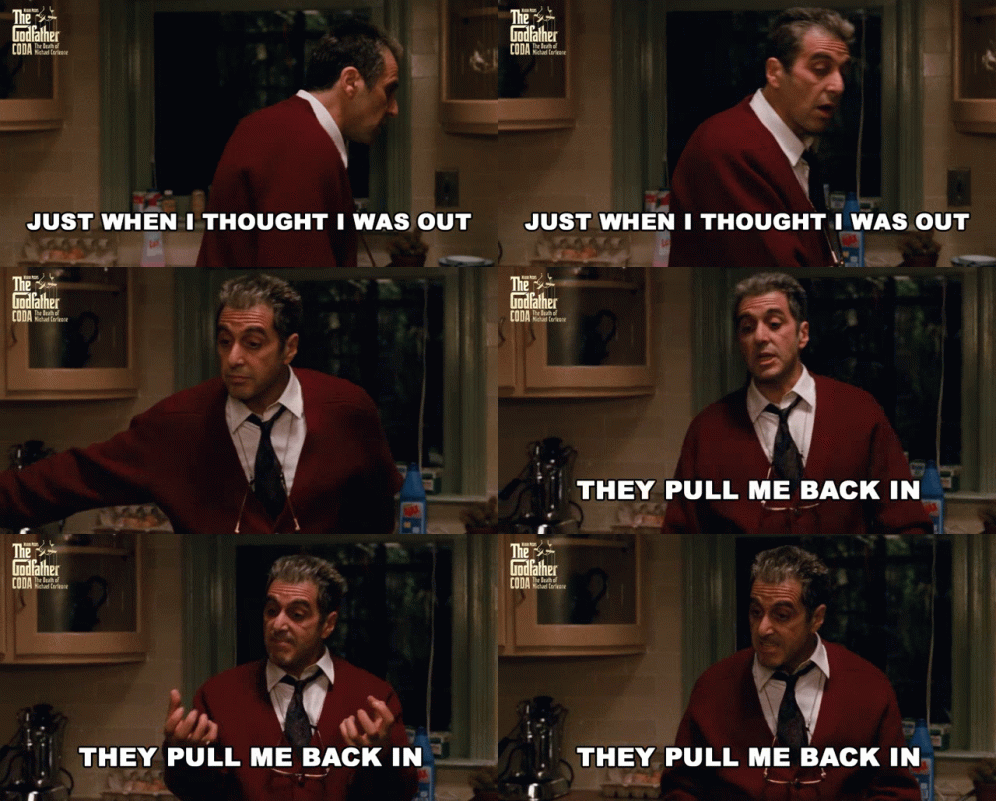
I felt like Michael Corleone:
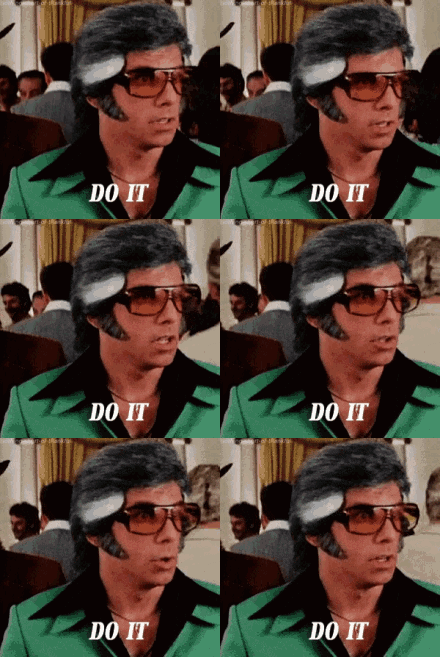
Or to use a reference from the 2000s:
So, here we are, instalment 1 of the nine-part Noughts Report. Over the course of 2001 to 2009 I ripened from 18 to 27. All the films covered in this series I saw either theatrically in their calendar year—or, for Oscar contenders and seasonal blockbusters, early the following calendar year—or subsequently on VHS, DVD, television, or streaming. Some of these films I’ve seen only once, others multiple times; some I haven’t thought about in years, others I think about routinely.
While I’ve significantly less nostalgia for this decade than the 1990s, and titles have had less time to stick and build repute, I still harbour some pretty strong opinions, even (and sometimes especially) on films and genres I no longer care for; on the flip side, I’m sure there will be movies where I fall prey to hivemind. I’ll also inevitably gloss over some major titles that are very special to some, only to go granular—from either a place of perversity or personal preoccupation—on others footnoted by history.
With those caveats, let’s kick off 2001. Leslie Nielsen vehicle 2001: A Space Travesty was a 2000 release, so doesn’t make the (match) cut, but I’ll begin, fittingly, with the last realised project from the director of 2001: A Space Odyssey.
In my piece on 1999, I noted what felt like a generational passing of the directorial torch that year, with the release of Eyes Wide Shut and Stanley Kubrick’s death on one hand and, on the other, the flourishing of directors like Paul Thomas Anderson, Sofia Coppola, Spike Jonze, M. Night Shyamalan, and David O’Russell. Kubrick’s intended final project, AI: Artificial Intelligence—about an abandoned robot’s fixation on its human stepmother and odyssey to reconnect with her—would be realised two years later by Steven Spielberg.
I was nineteen when I first watched this film; every year there are titles we watch on time, too early, or too late, and I’ll concede I wasn’t fully baked to appreciate AI: Artificial Intelligence, its profundity and deep melancholy, or the wonderful lead performance of Haley Joel Osment, the best of the handful of child performances he delivered in the wake of The Sixth Sense. My appreciation for the film has only grown with subsequent viewings of this meaty, thorny, substantial marriage of two great sci-fi and filmic minds, bolstered in part by reading about the film and its evident hold on critics as disparate as Armond White (a Spielberg admirer) and Jonathan Rosenbaum (a non-admirer who’s nonetheless enamoured with it). The passage of time more than box office or awards is the true affirmation of a film’s value, either multiplying or thinning it, and AI: Artificial Intelligence is a title that appears to have grown manyfold in repute.
Elsewhere in 90s All Over Me, I suggested that the 2000s began an incremental decline in Spielberg’s status as the dominant event filmmaker, with new directors like Christopher Nolan taking on that mantle over the next quarter century and Spielberg transitioning into respected elder statesman, albeit still capable of delivering big successes and still the most preternaturally gifted of storytellers. It’ll be interesting to chart how this shakes out over the decade.
In the meantime, Spielberg’s signature 90s franchise, the Jurassic Parks, changed directorial hands for Jurassic Park III, with steady journeyman Joe Johnston taking the reins and sending Sam Neill’s Alan Grant to another dinosaur-infested Central American island. This is the smallest Jurassic Park/World film, in both scale and length, and the climax feels a bit anti-climactic. However, its efficiency of storytelling—shorn of extraneous subplots and characters, in contrast to the Jurassic World films that compulsively pile them on—gives the movie a charming Son of Frankenstein/Friday the 13th Part III pumped-out sequel quality absent from the rest of the franchise.
Side bar: like many, I was deflated by the news of Sam Neill’s passing. Neill was a dependable class act: wry but reassuring, seemingly effortless but always switched on, never bad, always good. As a child of the 90s, Neill’s credits in that decade loom especially large in my mind, most obviously Jurassic Park but also The Piano, Hunt for Red October, In the Mouth of Madness, and so on. But there’s great work in the 2000s as well, and looking over his filmography I’m struck anew by the hefty volume of Antipodean titles. He was the rare export star who genuinely threaded the needle and worked across continents: see The Dish, Dirty Deeds, Perfect Strangers, Little Fish, Irresistible, Dean Spanley, and Daybreakers, among others. RIP.
I looked forward to both AI: Artificial Intelligence and Jurassic Park III, but was positively mad chomping at the bit for Tim Burton’s Planet of the Apes. For a cinephile, it’s hard not to feel like a scorned lover when a filmmaker you adore lays a spectacular egg, and that was very much the case with this film after fawning over Burton’s work for years. I’ve enjoyed later Burton efforts, and only two have grated as much or more—Charlie and the Chocolate Factory and Alice in Wonderland—but Planet of the Apes broke the spell with its perfunctory and mechanical story, indifferent handling of rich source material, obscene casting of Mark Wahlberg as an astronaut, and an ending I still cannot explain.
There are plenty of examples of Hollywood pulling wool over audiences and fooling them twice, but Planet of the Apes is one of those cases—like Batman & Robin a few years before, or Die Another Day a couple of years later—where, counter to ostensibly successful receipts, Hollywood got the message that more of the same wouldn’t fly and course-corrected rather than plundering further; it would be a decade before another, markedly different, instalment in the Apes franchise.
Although nowhere in the same league in terms of director cachet, promising IP, or levels of disappointment, Lara Croft: Tomb Raider was also very underwhelming and mechanical-feeling, lacking the wonky fun of Simon West’s colourful debut (Con Air) and slick sophomore film (The General’s Daughter). Also hewing from video game source material was Final Fantasy: The Spirits Within, heralded for its groundbreaking photorealistic animation except when characters talk, walk, move, or emote.
A decade earlier, animation was predominantly cell-drawn and sequences of actors interacting with computer-integrated elements in live-action films were novel and sparsely peppered over a film’s runtime, augmented with practical effects and in-camera trickery (see Terminator 2: Judgment Day, Jurassic Park). By 2001, cell animation was still present—exemplified by Hayao Miyazaki’s exquisite, elegiac Spirited Away—and increasingly niche staples like rotoscoping were utilised in Richard Linklater’s Waking Life. However, there were also entirely computer-animated works, like the aforementioned Final Fantasy and crowd-pleaser Shrek, and plenty more instances of actors integrating with animated elements, computer-generated or otherwise: Jeff Goldblum and Catherine O’Hara are menaced by cats and defended by dogs in Cats & Dogs, while Brendan Fraser is menaced by his simian id in Henry Selick’s Beetlejuice-aping, mark-missing Monkeybone.
While Terminator 2 was the live-action commercial champion of 1991, its brethren—Robin Hood: Prince of Thieves, Home Alone, City Slickers—did not contain computer-integrated elements. By 2001, following the Jurassic Parks, The Mummy, The Matrix, and Star Wars Episode I: The Phantom Menace—and, lest we forget we walk before we run, Spawn, Mortal Kombat, and Bicentennial Man—it wasn’t uncommon for the major releases of the calendar year to see live-action performers interacting with fully or partly digitally-realised creations. The first instalments of two signature franchises of the decade, Harry Potter and the Philosopher’s Stone and The Lord of the Rings: The Fellowship of the Ring, seized upon this affordance for large-scale, multi-story world-building, though compared to later instalments and spinoffs (i.e. the Fantastic Beasts and Hobbit trilogies) these original features retain some handmade craft and tactility.
I’m not the biggest advocate for either franchise—I’m agnostic on Potter and think Rings takes a big nosedive with its final entry—but Fellowship and Philosopher’s Stone are indisputably mission statements for their series and great works of table-setting in casting, design, and tone. In this respect, the Potter saga is very much the House that director Chris Columbus built; as middling as Philosopher’s Stone and his follow-up are, the next three directors to play in this sandbox all played on Columbus’s very sturdy foundations.
Although it would spawn nine sequels and one testosterone-packed spinoff, The Fast and the Furious does not lay foundations or hint at any aspirations for a globe-trotting, multi-film saga. It is, however, a fun vehicular actioner which, like Potter and Rings, makes some pitch-perfect casting calls that will pay off over decades.
Superheroes, another commercial lingua franca that would grow—with growing pains—over the noughts, were absent in 2001: X-Men was released the previous year, with Spider-Man to follow in 2002. In the meantime, comic book films were represented, atypically, by the smart, quirky indie comedy Ghost World, smarter-than-it-looks Josie and the Pussycats, and From Hell, which waters down Alan Moore’s anthropological dramatization of the Jack the Ripper case into a Victorian detective thriller but is nonetheless effective on its own terms.
While Potter, Rings, Matrix, and superhero sequels would reign financially in the years to come, the sequels of 2001 were largely earthbound, dutifully cashing in on their late 90s predecessors: Along Came a Spider dispatched Morgan Freeman’s detective Alex Cross on another case, Dr Dolittle 2 dispatched Eddie Murphy—markedly less enthused here than in Shrek—on a mission to arouse a bear (read the plot synopsis if you doubt me), and Rush Hour 2 dispatched Jackie Chan and Chris Tucker to China, much to the current POTUS’s amusement.
Only The Mummy Returns of these rapid-fire sequels brought a fantastical bent. Of its precursor, I wrote “Perhaps the unkindest cut against Phantom Menace was that The Mummy—made on a lower budget and with less CGI quality control, held together with scotch tape and charm—proved twice as fun and thrice as nimble, and remains very, very watchable.” The Mummy Returns is watchable but not especially nimble, ladling on the effects and cast members and fun to the point of smothering. It’s notable, however, for minting The Rock as a future movie star.
In 2001, an impressive cast of actors—as opposed to an impressive assemblage of IP—could still invest a film with some event status, as evidenced by two heist movies, Ocean’s Eleven and The Score. Steven Soderbergh’s remake of the lightweight Rat Pack vehicle assembled heavyweights George Clooney, Brad Pitt, Matt Damon, and Julia Roberts, with a supporting deck of former stars, up-and-comers, and character actors; the resulting caper is slick and entertaining.
The dour The Score, meanwhile, teamed Robert De Niro, Marlon Brando, and Edward Norton; in hindsight, one of those guys was prematurely canonised in that company. To his credit though, Norton works hard on the film, while De Niro flexes his furrow-browed muscles and Brando basically does whatever he wants. Director Frank Oz, a benign figure who has brought joy to millions, was rewarded for his efforts by being called Miss Piggy by his corpulent star.
Jack Nicholson’s presence in The Pledge, his first film in four years following his Oscar-minted work in As Good As It Gets, similarly afforded that Sean Penn-directed psychological drama some status, at least in arthouse circles. It’s a low-key, slow-burn work elevated by Nicholson, tapping into the quiet, coiled character study vein tapped previously on projects like Ironweed and The King of Marvin Gardens, as opposed to his default megawatt greatest showman mode.
Unlike Nicholson, humility does not become friend and fellow legend Warren Beatty, and the mercurial, profligate multi-hyphenate’s meddling saw production costs on the rather pedestrian farce Town & Country escalate to an unrecoupable $100+ million. I find Beatty fascinating and am disappointed there aren’t more Beatty films to talk about this decade (his next and to date final film would be 2016’s Rules Don’t Apply); Hollywood probably disagrees.
Gene Hackman is much-loved and much-missed, and 2001 is an embarrassment of riches for fans of the late actor. There’s Hackman in gruff, authority-figure mode as a military hard-ass in Behind Enemy Lines, badgering Owen Wilson’s wisecracking soldier and then saluting him when he makes it out of titular enemy territory despite being Owen Wilson. Heartbreakers sees him in comedic mode as a sleazy man of influence lusting over Sigourney Weaver’s con artist. Heist sees Hackman chewing into David Mamet’s very chewable dialogue, effortlessly channelling that gravitas on tap as a seasoned criminal. And in The Royal Tenenbaums, Wes Anderson’s star-studded third feature, Hackman exudes a mischievous glow as the dissolute patriarch scheming his way back into his abandoned family’s affections. With only two more performances in the tank, we didn’t know how good we had it.
As a product of the 1990s, I’m prone to occasional Tom & Nic nostalgia. While their marriage probably wasn’t very normal, and their onscreen partnerships were a mixed bag—not unlike Cruise’s Oirish accent in Far and Away—together and separately I think of them not just as major movie stars but big proponents for the medium: Cruise in his first two decades pursuing and collaborating with one major director after another—Coppola, the Scotts, Scorsese, Stone, Reiner, Pollock, De Palma, Kubrick, Spielberg—and over his next two decades aspiring to bring increasingly ambitious spectacle to screens; Kidman most obviously spruiking theatregoing in AMC pre-screening reels, but also amassing an eclectic filmography of big and small projects, in both lead and support roles, working with veteran provocateurs as well as nurturing newer talent.
Both divorcees fared well in 2001. Cruise headlined Vanilla Sky, a head-trip thriller remaking Alejandro Amenabar’s Spanish-language original Open Your Eyes. Whilst this polished studio product is not especially enthralling as a thriller, it’s fascinating as a star vehicle and there’s curiosity value in how director Cameron Crowe, removed from his typical wheelhouse, inflects his preoccupations into the material.
Kidman, meanwhile, sang, danced, and died tragically in ways only Baz Luhrmann could conjure in whirling dervish musical extravaganza Moulin Rouge, unravelled effectively in Amenebar’s period ghost story The Others, and was entertaining as a Russian bride conning and then falling for Ben Chaplin’s hapless banker in the neglected Birthday Girl.
Luhrmann maps his patented storytelling rhythms onto Moulin Rouge’s story: a zany, frenetic Act One with BIG performances and flashy scenes piled atop each other; a pivot to swoony romance in Act Two, with pace slowing accordingly; and steady, ratcheting dramatic stakes towards a tragic denouement in Act Three. Though made in Australia by an Australian director and largely Antipodean cast and crew, with its Scottish star (Ewan McGregor), American funding, and Parisian setting, Moulin Rouge feels like a film of the world, marking Luhrman as a global filmmaker. He would, with characteristic perversity, triple down on Australiana with his next feature.
Despite these international credentials, Moulin Rouge competed locally for Australian industry awards, losing in major categories to Ray Lawrence’s ensemble drama Lantana, entirely Sydney-set but with a whiff of the international via imported co-star Barbara Hershey and homegrown lead Anthony LaPaglia, who’d routinely played Italian-American cops and heavies throughout the 1990s. Lantana is based on a play by Andrew Bovell and has the texture and substance of a meaty piece of theatrical material, but is exquisitely crafted for film and never feels stagey under Lawrence’s execution.
Between these two titles, much of the oxygen for Australian cinema in 2001 was eaten up, but there was another musical (Rachel Perkins’ One Night the Moon), a hybrid documentary/performance piece (Paul Cox’s The Diaries of Vaslav Nijinsky), some other gems—He Died with a Felafel in His Hand, Mullet, The Bank, Yolngu Boy—as well as a couple of whiffs via unfunny comedy Russian Doll and the decidedly timestamped Let’s Get Skase.
There were also some American releases from Australian directors: Robert Luketic’s Legally Blonde, not my thing but indisputably a generational touchstone; Simon Wincer’s Crocodile Dundee in Los Angeles, a generation too late; Gregor Jordan’s entertaining military satire Buffalo Soldiers; Scott Hicks’ saccharine Hearts in Atlantis; and Gillian Armstrong’s wartime romance Charlotte Gray.
I’m a regular listener to the podcast This Had Oscar Buzz, which every week dissects a film that purportedly had Oscar aspirations but failed to bank any nominations. Charlotte Gray, with its period setting and titular role essayed by a post-Elizabeth Cate Blanchett, has the veneer of an Oscar wannabe, though I don’t believe it’s been covered on that show. However, several other titles from 2001 have been: The Majestic, The Shipping News, Captain Corelli’s Mandolin, all headlined and/or helmed by Oscar-minted or nominated talent, all signifying pedigree and Oscar worth in their setting, genre, or choice of source material, and each ultimately less than the sum of its finely-burnished parts. Ditto druggy period drama Blow, which evoked Goodfellas in its marketing and casting; prison drama The Last Castle, very earnest and dreary; and Pearl Harbor, which exuded a fragrance of Titanic with its historical romance set against a backdrop of disaster.
To be clear, I (mostly) don’t believe directors make movies to win Oscars; that’s certainly a commercial stratagem that dictates some films getting financed, but I’d argue directors are (mostly) more interested in telling a particular story, collaborating with particular actors, filming in particular settings, or dabbling in particular genres. In Michael Bay’s case, I can safely say he was most interested in blowing up Pearl Harbor.
The Best Picture winner of 2001 was ultimately A Beautiful Mind, Ron Howard’s biopic of schizophrenic Nobel Prize-winning mathematician John Nash. I’ve not seen the film since its theatrical release, so can’t testify to its posterity, but as a Ron Howard film I recall it being consummately made, thoughtfully acted, and emotionally manipulative; there are certainly other Howard titles I prefer from the decade (The Missing, Cinderella Man, Frost/Nixon) as well as others that are downright bad (The Da Vinci Code and its sequel).
Russell Crowe would lose Best Actor to Denzel Washington for his barnstorming work opposite Ethan Hawke—equally cooking, but at a different heat—in corrupt cop thriller Training Day; so too would Will Smith for playing Muhammad Ali in Michael Mann’s admirable if academic biopic Ali. Halle Berry would win a historic Best Actress Oscar for her work in Marc Forster’s morbid drama Monster’s Ball.
Comedy sequel Scary Movie 2 nearly featured Oscar-winning talent, with Marlon Brando clocking a day of filming on the movie’s prologue before bowing out due to health reasons. I wonder if Brando would have afforded the future creators of White Chicks more respect than Frank Oz. The role was ultimately filled by Oscar-nominated (not for this role) talent in James Woods. This ten-minute Exorcist parody is pretty funny, but the rest of the film is a slog, despite the cast’s enthusiasm.
Among other comedy releases of 2001, there was another quickly-produced sequel in American Pie 2, with Tomcats chasing American Pie’s tail and Not Another Teen Movie lampooning the entire teen comedy genre. SNL alum and/or Sandler acolytes represented in Joe Dirt, The Animal, and Corky Romano. There were several releases from marquee comedy directors: Ivan Reitman’s effects-heavy, laughs-lighter Evolution; Jerry Zucker’s amusing revival of the bygone star-studded chase comedy in Rat Race; the Farrelly Brothers maintaining brand in Shallow Hal; and Kevin Smith saying goodbye (fleetingly) to his cinematic universe in the all-star Jay & Silent Bob Strike Back.
Will Ferrell, on the cusp of comedy stardom, pops up in Jay & Silent Bob as well as Ben Stiller’s still-very-funny cult comedy Zoolander, while Tom Green torched his fifteen minutes of fame in Freddy Got Fingered. There’s also Martin Lawrence-starring time travel romp Black Knight; comedy team Broken Lizard’s debut feature Super Troopers; and a pair of starry noir-tinged black comedies in One Night at McCool’s and Novocaine.
There were also rom-coms Bridget Jones’s Diary, America’s Sweethearts, The Wedding Planner, and Kate & Leopold; a film masquerading in its marketing as a Julia Roberts/Brad Pitt rom-com, to its audience’s chagrin, in The Mexican; and chick flicks about girl power via dance (Save the Last Dance) and doomed romance (Sweet November). In short, and to bang a drum I’ll continue to bang over this series, lots of comedy and rom-com titles, some good and some bad, all theatrically released and rolled out with promotional heft, creating a healthy movie ecosystem.
I neglected to mention the cute French rom-com The Piano Teacher.
Just kidding. Michael Haneke’s characteristically nasty film isn’t for all tastes, but features some very great, undeniable work from Isabelle Huppert. Also hailing from France in 2001 was Jeanne Pierre Jeunet’s fantastical romance and global sensation Amelie, Francis Veber’s very funny The Closet, thriller Read my Lips, and Christopher Gans’s stylish historical martial arts horror mashup Brotherhood of the Wolf.
Those famous French defenders of monarchy, the Musketeers, also got another cinematic outing in The Musketeer, directed and shot by Peter Hyams. Unfortunately, The Musketeer has the look, feel, and whiff of a multi-national co-production on which actors and crew got paid in cash from paper bags, albeit shot in authentic Musketeer territory. Hyams’ film also injects some acrobatic martial arts into its action set-pieces, and promotion emphasised the film’s wire-fu element in the wake of The Matrix.
It’s a shame that Hyams, a solid journeyman who cranked out great middlebrow entertainment in the 70s, 80s and 90s, was dealt a rough hand between The Musketeer and subsequent A Sound of Thunder. Whatever my quibbles with his late 90s efforts Sudden Death or The Relic or End of Days, they’re pictures made with all the bells, whistles, and affordances of the 90s studio system, flawed and prone to error as it was. Left Behind: Tribulation Force, the second of three films dramatizing the actual Biblical End of Days, is another title working hard within its budgetary constraints.
Outside The Musketeer’s martial arts acrobatics, Jet Li’s global profile continued to rise with Kiss of the Dragon—the first and maybe best of the Luc Besson-produced international actioners of the decade—as well as sci-fi action movie The One, whilst Steven Seagal enjoyed one of his last theatrical forays with Exit Wounds, one of several post-Matrix Joel Silver-produced, Andrzej Bartkowiak-directed features mixing martial arts and rap/R&B talent. Stephen Chow’s Shaolin Soccer combined martial arts, soccer, and comedy to enjoyable ends, while Hong Kong director Ronny Yu, recently imported to Hollywood for Bride of Chucky, helmed the acquired taste Samuel L. Jackson/Robert Carlyle action-comedy The 51st State.
Side note: Monkeybone and Kiss of the Dragon were the final theatrically released films starring Bridget Fonda before her retirement from acting and public life. Adept at action (The Assassin), thrillers (Single White Female), rom-coms (Singles, It Could Happen to You), drama (A Simple Plan), and genre-benders like Jackie Brown and The Road to Wellville, Fonda was the real deal and, for this author, hugely missed.
After a troubled experience making Mimic with Miramax, Guillermo del Toro helmed Spanish/Mexican co-production The Devil’s Backbone. It’s among the better genre titles of the year, alongside Bill Paxton’s directorial debut Frailty and John Dahl’s Duel-esque Joy Ride. Similar road-games are played in Jeepers Creepers, from convicted pederast Victor Salva, weirdly produced by Francis Coppola on what was no doubt a very normal set. Several genre veterans released new works: Stuart Gordon with another Lovecraft adaptation, Dagon; Dario Argento with Sleepless; and John Carpenter with Ghosts of Mars, his sole release of the decade and penultimate movie.
After a nine-year absence, Jason Voorhes returned to screens for the space-set tenth Friday the 13th movie, Jason X, while the late Jamie Blanks’s Valentine introduced a new masked killer—who didn’t catch on—and producers Joel Silver and Robert Zemeckis’s remake shingle Dark Castle updated another creaky William Castle movie, Thirteen Ghosts. Takashi Miike’s Ichi the Killer catered to gorehounds, and even in my youthful enthusiasm for the transgressive, I found it repellent and hard to stomach.
As par the course, a handful of star-driven, glossy Hollywood thrillers also made transgressive content—serial killers, terrorism, trauma—palatable for mass audiences. In the last of my 90s pieces, I commented that the studio thriller and erotic thriller largely disappeared in the 2000s; scoping for this new series has refuted that, but returns and output definitely diminish as the decade unfolds. For the time being, Don’t Say a Word sees Michael Douglas, in one of his last ‘Mr Thriller’ headlining roles, protecting a traumatised Brittany Murphy from nefarious Sean Bean; in Domestic Disturbance, John Travolta must protect his son and ex-wife from nefarious new stepdad Vince Vaughan; in Swordfish, Travolta essays the nefarious criminal mastermind role, enlisting hunky hacker Hugh Jackman into his servitude; in Anti-Trust, computer whiz-kid Ryan Philippe stumbles onto a cyber conspiracy engineered by Tim Robbins’ Bill Gates-esque tech guru; and 15 Minutes sees New York cops Robert De Niro and Edward Burns pursuing immigrant serial killers recording their crimes.
There are clearly connections across this quintet, both in their themes—stranger danger, encroaching techno anxieties—and production strategies, such as teaming established stars with younger stars to boost their profiles and promoting 90s Tarantino-adjacent indie directors (Things to Do in Denver When You’re Dead’s Gary Fleder, 2 Days in the Valley’s John Herzfeld, Kalifornia’s Dominic Sena) up the budgetary ladder. 15 Minutes is probably the best of the bunch, landing some of its satirical jabs—certainly prescient looking back from our YouTube, social media, and influencer-saturated age—and story curveballs.
Swordfish opens with faux-Tarantino dialogue about most movies being bad, which might have floated in a movie that wasn’t Swordfish. By most objective metrics, Driven, 3000 Miles to Graceland, and Bandits are worse movies, but I find them much more interesting than the abovementioned titles. That interest is partly extra-textual; my affection for Sylvester Stallone and Kevin Costner and their career peaks & valleys is well-documented throughout 90s All Over Me, as well as here. Also documented is my fascination with director Barry Levinson, who in the wake of Rain Man was able to wrangle to screens big, polished, star-driven, adult (mostly) movies across multiple genres—some great, some not—including Bugsy, Toys, Disclosure, Sleepers, Wag the Dog, and Sphere; in short, to build the type of career nobody builds now, and even then felt like a unicorn. He did not fare as well in the 2000s, as this series will document.
Levinson’s film is objectively the best of this trio. Bandits casts Bruce Willis and Billy Bob Thornton as escaped convicts who go on a bank-robbing spree, crossing paths with a bored housewife (Cate Blanchett) who joins them on the lam. While never feeling fully-baked, Thornton and Blanchett give spirited performances.
3000 Miles to Graceland is a less benign crime caper, with Kevin Costner and Kurt Russell—the duelling Wyatt Earps of the 1990s—as criminals disguised as Elvis impersonators who rob a Las Vegas casino; things subsequently go awry. Costner—as de facto co-auteur on most of his projects—is clearly straining to pivot, looking to join the (mostly wretched) genealogy of post-Tarantino hip crime flicks; he’d also chase some of that Sixth Sense juice the next year in Dragonfly.
Roger Ebert’s review of Graceland is evocative, dubbing it “a movie without an ounce of human kindness, a sour and mean-spirited enterprise so desperate to please, it tries to be a yukky comedy and a hard-boiled action picture at the same time”. I’d concur, but Costner characteristically works hard, investing this dumb scuzzy movie with the same sincerity of intent and self-assuredness that compel a man in his twilight to irresponsibly self-finance a four-part theatrical saga of the American West.
Finally, Driven sees Stallone reteaming with Cliffhanger director Renny Harlin, playing a retired race-car driver enlisted to mentor a young unfocused whipper-snapper. Post-Copland, Stallone’s also, like Costner, attempting to pivot, here from action hero into mentor roles. His half-hearted performance suggests this was something he wasn’t quite ready for; that would follow more than a decade later, via the reliable avatar of Rocky Balboa, in the Creed movies.
Like Graceland, Roger Ebert’s review was memorable, calling Driven “a movie by, for and about the Attention Deficit Disordered”. Stallone and Harlin certainly conjure some of the archetypal rivalries and circus atmosphere previously captured so well in John Frankenheimer’s Grand Prix (and, a quarter century later, F1), but there’s not much flavour here.
Stallone side bar: I read recently that James Franco will be the villain in the upcoming Rambo prequel. That doesn’t sound like an even match, unless Franco seduces John Rambo into joining a bogus acting school.
Stallone side-side bar: At least once a fortnight I go to YouTube hoping to find the Hey Hey It’s Saturday segment of Stallone promoting one of the Rambo films where he flirts with Ossie Ostrich and Dicky Knee. If you’re sitting on this gold, please share it with the world!
More pedigree mainstream entertainment came via the Scott Brothers, with Ridley and Tony both delivering new releases; not for the last time this decade, but certainly the only time they unveiled three films between them. First was Ridley’s Hannibal, released circa Valentine’s Day. The sequel to the acclaimed The Silence of the Lambs and first of three Hannibal Lecter films this decade, the production was dogged by Jodie Foster’s non-involvement and divisive source material. Scott’s film ultimately charted its own course with new (Julianne Moore) and returning (Anthony Hopkins) cast, trading Jonathan Demme’s style for something more baroque, indulging some of its source novel’s excesses while jettisoning others.
Tony’s Spy Game followed in November, pairing Robert Redford and Brad Pitt as mentor and mentee agents. A former Screen Studies teacher once memorably described Ridley Scott as a wine & cigars guy and Tony Scott as a beer & pizza guy. The comparison has stuck in my mind, though Ridley has delivered his share of pulp fiction and Tony his share of sophisticated blockbusting, and Spy Game sits in the latter camp with its non-linear plotting, expected visual polish, and a terrific, shaded performance from Redford.
Ridley’s military drama Black Hawk Down opened late December for an Oscar-qualifying release. It’s impressively mounted and immersive and achieves some degree of realism when Ewan McGregor and Eric Bana aren’t speaking as American grunts, but it’s not a film I care for.
In addition to Pearl Harbor and Black Hawk Down, both Jerry Buckheimer-produced mega-productions, two other war films released in 2001 were Enigma and Enemy at the Gates, both World War II-set, English-language, international co-productions with name (mostly British) casts from veteran European directors. The former film dramatizes spy games and romantic triangles surrounding the titular code-breaking machines, while the latter depicts sniper games and romantic triangles in the aftermath of the Battle of Stalingrad.
Both Enigma and Behind Enemy Lines are very much products of their directors: like much of Michael Apted’s work (e.g. Coal Miner’s Daughter, Gorillas in the Mist, Nell), Enigma is thoughtfully made, attentive to performance, and a bit measured and academic; and like much of Annaud’s endearingly weird filmography (The Name of the Rose, The Bear, The Lover, Seven Years in Tibet), Enemy at the Gates is ambitious in scale, formally ravishing, and narratively and dramatically wobbly.
I’m somehow gotten very far into this piece without mentioning the film hailed by a BBC critics poll as greatest of the 21st century, Mulholland Drive. To borrow the lame but not-dishonest slogan used to promote Citizen Kane, considered the best film of the previous century: “It’s terrific!”
A Hollywood-set satire and noir mystery from David Lynch, the film was first conceived as a television pilot, rejected by its network, and ultimately retooled as a feature. Those seams—where the pilot ends, the feature begins, and the cracks papered over throughout—were very evident to me on first viewing; this didn’t detract from my enjoyment, but perhaps made me underestimate the film’s accomplishment. With time, my appreciation of the magnitude of said achievement—Lynch’s ingenuity in repurposing and expanding upon his text, deepening the bite of its satire and grip of its pathos, and reclaiming a work of art from a corporate system that closes off or shuts down its possibilities (and indeed, in recent years, deletes films entirely as tax write-offs)—has only multiplied.
Lynch tied for Best Director at Cannes with Joel Coen for The Man Who Wasn’t There, another blackly comic noir. Coen’s film is a very different beast—equally sardonic but a touch joyless; well-oiled and stylised in dialogue and design, where Lynch’s film feels nimble and hand-made—but like Mulholland Drive it’s singularly the work of its creator/s.
Three other veteran filmmakers also used thrillers of yore as launch points for new works: Robert Altman the British murder mystery in Gosford Park; Woody Allen hard-boiled gumshoe fiction in Curse of the Jade Scorpion; and John Boorman Our Man in Havana via John Le Carre in The Tailor of Panama.
Boorman’s best-known films tap into a mythic, primal vein, which makes them feel like either forces of nature (Deliverance, Excalibur) or somewhat embarrassing (Exorcist II, Zardoz). The Tailor of Panama settles for being an energetic, well-executed lark with a helping of political satire, as Geoffrey Rush’s former conman turned tailor compulsively lies to a self-serving British agent—Pierce Brosnan, memorably and astutely skewering his 007 persona—leading to potential political calamity in the Central American republic.
Altman isn’t especially interested in telling a detective story in Gosford Park: there is a murder and a mystery that gets resolved, and in the process secrets are exposed and dirty laundry aired among the manor born, the servant class, and vacationing Americans, but Stephen Fry’s bumbling inspector appears briefly and is no Poirot. The director, characteristically, is more interested in the interplay between characters, the rituals and the rich details, and the end product is more anthropological than investigative. In this respect, the movie fits into the long line of subversive takes on established genres from its director (see McCabe & Mrs Miller, The Long Goodbye) and is one of only several times (see MASH, The Player) that Altman’s idiosyncrasy has crossed over into some mainstream success. I suspect the heritage film casting helped: Gosford Park’s ensemble trumps Philosopher’s Stone as the most pedigree British cast of 2001, and indeed several players show up throughout the Potter series.
Curse of the Jade Scorpion likewise isn’t interested in telling a detective story: the villain’s machinations—hypnotising Allen and Helen Hunt’s insurance investigators and dispatching them to commit crimes—are established early and cleanly. Rather, the noir trappings gift Allen a milieu to play in, as well as the inherent comedy of seeing the diminutive star in oversized Bogie attire romancing Hunt and Charlize Theron.
Of these three elder statesmen, Altman would direct two further films, Boorman another three; Allen, seemingly directing to live rather than living to direct, delivered a film a year across the 2000s, and kept pace with another eleven thereafter, until ultimately thwarted by cancellation rather than age or box office. Allen’s first five films from the decade are mostly schticky, coasting on his gifts rather than testing them, but Jade Scorpion is the strongest of that schticky quintet.
At the other end of the professional life cycle, several filmmakers clocked quirky feature debuts in 2001: John Cameron Mitchell with Hedgwig and the Angry Inch, Richard Kelly with Donnie Darko, Jon Favreau with Made, and Michel Gondry with Human Nature. The first two titles are stronger and have proven culturally stickier as digestible outsider art, becoming adored cult films, and Darko minted a new star in Jake Gyllenhal. Richard Kelly’s subsequent filmography did not meet the bar and would curiously flame out by decade’s end, as subsequent entries in this series will chart.
Human Nature and Made haven’t proven as sticky, though the former would pave the way for Gondry’s excellent second collaboration with screenwriter-of-the-moment Charlie Kaufman, Eternal Sunshine of the Spotless Mind. Made sees Favreau playing in the same casting, budget, and tonal sandbox as his earlier screenwriting breakthrough, Swingers; in short, very different to the filmography (encompassing Marvel, Disney, and Star Wars features) he’d build over the next quarter century.
Todd Field, who’d chalked up acting credits in films like Twister and Eyes Wide Shut, also made a strong directorial debut with In the Bedroom, a fraught, fragile drama about parental tragedy. Where later entries in Field’s small and sparse filmography (Little Children, Tar) lean into archness, Bedroom is direct and unadorned. Sissy Spacek and Marisa Tomei are very good here, but the revelation and MVP, despite a sometimes-patchy accent, is Tom Wilkinson.
In the Bedroom wades, sans quirk, in the dysfunctional family waters of Donnie Darko; so too, in disparate ways, do the chilly The Deep End (my introduction to Tilda Swinton onscreen), the sentimental Life as a House (rote but featuring nice work from the ever-reliable Kevin Kline), and Larry Clark’s Bully, probably the most accomplished work of that seedy provocateur.
Two much jollier titles are The Cat’s Meow and A Knight’s Tale. The former is Peter Bogdanovich’s take on the death of movie producer Thomas Ince aboard a luxury yacht, with cargo including no less than William Randolphe Hearst, Marion Davies, Charlie Chaplin, and Louella Parsons. It’s more gentle ribbing than Hollywood Babylon, but clearly catnip for Old Hollywood enthusiast Bogdanovich and his game ensemble. A Knight’s Tale, meanwhile, was a stepping stone on Heath Ledger’s path to stardom. The film adds some teen spirit to Chaucer, incorporating anachronistic Queen and David Bowie songs into the soundtrack to good effect.
Teen dispirit is the focus of contemporary boarding school-set Othello update O, while Scotland PA updates Macbeth to a Pennsylvanian diner with a small serve of Christopher Walken on the menu. While this series generally won’t highlight television, I’ll single out the Andrew Davies-scripted telemovie Othello with Eammon Walker as Othello and the always interesting Christopher Eccleston as Iago, which updates Shakespeare’s drama to the realm of contemporary law enforcement.
Seven quick cuts to close out. Original Sin, a steamy period thriller with Angelina Jolie and Antonio Banderas, shares DNA with the erotic thrillers of the 90s. Testosterone is high in Mean Machine—a British remake of The Longest Yard—and crime road movie Knockaround Guys, but I don’t remember either film well. With apologies to their makers, I remember even less about Spanish thriller Intacto (which I sought out after Juan Carlos Fernadillo was tapped to helm 28 Weeks Later), Best Foreign Film Oscar winner Nowhere in Africa, and biopic Iris. I do, however, remember I Am Sam. I’ll defer to Robert Downey Jnr. on that one, lest I say something mean-spirited.
Full disclosure: I haven’t seen Monsters Inc or Y Tu Mama Tambien, two 2001 titles more fondly remembered than Final Fantasy: The Spirits Within and 3000 Miles to Graceland. I’m not unembarrassed by these blind spots.
Thanks for reading. The next instalment, looking at 2002, brings new entries in blockbuster franchises (not The Scorpion King) and comic-book movie breakthroughs (not Asterix & Obelix: Mission Cleopatra), as well as three Eddie Murphys, three Robert De Niros, four Guy Pearces, two weeks’ notice, eight women, and twenty-eight days (later). Til then …