
Aaron Sorkin is one of America’s most feted screenplay writers while simultaneously being one of its most underwhelming directors. His script for David Fincher’s The Social Network (2010) appeared tense, kinetic, and captured the zeitgeist of Facebook’s inception and the backstabbing and double deals that brought it into (then) hundreds of thousands of homes. Fincher’s film is rewatchable and still a contemporary masterpiece because it concentrated on character. Fincher in collaboration with cinematographer Jeff Cronenweth gave a sense of time and place that was in perfect balance with Sorkin’s script. We saw more than a set of conversations, we saw ambition in action – action being one key the differences between Sorkin’s follow up The Social Reckoning. We felt like we were seeing into the lives and personalities of Mark Zuckerberg, the Winklevoss twins, Eduardo Saverin, and what campus life was like for each person involved, and how that evolved into a company and how the twitchy, egotistical founder had the propensity for megalomania.
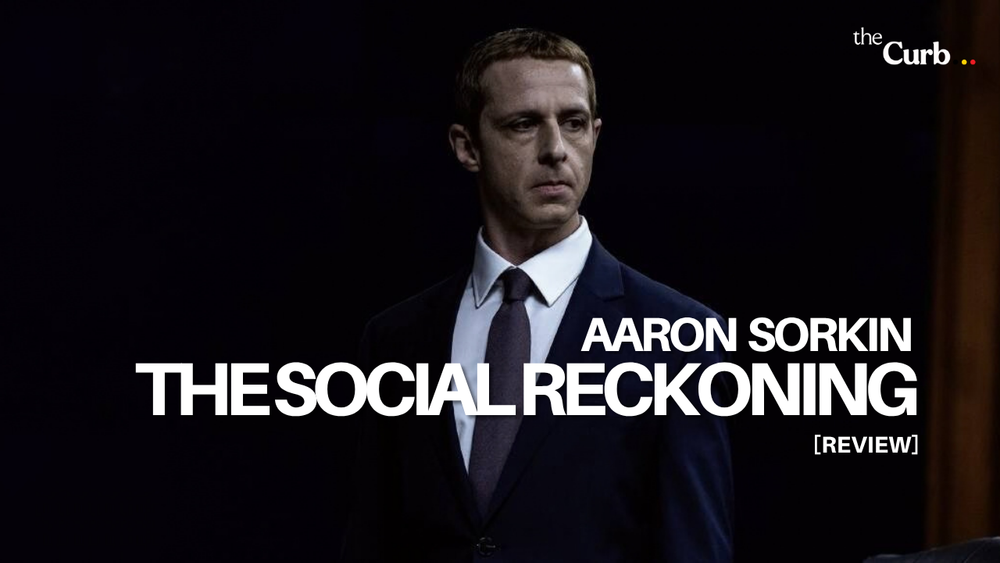
One of the most glaring errors of The Social Reckoning is the title itself. What reckoning? Mark Zuckerberg (played by an almost immobile Jeremy Strong) has managed to dodge any true repercussions for turning Facebook into a platform that encourages engagement with the far right and other harmful groups. A platform that allows and amplifies mis/disinformation to keep users (who are the product) glued to their screens and rarely looking up. Never mind the Cambridge Analytica scandal which came to a head in 2018 proving that at most Facebook would get a gentle tap on the wrist for illegally collecting user data and allowing that data to be used by Ted Cruz, Donald Trump, and Brexiteers to influence the public. Never mind it because Sorkin forgot to explicitly reference it. Instead, we begin with a question that’s already been answered by the Cambridge Analytica case, “How is Facebook radicalising people toward the right wing?”
Facebook data scientist Frances Haugen (Mickey Madison) watches a video posted by a “Patriot Karen” racially abusing two police officers. She recognises the woman in the video as someone who she once knew who used to be involved in progressive causes. Frances tries to bring this up with her boss Teddy Marks (Billy Magnussen) but is consistently shut down. Facebook employees aren’t there to have opinions, they’re there to do whatever makes more money for Facebook and Instagram. Analysing the data about how people end up in right wing and extremist groups on Facebook, Haugen discovers that Facebook’s algorithm itself is responsible for over 60% of the phenomenon using MSI (Meaningful Social Interactions) an initiative that values shares over likes and comments.
At the same time this is happening, Washington based investigative reporter Jeff Horwitz (Jeremy Allen White) has relocated to the San Francisco Bay Area to look into Facebook for the Wall Street Journal. Betty Gilpin plays his hilariously droll editor who gives him 90 days and two college interns to come up with a story. Frances tentatively reaches out to Horwitz giving him a taste of the rot in the machine. Frances doesn’t want to blow Facebook up, as a member of the Civil Integrity Team she believes that things can be fixed and Facebook can go back to being the platform that helped her connect with people as a shy outsider. She’s risking her job (and a massive lawsuit from a company more powerful than a country) but if there’s a chance that one story can change a negative outcome then she will have helped Facebook. The real issue is that Frances becomes aware of the viper’s nest powering the engine and as Jeff keeps pushing for documentation so he can verify what Facebook is doing, she becomes intrinsically linked to the “Cassandra” of ancient myth, whom Sorkin sets up in a chapter called “Cassandra.”
The film runs over a five-year period from 2018 through to 2021. In 2018 the audience is given the unsurprising revelation that Facebook knew it would be favouring “rage bait” and misinformation and just didn’t care. In 2021 Mark Zuckerberg is being taught by his crisis PR manager, Raya Akinola (Wunmi Mosaku) how to act like a human being in a mock-up of a congressional hearing where Zuckerberg is arguing against the repeal of Section 230; a law that means that internet sites can’t be sued for defamation for third party content, either in the form of paid advertisements or for any defamatory material. Raya has brought on board one former colleague and Facebook investor, Charlie Garrigan (an excellent Bill Burr) to truly challenge Zuckerberg about what he allows on the platform, specifically with political advertising.
As you can imagine, Sorkin is writing conversations, throwing out percentages and talking points (including cyberbullying and teenage self-harm and depression due to Instagram) like a man unleashed. What he’s not able to do is film any of the conversations with a remote sense of naturalness. Sorkin is a known speechifier, his adoration for the goodly monologue is his style. Sometimes he will get a good one, for example Bill Burr as Garrigan, but mostly he pontificates into the wind. For a film revolving around primarily real people, none of them feel real at all. It’s a tribute to Mikey Madison that she’s able to bring some pathos to Frances and the frightening situation she faces if she makes internal documents public. Under Fincher Jeff Cronenweth could make a conversation seem like a vital summation of character and intent; whereas under Sorkin, Cronenweth is holding so much at a distance that even when the film is aching for intimate characterisations the audience is given cardboard figures instead.
Perhaps the most heavy-handed part of the film is weaving in the January 6 storming of the Capitol Building. No one mentions the name Donald Trump, instead it’s “He’s just posted,” or “He’s a sitting President” as Zuckerberg has to make the decision to cut access off to a man inciting violent actions. Facebook was, in part, why the man was elected and its refusal to moderate open hate speech did help the rioters to connect with each other and organise. It’s only when Zuckerberg thinks he could be sued for allowing the footage to be continually uploaded on the platform by a “whitelisted user” that he shuts down the access. It’s a business move, not an ethical one.
The publication of the Facebook Files and Haugen appearing before congress (and the two books Horwitz and Haugen published) are the “win” in the movie. But, before Sorkin’s film was even released Facebook changed their name to META and settled some of the major lawsuits brought to bear against Zuckerberg’s Silicon Valley world empire. Nothing changed. There was no reckoning. And in the five years since 2021 we are seeing bigger threats from tech billionaires than imagined. Sorkin’s film is not only insipidly made, but also already irrelevant. People know that they’re being data harvested every time they send a message on messenger, or google a subject, or follow a Facebook ad. We’d already given away our privacy far before Jeff Horwitz and Frances Hauger collaborated on breaking the story of how sociopathically venal Zuckerberg (and fellow tech billionaires) is. Well, that is unless, like over 40% of Americans, we only get our news from Facebook. Instead of a wakeup call to action (air fist pump included) with a sense that somehow someone like Zuckerberg won’t control our information both in and out, like Sorkin thinks he’s achieving, the audience just sits as pre-boiled frogs who already know that not one revelation in the film is the least bit shocking.
Director and Screenplay: Aaron Sorkin
Cast: Mikey Madison, Jeremy Allen White, Jeremy Strong, Bill Burr, Wunmi Mosaku, Billy Magnussen
Cinematography: Jeff Cronenweth
Score: Alexandre Desplat