
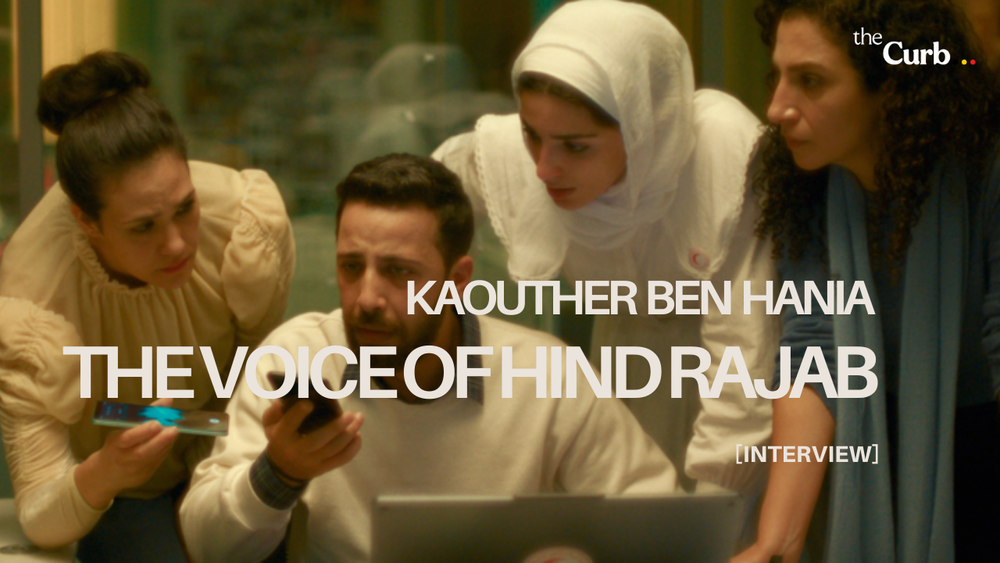
Kaouther Ben Hania’s The Voice of Hind Rajab is more than documentary, more than fiction, more than re-enactment, and more than a dramatisation of the calls received by the Palestinian Red Crescent Society (PCRS) Emergency line on January 29, 2024. It is a testament to the brutality of conflict spoken by a child who, needlessly and tragically, was murdered.
Nadine Whitney speaks with Kaouther Ben Hania about how she approached The Voice of Hind Rajab as a genre chameleon to honour those lost in northern Gaza and those who did everything they could to save the child hiding in a bullet-riddled car at the Fares service station.
You excel in the docudrama genre. Four Daughters was incredibly powerful. There's a new interplay in The Voice of Hind Rajab in that it sits between the fictional, which is not so much fictional, and the actual, the documented. How do you keep those modes, those disparities from overriding each other?
Kaouther Ben Hania: This was the question I was asking myself all along, the fabrication of the movie. Because I felt the need to tell this story in the present tense. So, to go through actors, I knew that it was in a way a little bit risky, because people think about actor as artifice, but we had in mind a re-enactment. We needed distance also because it's not easy to do a movie about such tragedy. So, there were many ethical questions about how to tell this story without being voyeuristic.
I think that the re-enactment and the fact that we were in those offices far from Gaza, in the image at least, because in the sound you have another space, the space of Hind. And this is a document, a real document, giving the movie the right distance to tell the story. There is not a drop of blood in the movie, because as Omar said in the movie: images all are all over social media. I needed to tell this story with the most respect and the most distance.
Those choices gave me this possibility to convey what I felt the first time when I heard her voice. Because the feeling I had, I needed to share with the audience. This was my job as a filmmaker. I didn't choose to tell Hind’s story – for me it was an encounter with her voice. Her voice moved me in a very deep way. I felt the helplessness, I felt the sadness, the anger; I needed to convey it in a movie.
But then you have all the questions. And as you mentioned, I'm very interested in the frontier between the genre, between documentary and fiction. This is something that I experimented with before. I felt like I have the tools maybe to go to this terrain because I needed to do the most respectful and impactful movie. To align those two things, is not an easy thing at all. So, this question was in my head. You can say that I'm genre fluid between documentaries. That was the main question I was asking myself all the time.
I was scared to death that I'll fail her voice and her memory by making an average movie or not a respectful movie.
I did this movie actually to make the voice of Hind Rajab resonate and echo; because the first time I heard her voice, it was on social media. And once when you hear it, you can’t unhear it. I thought that social media is a place for scrolling, a place for amnesia, and maybe cinema can give a space and a place to listen, to listen to her voice, to understand what she went through. I made this movie with this intention to honour her voice and to honour her memory.
In the beginning I reached out to the Red Crescent because what I heard on Internet was only a small extract. I wanted them to share with me all the recordings and to also understand what happened in their offices around the recording. They sent me the recording, which was around 70 minutes and also some footage. My job as a filmmaker was to tell this story in the most respectful way, and also I needed to tell this story in the present tense. Because when I heard Hind’s voice, it was really alive, she was alive.
I needed to go back there. And how you go back there? You do reenactment, you call for actors. When I decided to do the casting, I had in mind the real hero of this story. I talked a lot with them. They gave me their testimony. They told me everything I needed to know. And I had archival moments. One of their colleagues filmed them.
I did the casting. I was looking for Palestinian actors that looked like the real people because for me, it's like a contract with the audience. Those are actors. I needed this distance to not be in something voyeuristic, and to be in the offices, in this single location. And at some point, when the unthinkable happened, which is the bombing of the ambulance, I needed to go in this moment to reality, to archives. This archival moment.
I had this idea while I was writing the screenplay, because when I heard this and the recording, Yusuf al-Zeino the paramedic was saying, “Ah, there she is.” He saw the car at that moment, because he was in the dark and there is no electricity in Gaza. And at that moment, we hear in the recording the bombing. When I looked to this archival moment, they (the PRCS) heard the bombing, but they were trying to understand and confirm.
It was very, very important to say, “This is true, this really happened.” If you remember, in the movie, even the actor stopped acting at that moment to listen to the real character speaking to him. I built the movie to this moment, which is, as I said, beyond the unthinkable.
It's ongoing history. I'm doing a movie about something that happened recently and still happening when I was shooting. We were hearing about other ‘Hind Rajab’ stories. There is something about history and I needed to do this movie to be remembered, also as I to be impactful, to make the voice of this little girl resonate.
When I think about The Voice of Hind Rajab technically in terms of craft, pure craft, it's very easy. You have one location, four wonderful actors, some extras. And, by the way, all the extras were Palestinian also. But because of the context and because of the ongoing history, it was the most complicated movie I've ever done. So, at the same time, this movie gave me and the actors and the crew meaning about what cinema can do. I was asking myself a lot of questions about the impact of cinema, what can cinema say about the world we live in? I was starting to lose faith in cinema, but with this movie and when I saw the audience response, it was beyond my expectations.
We remembered that we should go on and do this movie because it's needed, and we have to bear witness. And for the Palestinian actors, it was important to tell their stories from inside, as they all have personal stories of loss.