
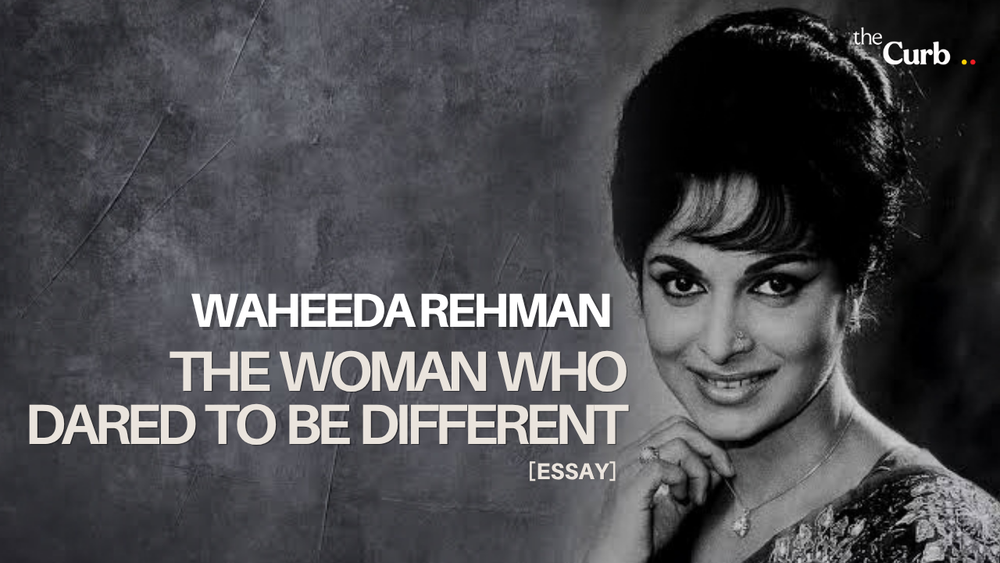
In director Raj Khosla’s Bombay noir C.I.D. (1956), an honest inspector attempts to unmask the members of an underworld gang who operate from the shadows. During his investigation, Dev Anand, who plays the cop, is called to an address by a femme fatale. Composer O.P. Nayyar’s ominous jazz-like opening to the song “Jaata kahaan hai divaane” plays in the background as Anand finds himself at a house party, his eyes searching all around for his mysterious caller.
And that’s when the magic happens. Khosla cuts from Anand’s searching gaze to a silhouette whose face is half-covered. A mischievous smile peeks from behind the veil draped across the face. Khosla zooms in, just as the face comes into full view and Nayyar’s dramatic musical prelude reaches its conclusion. The timing is perfect. Decades before Indian ‘mass’ movies popularised the hero's reveal build-up, Khosla uses the template to heighten dramatic tension and unveil his femme fatale. This is how Hindi cinema audiences first meet Waheeda Rehman. She is barely seventeen.
Rehman was thirteen when her father died suddenly, leaving her mother to make ends meet. She and her sister Sayeeda, both trained in classical dance, performed on stage. Rehman began learning Bharatanatyam around the age of nine, but some relatives disapproved. "Saab, you're a Muslim, and you're allowing your daughters to dance?" they asked her father. In 1950s India, the performing arts was not considered an honourable profession for women from respectable households, that too one from a Muslim family.
Her opening came with a song in the Telugu film, Rojulu Marayi, which roughly translates to "days have changed," and it couldn’t have been a more fitting descriptor for Rehman’s life ahead. The film’s success led to a meeting with Guru Dutt in Hyderabad. Three months later, in 1955, the seventeen-year-old signed with Guru Dutt Films and moved to Bombay. C.I.D. and Pyaasa (1957) followed, and by the end of the decade she was among Hindi cinema's leading stars.
It is remarkable to witness the self-belief Rehman had in standing up for herself from a tender age. On the sets of C.I.D., Khosla told her that the name ‘Waheeda Rehman’ was too long. They would call her ‘Waheeda’ and drop the ‘Rehman’. Dilip Kumar was Yusuf Khan, Meena Kumari was Mahjabeen Bano, Madhubala was Mumtaz Jahan, and Nargis was Fatima. But Rehman was steadfast and kept her name. She was among the first generation of Muslim actresses after the 1950s to decline a screen name, a Hindu one, that many of her peers had adopted. In a conservative, patriarchal industry, that stance required immense courage.
That same courage showed in how she chose to present herself on screen. For the song "Kahin pe nigahen kahin pe nishana," where she distracts the villain while the hero hides, she was handed a long-sleeved lace blouse with no lining and refused to wear it. Khosla was irritated. But Rehman did not budge, holding her ground that she would not wear a see-through blouse. Instead, she proposed having a dupatta over the blouse, which is what you see in the finished song.
Rehman in the song Kahin Pe Nigahen Kahin Pe Nishana in the film C.I.D. (1956)
Then came Pyaasa in 1957, and the role of Gulaabo, a sex worker, which both Nargis and Madhubala wanted. Rehman was just eighteen at the time. In the decades since, Pyaasa has rightfully taken its place as one of the best Indian films ever made. It is among the few Hindi films in which the hero builds a life with a sex worker. A more conventional narrative would let the woman or the hero die by the end of the story, sidestepping the social stigma. That Rehman took on a character as complex as Gulaabo at such a young age says a great deal about her instincts.
She was also present for one of Indian cinema's technical turning points, as films moved from black and white to colour in the early 1960s. Dutt decided to reshoot the title song of his film Chaudhvin Ka Chand (1960) in colour on a hunch that audiences would return to see it. The Censor Board wanted the colour version re-censored, asking for the removal of a close-up in which Rehman turns her face to the camera. They said her eyes looked "too red and sensual." Dutt explained that the red came from the strong lighting, and that the characters were husband and wife. The Central Board of Film Certification's decisions are often mocked today, but its instinct to apply a moral lens rather than certify films has always been present.
Rehman in the song Chaudhvin Ka Chand Ho from the film Chaudhvin Ka Chand (1960)
Her willingness to seek atypical roles caught the attention of the country's finest directors, including Satyajit Ray, who cast her in Abhijan (1962), adapted from Tarashankar Bandopadhyay's novel. When Rehman explained that she did not speak Bengali, Ray assured her that her character came from the Bihar–Bengal border and spoke a mix of Bhojpuri and Bengali, so language would not be an obstacle.
No film demonstrates her appetite for unconventional choices better than Guide (1965). Few people know that Ray wanted to adapt R.K. Narayan's novel and asked Rehman to read it, telling her he would cast her as Rosie if the film ever happened. But, as fate would have it, the rights to the book went to Dev Anand's Navketan Films instead, and the version Ray would have conceived was never realised. Where the stars were cruel to Ray, they were kind to Rehman, as the part of Rosie did eventually land in her lap, despite the film being made by a completely different team.
Rosie was exactly the kind of role that would be considered career suicide for a mainstream Hindi film heroine. She is introduced as a married woman, at a time when a leading lady was meant to be unmarried, chaste and desirable so the hero could fall in love with her. She leaves her husband to live with Raju, but the two never marry. An unmarried couple living together was unacceptable on screen. Rosie slaps her husband and walks out on him, going against everything a dutiful wife is supposed to stand for in a Hindi film. When Raju begins drinking, gambling and using her, she finds the courage to walk out on him too. She decides for herself, refuses a dead marriage, and refuses to keep propping up a love gone sour.
Despite being ten years younger, she had a close friendship with fellow acting stalwart Meena Kumari. When Kumari separated from her husband Kamaal Amrohi, Rehman suggested she buy a flat in her own building, so she would not be alone. When she heard her friend was dying of cirrhosis, she went straight to the nursing home to visit her. Kumari travelled to the Moscow Film Festival in 1967 to support her friend when Teesri Kasam (1966), with Rehman in the lead, was nominated for Best Film.
Their close friendship is being commemorated at The Indian Film Festival of New Zealand in October, which opens with Teesri Kasam, marking sixty years since its release, and closes with the new 4K restoration of Kamaal Amrohi's Pakeezah (1972), Kumari's final screen performance before her tragic death, courtesy of the Film Heritage Foundation. The two films bookend the program and the bond between two of Indian cinema's most loved cinematic icons who lived by their own rules.
Waheeda Rehman is the Guest of Honour at The Indian Film Festival of New Zealand, where a new, restored version of her film, Teesri Kasam, will open the festival next month.
Further reading:
Kabir, Nasreen Munni. 2015. Conversations with Waheeda Rehman. Penguin UK.
Chatterji, Shoma. 2025. Guru Dutt: A Study of Women in His Films. Storywell Books.