
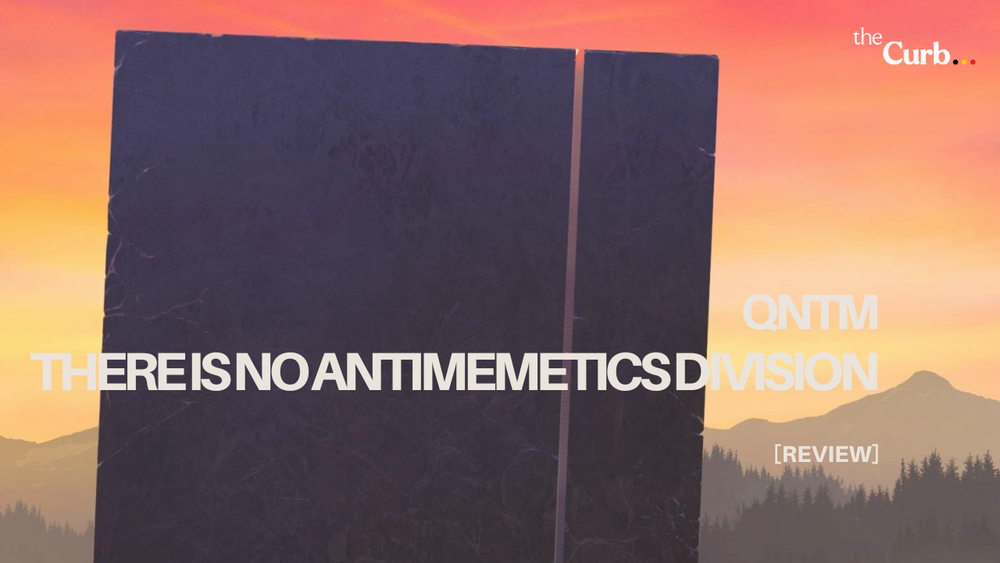
There Is No Antimemetics Division, a science fiction horror novel written by Sam Hughes (aka qntm) and published on November 11 2025, was spun off from an online fiction community but has literary and conceptual roots stretching back over a century.
The episodic but very well-structured plot follows Marie Quinn, an elite member of the shadowy Organisation, and other officials in her orbit as they study and combat unique “antimemetic” threats. If memes are transmissible units of information, then antimemes prevent their own spread, whether by preventing you from remembering or even perceiving them, or actively infecting and destroying information and consuming your memories. Hughes wields ingenious concepts and draws gripping suspense (and some pitch-black humour) from macabre abominations hiding in plain sight, a man’s past eroding as a predator closes in, and the hopelessness in needing to forget your plans so that an apocalyptic adversary can’t discover and thwart them. The prose is highly analytical yet deeply evocative (and only very rarely dry), and the sometimes abrupt tonal shifts – from Lovecraftian terror to calm debriefing – feel completely appropriate for threats that warp perception and which the characters are literally incapable of remembering.
There Is No Antimemetics Division began as a serialised story posted to the SCP Wiki between January 2015 and January 2016. The SCP Foundation is a collaborative online fiction community that presents itself as a secretive X-Files-like organisation, with stories styled as reference articles about the containment and study of paranormal entities and artefacts (“SCP” stands for “Secure, Contain, Protect”).
The 2025 professionally-published edition of There Is No Antimemetics Division removes any references to the SCP Foundation for Creative Commons rights reasons, which puts it in a similar situation to the Faction Paradox media franchise. Faction Paradox began as a subplot in nineties Doctor Who novels written by Lawrence Miles, but quickly evolved into its own legally-distinct universe.
Doctor Who often deals with antimemes, though not under that name. Perception filters, a popular plot-point, cloak the subject by preventing people from noticing it. In the 2024 episode 73 Yards, Ruby Sunday is haunted by a living antimeme in the form of a mysterious old woman who follows her everywhere at a fixed distance. Nobody notices the old woman unless she is specifically pointed out, and anyone who tries talking to her immediately runs in fear and turns against Ruby. The most intimidating, insidious antimemes in Doctor Who are the Silence villains from Series 6 in 2011, whose “memory-proof” ability causes you to forget them as soon as you look away.
Antimemes are closely related to the concept of information hazards (called “cognitohazards” in There Is No Antimemetics Division and other SCP media).
Defined in 2011 by philosopher Nick Bostrom, information hazards, or “infohazards”, are ‘information that may cause harm or enable some agent to cause harm’ if disseminated.
Bostrom identified six major types of infohazard: straightforward data (such as instructions to make a deadly pathogen or atomic bomb), non-specific but dangerous ideas, unwanted attention toward something hazardous, risky viral behaviour, social signalling that may attract abuse, and damaging or offensive methods of conveying ideas.
Spoilers are social infohazards: if you reveal the plot of a movie or show to someone who hasn’t seen it, you harm their enjoyment of the piece (and risk a slap). YouTube science communicator Kyle Hill points out the Streisand Effect as an “attention hazard”: in 2003, ‘mega-singer superstar Barbra Streisand tried to have [a] photo of her home removed from the Internet. Instead of being seen by just two of her lawyers, the Internet had its attention called down upon the photo by 420,000 people’ in a single month.
Infohazards can be a pretence for censorship and repression. The recurring moral panics over violent video games, heavy metal music and Dungeons and Dragons frame such media as infohazards corrupting our youth. Christian fundamentalists regard Harry Potter and other magic-themed media as Satanic infohazards, despite the fact that most magical heroes use their powers for good against a clearly-defined evil. American conservatives have a running list of infohazard books they seek to ban.
The Nazis in Philip K. Dick’s iconic 1965 alternate history novel The Man In The High Castle treat The Grasshopper Lies Heavy, a banned but popular in-universe book about an Allied victory, as an offensive infohazard, as even the suggestion of an Axis defeat threatens their rule.
The totalitarian Party in George Orwell’s 1984 treats regular English as one big infohazard, and constantly culls words and constrains expression to stifle any dissenting speech or thought.
An infamous alleged infohazard in popular philosophy is the Roko’s basilisk thought experiment, which was first posted to the LessWrong forums in 2010. Roko’s basilisk posits a future artificial superintelligence that tortures anyone who knew of its potential existence but didn’t aid in its creation. The AI is named after the basilisk, a mythological beast that, like Medusa, kills with its gaze, because of the (unsettling for some) implication that if you know about the AI, it can “see” you, and ignorance of the basilisk is your only salvation. You don’t have to worry, though, as video essayist Thought Slime considers this thought experiment ‘a technobullshit sci-fi version of Pascal’s Wager.’
One of the monsters in There Is No Antimemetics Division is a bitterly ironic infohazard: the only surefire way to contain the creature is to completely forget about it, but Quinn unwittingly releases it by restoring a dying researcher’s memories.
Infohazards in social and political discourse are ideas and information that may have harmful effects, but serious infohazards in fiction, including Hughes’ memory-devouring antimemes, can attack and destroy the mind itself.
In American author Ted Chiang’s 1991 short story Understand, a braindead man named Leon Greco gains superhuman intelligence through an experimental serum. Leon ultimately learns of a rival supergenius named Reynolds, who sets a trap for Leon using a string of disparate stimuli. Each stimulus means nothing on its own, but together they form a catastrophic infohazard that unravels Leon’s mind once Reynolds utters the kill-phrase of the title.
Speaking of kill-phrases, cyborg agents Gunther Hermann and Anna Navarre in the 2000 video game Deus Ex are programmed with special phrases that will instantly kill them if they ever go rogue.
In Melbourne author Max Barry’s 2013 novel Lexicon, a secret order of “poets” have an almost magical capacity to influence and manipulate people through language, and a lethal word triggers the crazed destruction of an entire town.
The King In Yellow, an 1895 short story collection by Robert W. Chambers, contains what may be the first literary infohazard.
A landmark work of supernatural fiction and a major influence on H.P. Lovecraft, the book’s darker stories delve into delusion and conspiracy, an alchemical accident, macabre visions in a cemetery and a lover lost in time.
The titular motif is a mythic, feared in-universe play that we receive small snippets from throughout Chalmers’ stories. Like Reynolds’ trap or the antimemes Quinn and her team fight against, the King In Yellow play drives anyone who reads it to completion insane, and even characters who read small snippets are left deeply shaken.
If the King In Yellow play existed in the world of There Is No Antimemetics Division, the Organisation would probably classify it as a deadly antimeme and suppress or destroy every copy.
Sam Hughes’ There Is No Antimemetics Division is a very modern novel, being the product of an online forum community, but its themes of antimemes and infohazards draw from a long literary and pop-culture legacy.
