
By the time a franchise reaches its fifth entry, it’s rare for it to maintain the quality and innovation needed to sustain and satisfy its audience. Flop blockbusters such as Ice Age: Collision Course, Terminator Genisys, and Pirates of the Caribbean: Dead Men Tell No Tales, prove certain stories reached their natural conclusions multiple entries earlier, ending up presenting tired ideas and rehashed methods into new realms of diminishing returns. For the rare exceptions that rise above this, think Fast Five or Mission Impossible – Rogue Nation, success comes from fundamentally reinventing the established formula, pushing the series into new and fresh territory.
What makes Toy Story 5 fascinating is that it is both playing with, and maintaining, what makes Pixar’s beloved IP so enduring. Rather than reinventing itself entirely, it relies on the emotional recipe that made the first four films so beloved while introducing a timely new ingredient: how do toys remain relevant in an age of technological overload? The result is a film that feels familiar yet evolving, continuing the story of our favourite toys while inserting a modern, tech-driven edge to its sentimental charm. With Jessie (Joan Cusack) taking up leadership duties of Bonnie’s room (Scarlett Spears), it falls to her and her now-deputy, Buzz Lightyear (Tim Allen) to prove the toys’ value when the frog-shaped tablet Lilipad (Greta Lee) begins turning playtime into screen time.
Toy Story 5 follows three concurrent storylines, each that have merit but feel unbalanced in the opening acts of the film. First there are the ‘Multi-Buzz’, a group of high-tech Buzz Lightyear toys that have washed ashore from a container ship. They are comically stuck in demo mode and determined to reach ‘Space Command’. Alongside this is the returning owner of the toys, Bonnie, who is exceedingly lonely and struggling to find friends. She’s the only kid on the block who still plays with toys – everyone else is glued to a screen as if infected by a pixel-driven plague.
Bonnie’s parents decide to buy her a Lilipad, a child-marketed tablet, to counter her feeling of alienation and connect with other children online. Immediately, much to Lilipad’s delight, the shy eight-year-old becomes utterly enamoured with technology, and less attentive to her toys. When her first social experience on the tablet goes pear-shaped, Bonnie does everything she can to erase who she is, desperately trying to fit in with a trio of screen-addled mean girls. Does this mean irrelevance and abandonment for the toys?
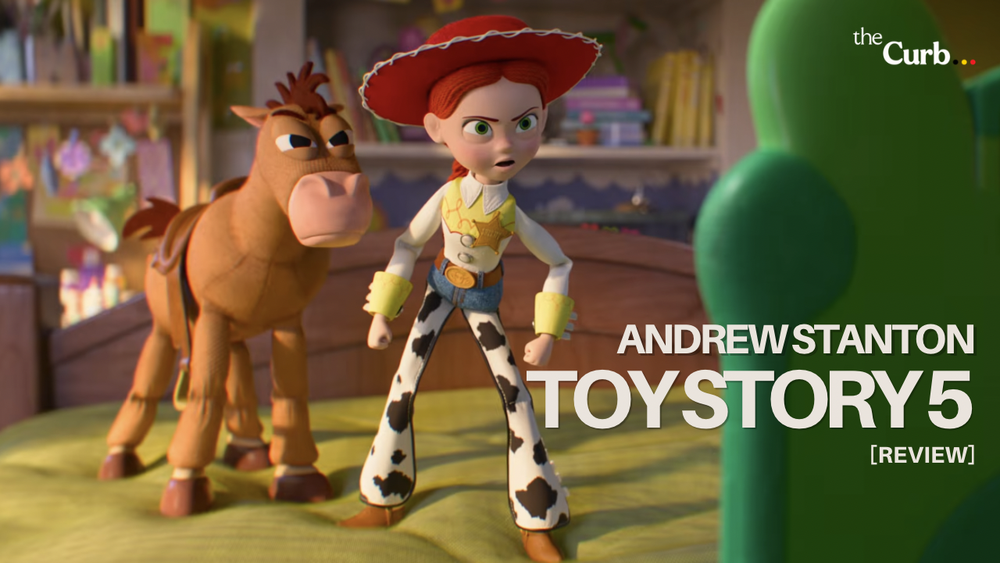
The strongest and most predominant storyline involves Jessie, who takes up protagonist duties from Woody (Tom Hanks) and Buzz and becomes the narrative and emotional anchor of the film. Jessie is at odds with Lilipad from the get-go, hell-bent on switching her off and finding Bonnie the right friend who can play with her without the necessity of a screen. After a quick radio call to Woody for help, Jessie and Bullseye eventually end up away from Bonnie’s room and accidentally returning to the home of Jessie’s original owner Emily and meeting the new occupant, the horse-loving Blaze (Mykal-Michelle Harris). It’s up to Woody and Buzz to team up once again while Jessie battles both the screens and her past.
The second half of Toy Story 5 is a lot better than the first half by managing to bring many disparate elements together and craft a touching story about the importance of physical connection, friendship, and the unknowable impacts a toy can have on a child. Joan Cusack gives a determined and poignant vocal performance, giving Jessie the long-overdue spotlight she deserved since the days of Toy Story 2. The direction by Andrew Stanton, who co-wrote the film with Kenna Harris, reveal touching new layers to the character, particularly in one of the film’s defining moments. Tim Allen and Tom Hanks are always reliable as Buzz and Woody, but the latter’s shoe-horned purpose wedged into the plot begs the question: would it have been better for Toy Story 4 to remain as the iconic cowboy’s swansong?
While all the legacy characters take a backseat for most of the film, the new additions include Conan O’Brien, Craig Robinson, and Shelby Rabara as digital gizmos Smarty Pants, Atlas, and Snappy. While they all add a fun, comedic expansion to the roster of toys-needing-batteries, the now thirty-plus voice cast feel increasingly over-stacked. This means characters fleshed out in the previous entry: Forky (Tony Hale), Duke Caboom (Keanu Reeves), and Bo Peep (Annie Potts) feel like a disappointing afterthought. Thankfully, Greta Lee brings a certain conniving nature to Lilipad, a tablet that can hack and manipulate with sinister glee – a reminder to audiences that technology with too much autonomy can yield damaging consequences.
After the photorealistic spectacle of Toy Story 4, the fifth entry maintains the industry standard for animation while also experimenting with the form itself. Some of the film’s strongest sequences unfold within Bonnie’s imagination, swapping hyper-realism and full frame rendering for watercolour and pastel palettes, softened by illustrative, crayon-esc brushstrokes. Using this stylised format, the audience is quite literally transported into the wonder and joy of a child’s creative vision, reinforcing the innocence and importance of playtime. A dreamscape wedding has never had more whimsy and youthful charm.
Pixar’s rendering software has progressively evolved to the point where visual effects across multiple shots can be adjusted at once, allowing lighting, colour-grading, and reflections to appear more dynamic, detailed, and distinguished than ever. Under the new renderer, titled XPU, this makes the film a visual feast. Bonnie’s eyes are as equally expressive as they are reflective, a cavalry of Buzz Lightyears on horseback dazzle with multi-rendered flashiness, and the sunsets over Jessie’s childhood pastures radiate a nostalgic yet luminous warmth. This industrial leap also produced a notable breakthrough for the studio: Blaze’s tight curls a new revolution in the way textured hair is developed and rendered in animation.
All this digital prowess creates a slightly comical dissonance at the centre of Toy Story 5 – a franchise that has consistently used technology to innovate now devotes much of its narrative to tell a cautionary tale about overreliance on technology. This is particularly ironic from the team who once developed the first fully computer-animated theatrical feature. However, the film’s messaging is faithful to its origins; promoting a balance between face-to-face interaction, technology, and imagination – encouraging audiences to stay true to themselves without becoming subsumed by our devices.
Toy Story 5 feels like a natural next step for a franchise that has proved its relevance for over three decades. With a smart decision to make Jessie its lead, a mature reminder for both parents and children to balance our screentime, and ground-breaking animation that captures the wonder and significance of imaginative play, it’s rare that a series can bring a tear to the eye five films in. It may never reach the heights of the original trilogy, but Toy Story has continually proved that the fear of abandonment, and the need to feel wanted, is a beloved story worth continuing.
Director: Andrew Stanton
Writers: Andrew Stanton, Kenna Harris
Producers: Lindsey Collins, Jessica Choi
Cast: Tom Hanks, Tim Allen, Joan Cusack, Greta Lee, Conan O’Brien, Craig Robinson, Tony Hale
Music: Randy Newman