A colleague of mine, Travis Johnson, asked once in a piece on Ken Loach, “Where have the great social realists gone?” He was writing around the time Sorry We Missed You came out (2019) and noted that somewhere along the line there was a near death knell coming for the working-class drama. Ken Loach, now a nonagenarian, bid cinema goodbye with his excellent drama The Old Oak. Mike Leigh returned from the mode of historical drama with Hard Truths, a brilliant film that he couldn’t get into major festivals. There are working-class stories, of course, but they’re now reduced to small cinema fare. Who are the Robert Bressons? The Vittorio De Sicas? There are stalwarts like Andrea Arnold, but even her last film had a touch of the “magic social realism” that seems to be more popular.
Social realism isn’t gone, in fact it is flourishing in Europe with the Dardenne brothers, and in Middle Eastern countries such as Iraq and Africa (Happy Birthday and The President’s Cake being excellent examples). Visar Morina’s Kosovo set drama Shame and Money is a masterful social realist tragedy that chronicles the changing fortunes of a rural family who are forced to leave their farm and look for work in Pristina the capital city of Kosovo.
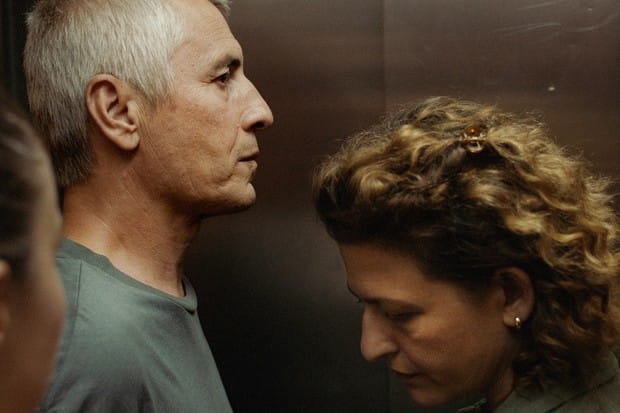
Shaban (Astrit Kabashi) lives on a farm with his wife Hatixhe (Flonja Kodheli), their three daughters, his mother Nana (Kumrije Hoxha), his two brothers and his brother’s wife and children. Their daily routine is one of shared responsibility and bartering with neighbours and selling dairy produce. The youngest brother Liridon (Tristan Halilaj) asks Shaban and their mother for 1800 Euros so he can relocate to Germany with a friend. They leave a small amount of money around which he takes (the logic was that he takes what he thinks is all the money), but unhappy with what he considers a paltry sum Liridon steals and sells the farm’s cows leaving Shaban, Hatixhe, their children and Nana unable to sustain themselves. The other brother, Agim (Abdinaser Beka), who is a schoolteacher says that he and his family will stay in the village but no one is to talk about what happened. He cannot be connected to the shame of having a brother who is a thief.
Shaban and his family, including Nana, make the move to the capital city partially reliant on Hatixhe’s sister Lina (Fiona Gllavica) and her businessman husband Alban (Alban Ukaj) to help with securing an apartment for them in the city and providing a janitorial job for Shaban at his bar. Meanwhile Hatixhe is asked to “help” with Alban’s disabled father by Lina; a favour that becomes almost a full-time unpaid position. Unable to sustain six people on a part-time wage from Alban, Shaban lines up on the street with other workers hoping for small construction jobs. A practice that Alban finds shameful as his neighbours could see his brother-in-law “begging” for work.
Morina’s drama is (mostly) unembellished and potently matter of fact. Shaban and Hatixhe are hard workers who don’t want anything they haven’t earned, but the one thing they can’t earn is a level of respect and dignity from the faceless city that doesn’t allow them to fit in. As they slowly lose precious keepsakes and their ability to control the most basic aspects of their lives, Shaban and his family begin to realise that they have no value, not only to the many businesses that turn them down when asking for work, but to Alban and Lina who increasingly exploit them but do so with the aspect of “charity” and goodwill. After all, Shaban is a “good guy” and will wear the continued dehumanisation because he’s not in a position to fight it.
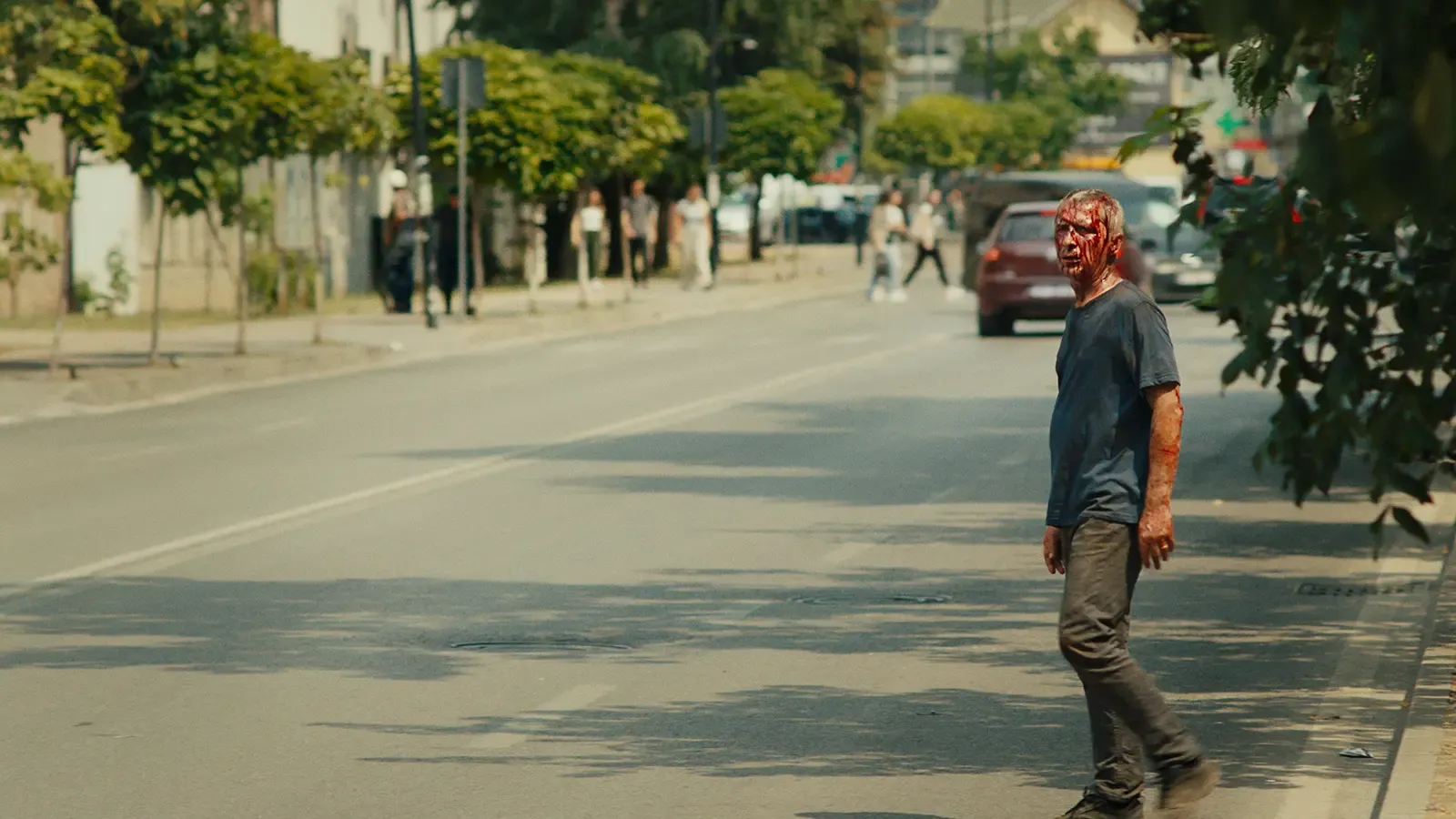
“We don’t have the luxury of shame,” Hatixhe says to her sister when Lina once again begs her to talk to Shaban about not joining the line. Shaban is losing his grip on what and who he is as he struggles every day to bring in enough money to keep his family alive. “Sometimes I feel like I’m not all there,” he tells his worried wife as she watches him descend into depression. It’s that loss of personhood that Morina keeps his camera trained on. Astrit Kabashi’s performance as Shaban with his patient rhythm of work and love for his family becomes heartbreaking: not because Kabashi ever forces the breakdown that will end in violence, but rather the opposite. Kabashi projects an aura of resilience and respectfulness that speaks to his basic decency and the trust that he has that others will also be decent.
Shame and Money is incredibly accomplished and understated, and when there is the eventual rupture that the film builds to, Morina hasn’t forced empathy in the viewer but fostered understanding through brilliant character work.
Shame and Money proves that impactful social realism is something audiences will remain rewarded by because it is a truly humanistic mode, and one in which Visar Morina excels.
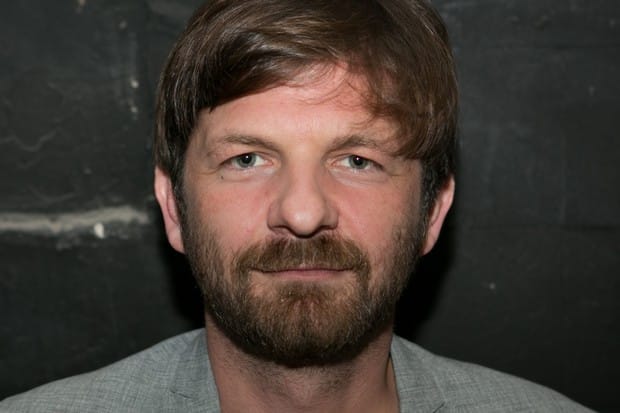
Nadine Whitney spoke with Visar Morina courtesy of the Sydney Film Festival.
Shame and Money is extremely, extremely effective. What an amazing experience to watch someone's autonomy being eroded through just not fitting into a capitalist structure in their own country. How did the film come about?
Visar Morina: There were actually different things I think that had an effect on creating the film. First of all, in my previous film Exile there was an image of the two actors Astrit Kabashi and Flonja Kodheli who are the leads of Shame and Money. They had a tiny scene together, and after the shooting of the scene, I took a picture of them. Astrit was putting his hand over Flonja's shoulder and looked a bit insecure. I was looking at the image, and I felt very much reminded of my parents. During COVID I was thinking a lot about my parents, and I was a bit worried about them. Somehow, I thought about them in a way, maybe also because of my age, but I started seeing them in a different light. Thinking about the difficulties that they went through in migrating to Germany. I was just wondering what the times would be like to leave home (rural Kosovo) What would their path be? I started writing it about the house and farm I grew up on.
I grew up actually in the same village that the beginning of the film is set in. I grew up with cows. I still love them. I had a very nice connection to the cows, to be honest. I miss them a lot. We had chickens. We had a small farm, and when I think back, I think it was quite a good time for my parents.
You create a wonderful feel and display the rhythm of the farm. Sha an is calmly capable within that environment.
VM: I was thinking a lot about this CV Shaban has been asked to provide for his brother-in-law in Pristina. I was thinking a lot about this concept of work. and you know, If you live in a contemporary city then it's maybe it's hard to imagine having a CV. But if you are born into a society like Shaban was at the very beginning, that’s not conceptually how you view work and experience. For Shaban and Hatixhe, if a flower needs help when you water it, or if an animal needs help, or brother, or your son, or whoever needs help, you help. That is part of being together and it’s not so much a concept of “work.” Being brought to the city and asked what can you bring to the society that we can make money off. This is basically how Shaban is being valued.
Helping comes through as well with Hatixhe when she is caring for her brother-in-law's father. She doesn't see it as something she should be paid for, because that's part of helping. When her sister buys her clothes, or whatever, she’s uncomfortable because she feels like she’s “being bought.”
I think that that's a very strong indication of how their paths have diverged from the rural setting into the city setting. What Hatixhe is doing is a job people do need to be paid for when providing that level of care.
VM: I thought that was also very much like the line where things are getting unclear. I like that Hatixhe doesn't feel comfortable getting this jacket as a present. She feels like actually she's being bought, then then she feels bad because her sister gets offended. Yet, then her sister asks again, “Can you please take care of them?” That’s a line where there is misuse.
Shaban’s mother says to him that he’s not to be a gardener at Alban and Lina’s while they’re living in a small garage on the property. She reiterates that they are not their servants.
VM: I was putting my mother’s wisdom in there. Don't mix things. If you’re working for someone so close to you, you might get difficulties. My mother was right, For me a very important process during the writing (I didn't write it myself, I wrote it with a friend Doruntina Basha) was to emphasise that this feeling of disappearance; this feeling of not being there, and this feeling of being so disconnected to everything that you some at some point feel like a thing circling around, a being no having no attachment to anything.
I feel when you see films portraying what we call the working class, very often there is a very classist view on them. Someone decides if someone is cleaning the window it’s only because he or she had a terrible childhood or was assaulted by her or his parents, or whatever. The people making the films very often form a point of view where they are very sure that what they are thinking, what they are doing, it's good and it's better than what someone who is cleaning the street.
To be honest with my job, I don't know if it's sometimes much smarter to be a street cleaner. I’d know what I'm doing. I’d see that through my work the street is clean. I’d have a sense of momentum and accomplishment. And so, from the very beginning, breaking down assumptions was a very important thing. It's about dignity.
We were also, for example, concerned about how to portray the animals. I really didn't want them to be as props in the film. It needed to be honest. I'm deeply influenced by, by Italian neo-realist cinema, and by Iranian cinema. I feel they are so good and so great at portraying the reality they are set in. But very often even in those depictions to your soul goes under in a way.
My biggest challenge was to create a shift. To start with a social environment, and basically to examine what it does to the people offering themselves every day and being treated like they are treated. Trying to convince people “I'm worth being part of this, you know, and I am also a human being.” I feel at some point people start wondering if they matter. Trying to convince yourself of that is where the shift starts.
It’s quite the existential question that we deal with in the West. We value the bits of paper we have, and what we own, and all those sorts of things as tell us (and others) what our personality is. I think that that's just consumerism within itself, it creates class and aspirational class.
It also fosters the rebellions against being told precisely what you can and can't do based on class. In Shame and Money, you illustrate having your personhood stripped away from you. It leaves one as a raw edge of emotion. You see that when Shaban is triggered by certain words that he no longer has the buffer of self-worth to remain completely in control.
VM: I think I have a very nice dad, and honestly, during the edit, I realised how much Shaban is also my dad. He was always labelled as being decent, being nice; so many words linked with “good.” I remember as a child being a bit pissed when people referred to him that way and later I realised actually it's a euphemism for “harmless.” It's crosses the line of not taking someone seriously. You seem like a good guy. There's no harm I can expect from you, so I can misuse your decency.
I was not expecting how much people related to the film. After the screenings at Sundance people started telling me about their own situation, or the situation of a family member, or a friend. How much they feel this threat of becoming homeless every day, or jobless every day. It was very touching.
In America as there are no real governmental safety nets many people are inches away from the poverty line even if they have jobs. It’s highly ironic that the Bill Clinton statue plays such a big part in the film and that America was aspirational.
VM: Everywhere people always say something or have a question about the statue, but to be honest, it was more or less an accident. The statue is standing there next to the workers line, and each time you enter Pristina you see it. I was always a bit horrified, and a bit amused, and a bit weirdly touched by the statue as it does represent an end to war.
Director: Visar Morina
Screenplay: Visar Morina, Doruntina Basha
Cast: Astrit Kabashi, Flonja Kodheli, Kumrije Hoxha, Fiona Gllavica, Alban Ukaj