
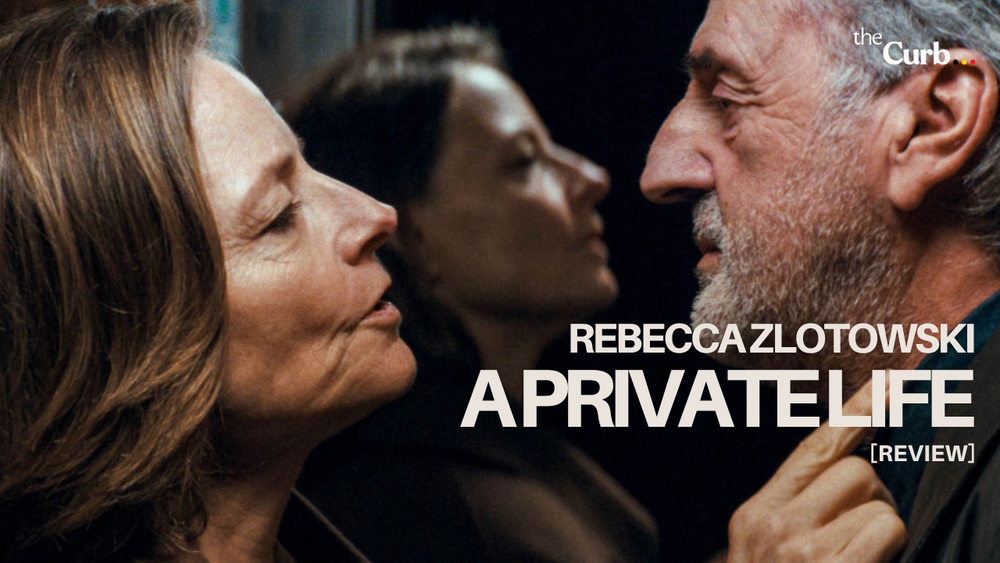
Rebecca Zlotowski’s lighthearted mystery about a psychiatrist descending into an endearing and bourgeois neurosis gives us thrills with a delicate touch, before wrapping us in a warm blanket and handing us a glass of Bordeaux in front of a beautiful cityscape of Paris in the snow. It’s a cosy experience, one that represents a fantasy of bourgeoisie living and its accompanying problems, problems that feel severe but can be easily solved with an honest conversation and a nice bowl of pasta.
Jodie Foster, in her first French speaking leading role, plays Dr. Lilian Steiner, one part MiniDisc-committed Luddite, one part repressed intellectual; her bookish and logical brain trained to contextualise her feelings into near non-existence. Upon learning of a patient’s suicide (played by Zlotowski regular Virginie Efira) she examines the tears coming from her eyes with the cold demeanour of a hard-boiled detective. Luckily, she retains chemistry, both emotional and physical, with ex-husband Gabriel (Daniel Auteuil), who, being an ophthalmologist, tells her she is, in fact, crying. It’s the first time he’s ever seen her tear up. Upon asking her what happened, Lilian provides the only answer a self-respecting introvert can give: “No, nothing special.”
If the external mystery of the movie is what really happened to Lilian’s late patient, the internal mystery is why does Lilian and her normally balanced interior care so much about this particular woman? Like any good enigma, we are given clues to both: a note representing the final writing of this potential victim of crime, and Lilian’s own desperation to bring a stop to her ceaseless tears. Cynically inspired by a disgruntled ex-patient, she seeks out the help of a hypnotist (Sophie Guillemin), who tells her bluntly: “You’re in mourning.” Lilian’s taken aback when this hypnotist envelops her into a trance-dream whereby the emotional breadcrumbs stack up – classical music, Nazis, a gun, and Lilian herself expressing love in a most unexpected way.
In the spirit of psychiatric overthinking, Lilian pursues answers to her late patient’s death with the kind of intrigue that would make Poirot proud. Listening to MiniDiscs of their recorded sessions, Lilian hears the plot as she wants to hear it: murder! The jump is illogical, hardly sold to us as something worth truly believing, as if A Private Life has trouble trusting its own intentions. Yet, if you’re often beset by cosy mysteries, there’s a part of you that never wavers in enjoying the flaws and indulgences of Lilian as she co-ops her ex-husband along for an investigatory ride of confirmation bias and an ever-so-slight touch of danger. She can be an adorable character, unleashing her humanness in small and heavy doses: “I want to drink a lot in a short time,” she says, before her ex-husband gives her the response we all want to hear: “I’ll join you.” She drunkenly tries to explain to police officers the growing web of homicidal intrigue, only for them to react like she tried to summarise quantum mechanics.
The mystery itself is only moderately distracting, but since it’s based on a sweet, unexpressed queer love and also brings with it a sly comedy that’s gently aware of its own silliness. Jodie Foster has plenty of empathetic moments to slightly elevate this material above a forgettable thriller. There’s even time to challenge her, to push her character on her contradictions. Whilst meeting her psychiatric mentor (the legendary documentarian Frederick Wiseman), she’s told exactly the problem one hour in: “You’re in avoidance.” It’s a flaw we see so clearly, and yet A Private Life is still willing to leave Lilian in the darkness of denial, even at the risk of alienating her from the audience, which is where the talent of Foster becomes paramount – even in ignorance, she is delightful to spend time with. It’s not a gift many performers possess.
Like many French dramas, it glows during dining scenes where our characters are forced to socially confront their absurdities. As the food and wine mix at dinner, Lilian projects her vivid hypnotist vision onto her own son to take him down a peg. Here the thin line between comedy and tragedy is beautifully woven as her psychiatric armour cracks and her neurosis spills out to bruise her immediate family, all delivered like she’s granting kindness – the cruel trick of a trained psychiatrist.
But before things get too serious, Lillian and her supportive ex-husband return to their investigatory meanderings, breaking and entering a home with the goal of a finding a smoking gun, the complexities of their prior relationship revealed as they bury themselves deeper in contretemps. Unfortunately, since the antagonist is never with conviction, the formidable Mathieu Amalric never gets out of first gear by the final act, he is reduced to a figure who should induce fear but instead feels under-cooked. As the mystery grows more contrived, we do receive a much needed denouement that rounds out Lillian’s arc as a person who needs to spend more time connecting with the people in her life. If she doesn’t quite contend with her feelings of covert love, we still get a sense that her willingness to live in the present moment is earned. In the cosiness of Paris in winter, red wine dinners, and old lovers in new trysts, it seems the pleasure of A Private Life is more in the fantasy of bourgeois misadventures than in the sincerity of its storytelling.
Director: Rebecca Zlotowski
Starring: Jodie Foster, Daniel Auteuil, Virginie Efria
Writers: Rebecca Zlotowski, Gaëlle Macé, Anne Berest