Franz: Becoming Kafka directed and co-written by Agnieszka Holland presents the literary icon as both mysterious and a fairly rounded and functional person who enjoyed rowing, fell in love, cared deeply for his sister, obeyed his overbearing father, and actually wasn’t propelled into some self-guided destruction.
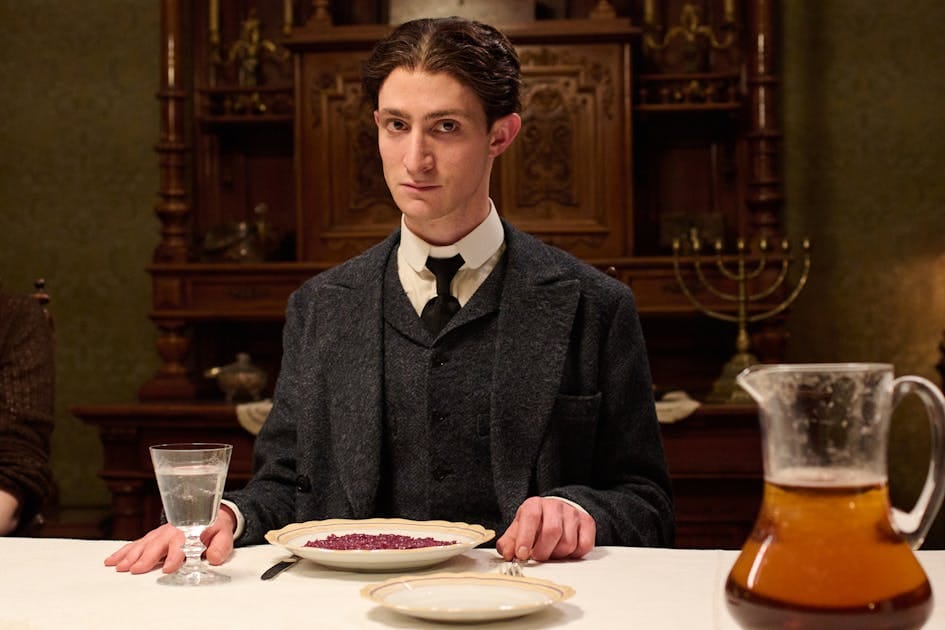
Idan Weiss plays Franz Kafka as a man who certainly had some fixed ideas and mountains of self-doubt that wasn’t alleviated by the constant literary rejections he received. But Franz was not the human version of Gregor Samsa. He valued quiet after living in a household with chaotic sisters. He valued his friendships. He had a peculiar idea of fairness, but he was a great deal more quotidian in his day-to-day life (at least to the outside world) than the collective imagination has decided he was.
The beauty of Holland’s film is that it intersects Kafka’s life with Kafka’s reputation over 100 years after his death. She creates an interactive Kafka Museum where tourists go to experience “Kafka” while in the film the man struggles to become part of the Austrian literary establishment and eventually battles ill-health. Frank Kafka has no idea he will become the primary voice of absurdity in a future that reads his work as prophetic and cutting into the core of bureaucracy and the cruelty and foolishness of both the middle-classes and the ruling classes. Idan Weiss is the Kafka who can’t stop giggling in front of his superiors at work. He’s the Kafka who goes rowing on the Vltava and spends time in fitness retreats. He’s the Kafka that falls out of love with one woman and in love with another. A child who imagines great shadows falling across Prague, and the man whose first major public literary reading was of the forever-chilling The Penal Colony.
Franz Kafka was a man of his time but also a man of the future. Holland’s film shows him reaching toward the avant-garde with his unique imagination. At its very best Franz: Becoming Kafka drops breadcrumbs for the audience to follow to go on their own search for an author who shapeshifts in our understanding; and in adopting that openness and style, Holland has made a stunning biographical and imaginative literary work.
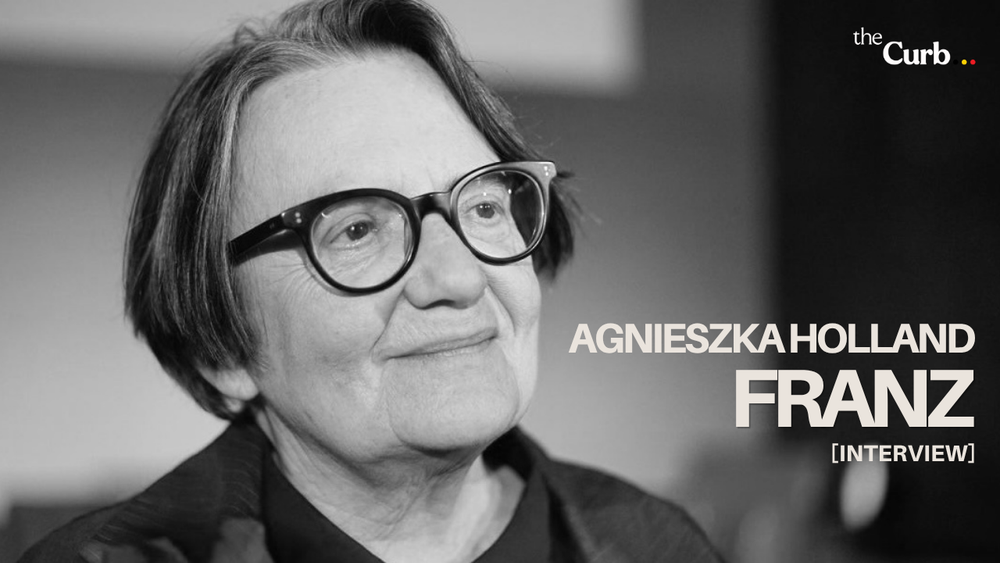
Nadine Whitney was lucky enough to speak with Agnieszka about the film and her fascination with one of the greatest writers of the twentieth century.
Nadine Whitney
I loved Franz. Idan Weiss is a revelation as Kafka. How did you find such a perfect actor for the role?
Agnieszka Holland: It was luck because he was totally unknown, and he was presented to me by Simone Bär a legendary casting director from Germany. Idan was in the first video she sent to me. I wanted, absolutely, to meet him as soon as possible; and I wrote to Simone, and she didn't answer for one week and then not for a second week. The German co-producers, and they told me that she just died. I have to say that Idan was her last gift to me.
Idan was not very experienced in terms of the film set and so, but he was very soulful and thoughtful; and he prepared by diving into Franz Kafka's work. I had to push him a bit to avoid going into the dark and help him to open up for the other dimensions I wanted to touch. We didn't want to fall to some kind of the stereotype about crooked dark France hiding in the shadows. We’d been looking for the playfulness as well, and for some of the of the differences which were not only in Kafka’s talent, but also in his psychological construction. I can’t imagine how the film would look if Idan didn’t exist and wasn’t proposed to me by Simone.
Yes, he is extraordinary. You mentioned something that I wanted to touch on myself. The film busted a lot of myths about Franz Kafka as a person. There's always a sense that Franz was the ultimate outsider, but you show that he was fit and sporty, he had relationships, he had a sense of humour, he had friends. These aspects of Kafka I think people forget when they go in depth into his work. There is an assumption the man who wrote Metamorphosis must be sterile, anxious and permanently suffocating in existential dread. You've captured a rounded human being. What was it like bringing a kind of revolutionary version of Kafka to the screen?
AH: I was fascinated by, or I felt really close to Franz Kafka, since I was a teenager. In my youth I had very like personal relationship with him. I had the impression that I knew him, that I understood him, that I could maybe save him even or help him. It was a fantasy about him that remained in my sensibility even when I was more taking care to understand his literature and his diaries.
I finally thought that we can try, that I can try with the help of the screenwriter and my Czech producer Sark Cimbalova, to find different ways to speak about him, not only in terms of the of the of the breaking down the stereotypes about his persona, but examining a different style, and a different form in creating something biographical about Franz Kafka. I told to myself that it will be something which I can call “looking for Franz”, that it will be the process of searching. To approach him from different perspectives, and through different means, through different media, and multiple approaches. In the fragments or puzzles or our kaleidoscope, we can maybe find something which was hidden, you know, to at least to most of the people who know about Kafka.
There's an incredible statistic in the film about the number of words written about Kafka compared to the number of words that Kafka wrote himself. Ten million words about Kafka for every word he wrote.
AH: I'm not sure that it's exact, the account is changing. What is not changing the words he wrote, but what is changing it is what is written about him. Especially during the anniversary year of Kafka, there were new books and biographies, and new academic analysis.
Kafka is so incredibly important to literature. Another aspect that I found remarkable in the film, is the way that you were able to bring in Kafka's stories and ideas into his biography through kind of fantastic means. You have Franz outside his apartment as a child, and you add these exaggerated shadows. When he's doing a live reading of The Penal Colony, you've filmed a version of the story to give people the intensity of what is actually being read aloud. Can you tell me a bit about creating Kafka's literary worlds within the film?
AH: We’d been struggling with that all during the preparation, writing, and the filming. As you can imagine, and, as you know, by watching probably different adaptations of his work, it is not only difficult, but sometimes it's not possible to translate his writing for the screen and the audio-visual narrative space.
Many years ago, in 1980 with my ex-husband I adapted The Trial for Polish television. It was one of the most exciting intellectual adventures for me. I had to deconstruct the novel and then reconstruct it for different media and with different language. I think that we were close to be successful. I know what it means to try to give to the viewers the idea about the mystery and complexity of his literature.
I think Kafka is so fascinating that somehow, he becomes impossible to interpret in an ultimate way. He remains somehow obscure and new interpretations depend also on the historical context of what's going on in the world in that very moment. Reading of Kafka after the Second World War, and the later in the ‘60s and ‘70s. It was different after 89 (the Velvet Revolution where the Czech Republic was no longer controlled by the Soviet Union) and it is different today. I'm not speaking only about political context, but also the existential and philosophical context. Some elements of his writing keep a firmer meaning. same somehow,
I knew that we had to try to film at least one of his works as completely as possible, and The Penal Colony was the logical choice. It was a story which made him really famous after WWII, when the people started to look at him as some kind of prophet. I think it reinforced his global fame. Secondly it was something that was actually possible to translate to the screen, and one of the of the first of the first pieces he read in public, and the reaction was disgust.
So, it was a challenge for me as a filmmaker. If it is possible in our times to shock, when we are so used to the presentation of violence in the media. We see violence so graphic that it seems impossible to upset an audience in the way that his contemporary audience was upset.
I remember when we screened the film first time for our television co-producers, the first reaction was, "Can we cut out that that sequence or shorten it? I said, “Okay, we got it!” It means it is exactly the kind of the reaction we wanted to achieve. Also, how brave Kafka was. How he was able to write a fable which was fantasy or dystopia and to have it create such an effect – waking people up to reality.
There's a great scene in the film where it imagines if Max Brod actually burnt Kafka's writings as he’d asked him to do in 1924. That is how close the world came to not having Franz Kafka’s The Trial and The Castle. Does that idea chill you slightly?
AH: How it would be without Franz Kafka? Well, the story of the friendship between Max and Franz, which is a part of our film, is so rich and so paradoxical, and so dramatic somehow, that it could be different film altogether; showing that ambiguous effect on Max's life, and of the life of the humanity, and the challenges he was facing. There was also a kind of the jealousy, certainly. Mx Brod’s legacy became being the caretaker of Franz’s literary output and he became neglected himself as a writer and philosopher.
We definitely know that he also was somehow behaving like the widower of the famous writer, and censoring Kafka’s writing. The uncensored version of the diary appeared only a few years ago.
We have the permanent Kafka museum in Prague, which is very different from the museum we created for the film, which is much more atmospheric; everything is dark but based, of course, on the facts, from Kafka's life and the contemporary knowledge of his position as a literary icon. We wanted our museum to be more interactive, and ironic.
Why I have problems with biopics, is that first, mostly they’re made in an arbitrary way, but the reality is it they’re presented as if the filmmaker or screenwriter, or whoever, knew the truth about somebody's life. I don't believe in that. I don't believe that we know the truth about our own life. How do you talk about the life of some public figures who spent a lot of energy in some kind of hiding or creating, self-creating? In classical biopics, about 60 to 70% of the energy goes into the staging or dramatizing the information. I wanted to skip that part as much as possible and use the ideas that the people speak directly to the camera – characters from his life, and also in the museum, and the way the guides and interpreters are condensing in a quite ironic way.
If I created the scenes to exactly stage that information Franz would be a quiet heavy classical biopic. I thought about Franz Kafka's life, and it is not susceptible to that kind of narration.
Franz: Becoming Kafka opens in select Australian cinemas via Sharmill Films on May 21.