
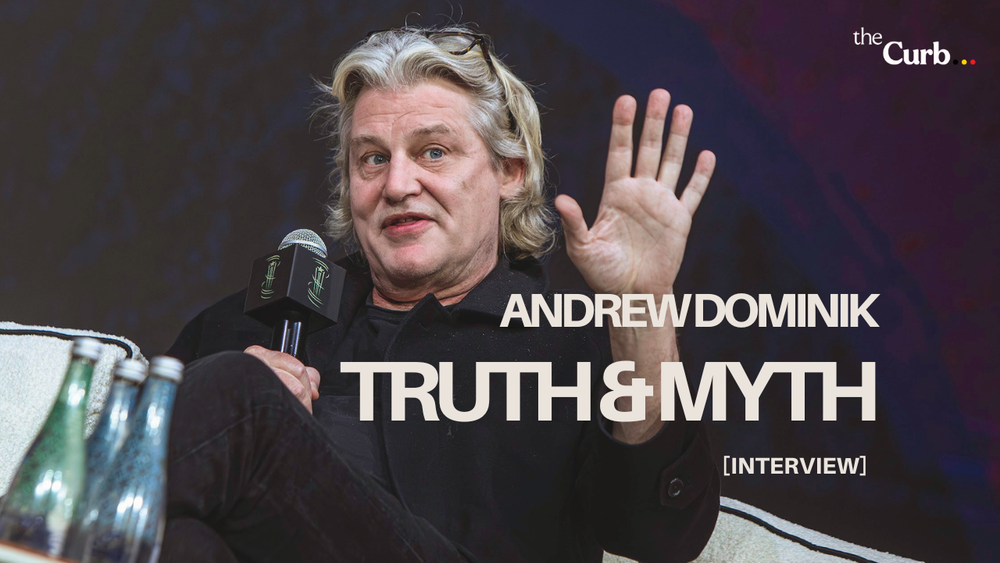
Andrew Dominik has long occupied an unusual position in Australian cinema. After his breakthrough with Chopper in 2000, Dominik’s career has been forged almost entirely in the glare of American myth. Yet he has never followed an easy path, and his sensibility feels closer to European art cinema than to Hollywood narrative tradition. From The Assassination of Jesse James by the Coward Robert Ford (2007) and Killing Them Softly (2012), through two documentaries with Nick Cave, a biopic of Marilyn Monroe (Blonde, 2022), and Bono: Songs of Surrender (2025), his films resist consolation and tend to improve with rewatches.
Our conversation takes place at the Marrakech International Film Festival, beginning on the red carpet. Dominik is the last person to walk it on the third night of the festival and, as staff begin packing it up, he refuses to move.
“This bloke has come all the way from my hometown to talk to me,” he tells the publicists attempting to usher him into a premiere at the Palais des Festivals before allowing a comfortable silence to sit. Under their tired yet piercing gaze, I ask about Brad Pitt.
“Brad is the reason I work,” he says. “I make a film, they put me in director jail, and then Brad comes down to the parole board and says, ‘Look, he's learned his lesson. He's going to make something a bit more user friendly this time’. They let me out of jail, I make another film, and they put me back in,” he laughs. “But, as a producer, he's great. He’s my protector. He’s great with actors. I’m really lucky to have a friendship like that.”
It’s a small moment of stubborn generosity, and a fitting way into a body of work that has consistently resisted easy resolutions. The next day, as we sit down in the courtyard of his hotel where he can smoke liberally, the same publicists hover in the background, checking their watches.
Your films are often described as interrogations of a myth. American myth, masculine myth, celebrity myth. Is that something you’re drawn to exploring?
Andrew Dominik: If you look at it from the outside, sure, but that's not the way I think about them. That's not the way that you get into a film. I'm more concerned with the people or the characters, and when you examine them, when you look at their lives, it's often different from the myth. Perhaps that's why it looks like a deconstruction, but it’s certainly not the intention.
Your characters are often split between this public and private face, the weight of expectation on them, and the private self. Marilyn Monroe is the most recent example. What do you find compelling about that as a director?
AD: For Blonde, I’d always wanted to make a film about how childhood trauma shapes an adult life, how people get stuck in a childhood drama and then project that drama out onto the world. My first thought was to do it as a serial killer film, you know, show someone with this horrific childhood who then acts it out. I had read the book around 2000, but I never thought of making it into a film. But later, around 2008, I had a girlfriend who had a miscarriage, which made me think of Blonde, so I reread it and realised I could do this about Marilyn Monroe.
She’s somebody who’s split in half. She’s got a public self and a private self, and the private self can never live up to the public self. The trauma itself is the thing that necessitated the split. There’s a secret, shameful, unlovable self, and then there’s the myth, the blonde Marilyn. In a way, every person can understand that. We all have a face we present to the world and a face that’s private, but with a famous person it’s so much more exaggerated. They literally have a different person. She literally has a different name.
Looking at how that film was received, reviewers used the term “trauma porn” and some people objected to the extensive scenes of suffering and the cost of maintaining her public face. People seemed to want to hold onto that public face of Marilyn.
AD: Suffering is the thing that connects us all, because suffering is the thing that we have in common. Suffering is what it is to be human. To feel compassion and empathy for a fellow sufferer is one of the things that makes you a beautiful, broken, glorious human being. Blonde was about movies, projection and the 1950s, that weird time where psychoanalysis and method acting sort of overlapped each other. I find it very compelling.
When I look at the people you’ve interrogated – Chopper Read, Jesse James, Robert Ford, Jackie Cogan from Killing Them Softly, Marilyn – no one finds peace. You’re constantly refusing the hero’s journey.
AD: I’m interested in people. I particularly like self-destructive people, damaged people, because they’re much more entertaining, much more interesting. They do wild and unexpected things. When I go to the cinema, I don’t want to see the same old shit. I want to be surprised by a movie. I can’t tell the hero’s journey, the Star Wars narrative of the innocent upstart who leaves the tribe, meets magical friends, defeats the enemy, sacrifices himself and returns home. That’s ninety per cent of movies. The use of fiction is to make meaning, that’s its function. We tell ourselves a story about what happened and that allows us to surrender to it and move on. Whether the story is true or not doesn’t matter. People are walking around with stories about themselves that bear no resemblance to reality, and you’re interacting with that picture of a person, not the reality.
Even the two documentaries you made about Nick Cave, One More Time With Feeling and I Know This Much to be True, seem to buck the traditional documentary format. Was that something you set out to do?
AD: One More Time… was a film that I made for none of the motives that you would usually make a film for. Nick was a friend of mine and his son, Arthur, had died. It was a cataclysmic tragedy that affected him, [his wife] Susie, Earl, his other son, and everyone around them. Nick had a record to promote, and there was no way he was going to sit down with journalists and talk about his dead son. So he said, “Will you make a film? I’ll just sing the songs from the record.”
I said, “Well, how long is the record?” “It’s 34 minutes.” You can’t make a 34-minute film. We had to do some other stuff. The idea became that I would shoot them doing overdubs or recording, he would perform the songs and we’d just see what happened. But it was clear that what we had to deal with was the loss of Arthur. Nick is someone who’s always been able to deal with anything that happened in his life by casting it into song. Once it’s in a song, it’s safe and you can put it away. Nick tried to do that when Arthur died, and he just could not do it.
So I turn up and I’m shooting this stuff and I have no control over the film. I’m in a recording studio where I’m just an irritation. I’m not even the primary creative event. There’s a record being made and we’re these annoying people in the corner. They’re not waiting for the camera and they’re not going to do things twice. I wasn’t important, the camera wasn’t important, the film wasn’t important. I wasn’t even making it to try and make it good. And it was the most liberating thing that had ever happened to me.
When you go to work every day with no idea what you’re going to do, that’s when you start to realise that when you act on instinct, your unconscious is directing the show. If you trust your instinct and you trust that the threads you’re setting up will become something, then it becomes an investigation. So, we circle around and around the tragedy, and eventually Nick has to talk about it and has to explain what it’s like, how you get through it. Not because he’s ready, but because his life has been shattered and he has to move forward and just the first steps he can take. It was really beautiful. It was a very moving experience.
Did this experience make you trust your unconscious more, or change the way you went about filmmaking?
AD: Making that film was like nothing that had ever happened before. I have never believed in making films the Hitchcock way, where you’ve worked out the entire film on paper and then you just execute the storyboards. You have to make a film live. The worst feeling is when you’re shooting a scene and you’re bored, you don’t believe them and you don’t care what happens next. I believe in the unconscious. When you act on instinct, your unconscious is directing the show. If you trust that, the film will talk back to you and tell you what it needs to be. One example of this is in Jesse James where Brad Pitt walks out onto the ice, pulls out his gun and starts shooting into the ice. That was just something that occurred to me when I saw him and. I thought, what if he's doing this self-destructive act? I'm happy I got this, because at the time I couldn't see how that would fit into the film. Now, if I have an idea, I just do it. I don't think, I don't question it, you know, because I believe in the unconscious anyway.
How did you first discover filmmaking?
AD: When I was a kid, like 11 or 12 years old, I started making films on Super 8. I was always interested in film and how to put it together and then I got a video camera. I didn't have editing equipment, so I'd have to cut in camera – shoot the shot, stop, then reframe to the next shot, shoot, start again. I just always wanted to do it.
Have you always been agnostic towards technology?
AD: I've become that way. I mean, there's so many beautiful things about film that have been lost. You can't shoot chrome anymore. You can't print black and white. I was always very resistant to digital until I had to shoot a commercial in black and white. The cameraman said to me, look, there's this monochrome camera, you should see it. And he brought along an Arri Alexa XT, and it was so beautiful. I suddenly realised that this is a delivery system for black and white. I was so impressed with how it looked, but it's not just the camera, it's also its combination with lenses, certain lenses that you use with black and white. When I had to shoot another ad I thought, ‘fuck it, I'll try digital in colour’, and it was so beautiful. I became a convert. I wasn't a fan of CGI but now AI image making, I think, is amazing.
What excites you about AI, artistically?
AD: I think it’s a tool. I don’t like text-to-text, but I like starting with images and manipulating them. It depends on the project, but I'd like to do something that's specifically designed for what the thing does and doesn't do and I think you need to get beyond the idea of beauty. All of my films look good and I think Blonde looks really good, but there's parts of Blonde that are ugly and photographically rough. It's about the feeling it makes. You could be a slave to the beautiful surface, to professionalism, if you like, but there's something about imagery that can get deeper than that.
What is exciting you at the moment? What are you looking for as the next thing to make into a film?
AD: Two completely different things. One is I’d like to make a religious film or a spiritual film. The other is I’m completely fascinated by AI as a generative visual tool, and what could be done with that. That has no limits to it.
Could they be combined?
AD: No, I think they’re different. One is a very raw film that’s not even in focus that I’d like to do. The other one is something that’s completely stylised, that cannibalises other images.
Would you make an Australian film again?
AD: Yeah, I mean, if I could think of an Australian story. I think a lot about [drug dealer and alleged serial killer] Dennis Allen. You can make a comedy about Dennis Allen and his brothers. I guess it's similar territory to Animal Kingdom, with the Allen brothers and Walsh Street, but have you ever read that book Disorganised Crime? The chapter on Dennis Allen is so funny. Really funny.