
This essay was original published on Pure Shit Australian Cinema and is written by Mike Retter.
Mike Retter is a film director, of the indie feature Youth On The March, creator of the zine "Cinema Now", and the Podcast "Meat Bone Express", and part of the Port Film Co-op. |
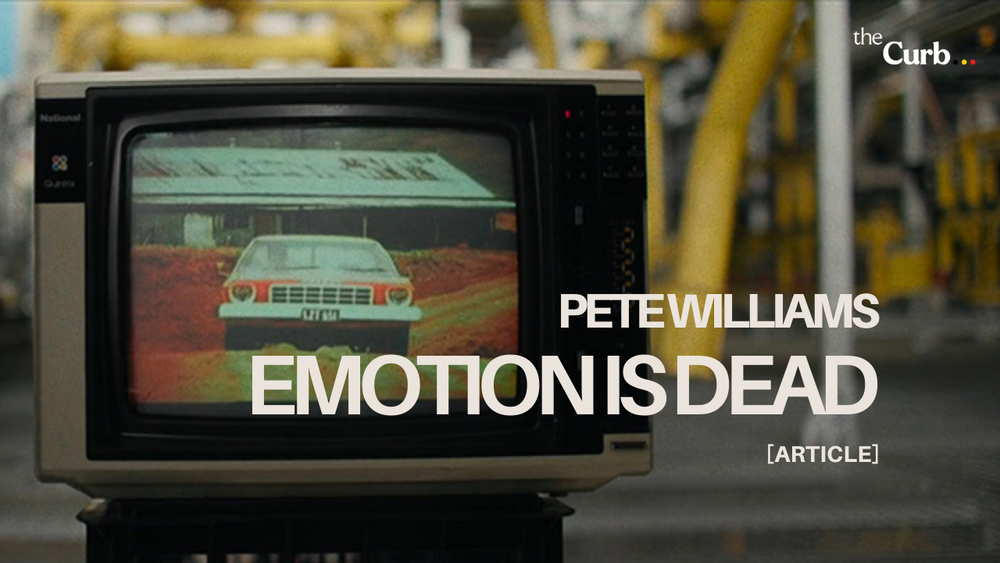
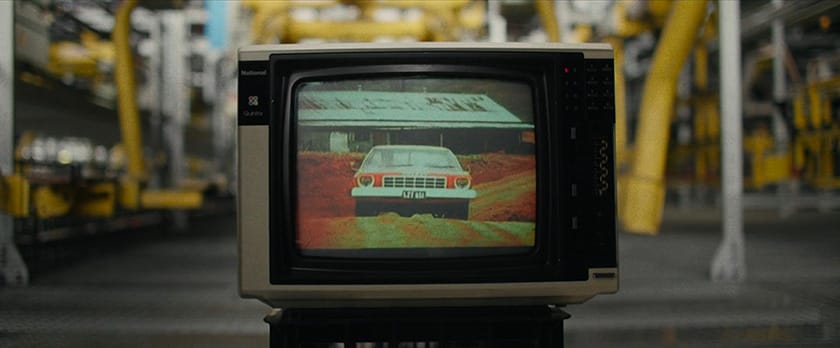
Over the last couple of years, several people have brought up Emotion Is Dead (2023) and suggested I watch it. It's a loose thriller plot wrapped around a conceptually more interesting look at deindustrialised Elizabeth and closure of the Holden automobile plant. The film opens with old television sets playing nostalgic Holden commercials and rosy educational films about Elizabeth before the city was gutted of industry. It then centers on a young man in the present played by Jude Turner working as a gardener who starts thieving from wealthy clients.
On the one hand, we have a valiant attempt to make an independent film that explores serious existential issues for many thousands of people. Social catastrophe comes in the wake of deindustrialisation and the film is quite aggressive in its position and sincere in its tribute to an ocean of people affected.
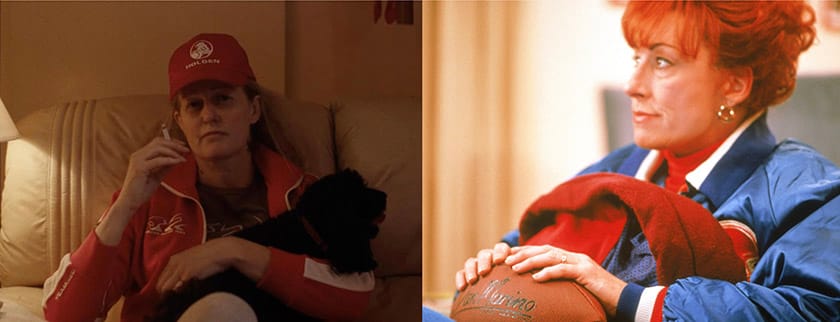
But on the other hand, the film is filled with a great degree of caricature where it could have used more naturalism. The protagonist's mother is uncannily written like that of Vincent Gallo's mother in the black comedy Buffalo '66 (1998). She is dressed in Holden-branded clothing and living past glories of Peter Brock car races like Vincent Gallo's Buffalo Bill's obsessed VHS watching mother played by Anjelica Huston. The problem is, Emotion Is Dead plays it straight and it comes off as immature cliche.
Sometimes artists use being born in a town as license of authenticity in regards to what they depict. But very little of Elizabeth's character, a city that has lots of it, is actually captured or depicted. Instead we get a cartoonish class consciousness, where an upper-crust university friend puts the protagonist through some demeaning hazing rituals. It's just ridiculous. Even the train journey is a lost opportunity to make an impression of the landscape or express the often atmospheric train cabin interiors. Elizabeth has many interesting vistas that catch the light and distinctive red soil that tip-toes to the desert. Much more attention to detail is spent capturing the leafy green Eastern suburbs where the lead actor does gardening work and arguably the film's sensibility lies.
Buffalo New York, the hometown that director Vincent Gallo sometimes claims to hate, is shown in more focus, familiarity and reverence than anything about the Northern Suburbs in Emotion. Look at all the scuffed surfaces of Recckio's Bowling Center in South Buffalo. Gallo buys Christina Ricci a heart shaped cookie, a regional Buffalo specialty from Dickie's Donuts. The local Denny's haunt evokes transience and Americana. People online mourn the loss of Caffé Lococo, which became iconic because of how Buffalo '66 presented its graphical signage. You can make big claims about being a local and use it as a selling point for your film's authenticity, but what is the purpose if you don't capture the area's character?
Another northern-born filmmaker who felt they had a golden ticket to depict these suburbs however they liked was Justin Kurzel. Snowtown (2011) on first release felt like a revelation. It had a high level of competence and a lot of skillful restraint in terms of naturalistic direction. But it's a film whose initial praise is now worth critical revision. In reality, its a film that depicts the lower-classes as entirely sub-human and takes the form of torture porn while dressed up as an art film. Ice cream vans with distorted chimes traveling across dilapidated expanses are hackneyed symbolism, naff comedic wide and suburban cliche.
Justin Kurzel's hackneyed surrealism of ice-cream van and its distorted music traveling through the Northern Suburbs has dated poorly and his film Snowtown (2011) should be critically revised as anti-working class torture porn.
In the case of Emotion, I just think director Pete Williams has been out of town too long. He's quite proudly a rootless cosmopolitan who left for London to study filmmaking, worked overseas in advertising and corporate media such as Amazon Prime, Disney Plus and doesn't speak like he's ever lived in Elizabeth at all. Although I think the central concept is great, which is to meditate on Holden car production vanishing from Australia despite being so embedded in our psyche, I just think its development was rushed and the thriller narrative desperately forced around it. Rather than being life finding a way through cracks of concrete, it felt a bit astroturfed.
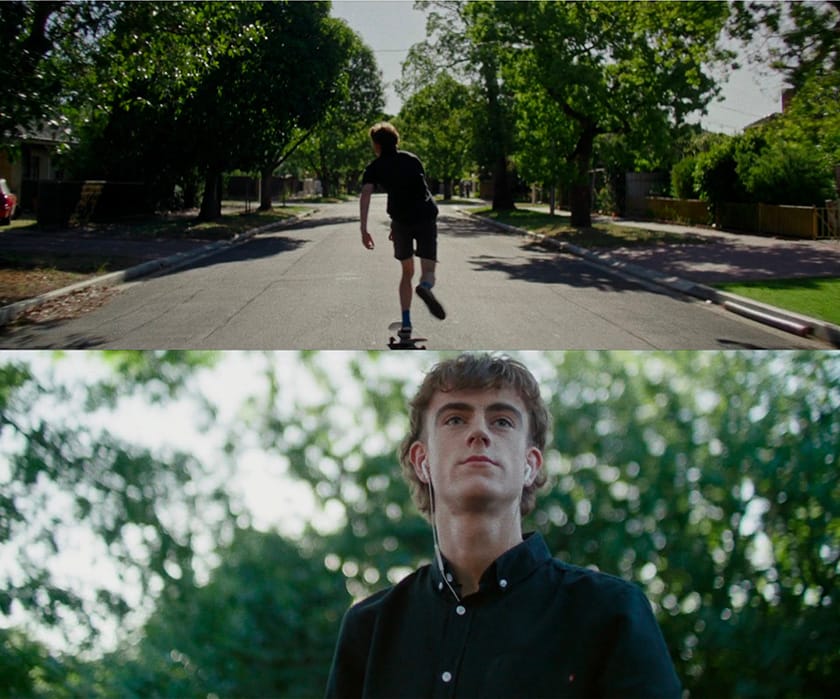
The film does have transcendent moments, some of the skateboarding and camera movement around this action is effective.. Empty tree-lined streets become a canvas to sketch movement through. Skate wheels transform dormant factory floors into playgrounds. Sequences like this often give us respite from the emo soundtrack with a recurring traditional score by Max Tulyewski, which does marry well with Johanis Lyons-Reid's images. These sequences make us feel the breeze and the score creates a delicateness for such moments.
The pop-punk emo tracks used probably meant a lot to the director.. But I'm not sure how well they resonate for the audience. For me, It's like taking the worst of the tail-end of a genre, where it had become as emasculated as the hippies that punk originally came to depose and stripped it of much of its noise and texture.. All the while expecting me to feel pathos. I just don't think this music sub-genre stands the test of time. But the use of such material isn't as egregious as say Hounds Of Love (2016) using Joy Division for its groan-inducing ending.. Director Pete Williams does at the very least use the music logically to evoke his youth. In that sense it is personal filmmaking.
The inter-cutting with archival footage and empty factories is memorable. If the film didn't push such a slapped together narrative around it, we could have had more of a poetic art film. But much of this intertwined historic material does serve the central concept well and validates the overall experience. The central character being a young man with no economic future is an important lightning rod and substantial core of the picture. An every-boy and cipher for the radicalised zoomer denied their birthright.
There is a class of filmmaking in this country where independents put some serious personal money into equipment and craft to deliver a product with a level of sheen that if you squint looks like Netflix. Lighting, high-end cameras, gimbels, rigs etc. These are usually made within popular genres such as horror, zombie, fantasy .. But what they often lack is a sensibility of their own .. It's like the filmmakers have missed a step, which is cinephilia and haven't drunk enough from the well, haven't paid their cinephilic dues.. They have the energy and passion but no reference points beyond Amazon Prime. Sometimes these productions feel like competent applications of YouTube tutorials but appear otherwise empty. I often think these films would be better-off made on simpler equipment and shot in a rougher, more immediate way. The process itself forcing a unique sensibility upon the film-form as it closer resembles the narrative.
Emotion is a step-above this content, it often does have a sensibility of its own, especially with its interwoven bigger picture, but I still think it could have been better served if shot in a more raw style akin to the work of Larry Clark. Less would have been more when it came to dialogue and characterization. At times dramatically it felt like a TAFE short film and then at other moments it truly did soar cinematically, usually when the protagonist was soaring down the road through the breeze. But its mainstream commercial aesthetic shackles it, keeping intuition and discovery from rising to the surface. A strength of indie cinema is the opportunity to capture the real, accidental and what the universe offers through the process. Dry Winter (2021), a feature film made within Flinders University honours program, achieves an intuitive sensibility while also tackling the subject of deindustrialisation by depicting idle hands doing the devil's work. Dry Winter was also made on a fraction of Emotion's $300,000 budget.
It's probably important to point out the obvious and something that parallels the grand narrative of Emotion. We don't really have a film industry. To say we have a film industry is like saying a government department is an industry. We are living off past glories of Mad Max, Bad Boy Bubby, Crocodile Dundee, Picnic At Hanging Rock and probably the most recent being Chopper or Wolf Creek. The Philippou brothers and James Wan have carved-out sizable niches within the horror genre globally, but that doesn't constitute a national cinematic revival. There are only a few conventionally budgeted mainstream movies made here per year. And then a handful of art films competing for limited funding. Outside of that, we have renegades and those willing to work on minuscule budgets. That entire patchwork does not constitute a real industry.
We are not the Hollywood of Asia.. We don't compete with Asia at all. Hence those working independently are often operating in isolation and with few peers doing the same thing. And this affects the work.. It's not a rigorous environment or culture.. Whether it's the layman lacking sophistication, the sophisticated making films for insular audiences or in Emotion's case the cashed-up coming from a corporate TV background ultimately landing a middling work. It's not an industry or culture with all pistons firing. How might this be remedied?
But if you are interested in understanding local cinema, Emotion should be seen and its ambition respected. It's a first feature and despite all my criticism it has some originality in it. And although we should look at all films on their merits and objectively compare them to the wider world of cinema, the fact that we don't have a real industry does require us to appreciate how a work is made in isolation. And we will have our own understanding of certain local particulars that an international audience would not. Even when aspects of a work misfire, it can still be a film of historical importance and Emotion does take history head-on.
Being self-funded, Pete William's film is able to critique (in the abstract) government, unions and international finance's role in destroying the city of Elizabeth. Australian films tend to ignore all this and go straight to critiquing the mostly men who were put out of work by such deindustrialisation, depicting them as savage animals like in Snowtown (2011). So as cartoonish as Emotion is at times, at least Williams gives the victims of oligarchy their dignity rather than sticking the boot in.
Director: Pete Williams
Cast: Jude Turner, Adam Tuominen, Brad McCarthy
Writer: Pete Williams
Producers: Brian Hayes, Pete Williams
Cinematographer: Johanis Lyons-Reid
Editor: Jack Mason Intini
Screening or Streaming Availability from JustWatch: