
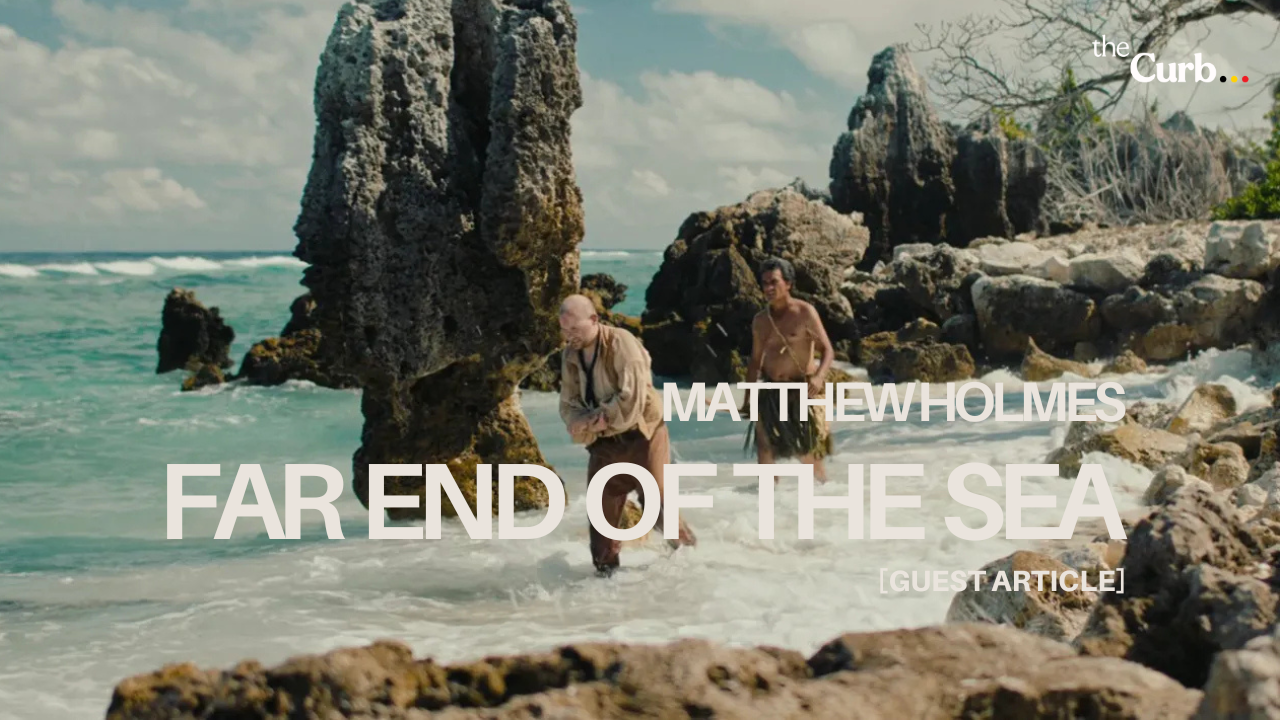
Zijian Qi, Managing Editor of China's Xinhua News Agency Sydney Bureau writes for the Curb about Nauru's debut film Far End of the Sea by director Matthew Holmes and writer Jamie Coffa.
While cinema has flourished for more than a century and evolved into a mature industry in many countries, filmmaking has long remained an elusive craft in Nauru. However, the island country has recently achieved a historic milestone with the release of Far End of the Sea, its first ever film.
The 53-minute film, created by Pleasant Island Productions, a Nauru-based film production company, tells the fictional story of Scottish sailor Hamish MacKay's shipwreck and captivity on the island in the 1800s. Following its premiere on May 15 and screening, the film sparked an enthusiastic response, marking a new chapter in the country's cultural development.
"Nauru is a little gem in the South Pacific and it's so rich in culture," Jamie Coffa, the writer and leading actor of Far End of the Sea, told me in a recent interview. "Film is just a great way to showcase that."
NAURU AS FILM'S "SIXTH CHARACTER"
Seated at a wooden table on the beach, with the sound of waves in the background, the film's creative team sat down with me, two days after the premiere which I attended, to discuss the making of the film.
"Even though technically there are five characters in the film, there's actually a sixth character. And that sixth character is Nauru," said Coffa.
When he originally wrote the script, Coffa sought to explore several themes before deciding to focus on Nauru's culture. "One thing we really wanted to do was to inject as much Nauruan culture into it and make it as authentic as possible," he said.
Featuring a cast and crew that includes 58 Nauruans, the film was shot entirely in the country across seven locations.
Reflecting on the film's impact, Coffa said that "the most important aspect for me is the fact that little Nauruan children can look up on screen and see themselves."
"After the film premiered, a few more people came up to me and said they love the Nauruan dialect," said film producer Yannick Detsiogo. "They love that you grabbed this really old Nauruan language and brought it back to the screen."
"We embed more Nauruan elements inside, like the jokes and the little cultural things that Nauruans like to do, such as the way they express disappointment or happiness," Detsiogo said.
"We did that to make Nauruans feel more connected to it. And I think it worked."
TELLING A DEEPLY HUMAN STORY
Coffa, who grew up on Nauru and is now based in Melbourne, wrote the script in 2018, and revisited the project in March 2025.
Within a rich cultural and heritage context, the film tells a deeply human story.
"What I really wanted to do was tell a tale that shows the interaction between Europeans and the Nauruans at a time when there was tension," he said.
Coffa sought to portray humanity and compassion in this film.
"We all feel love, fear, and sadness. And in those emotions, that's where we can find our commonality," he said. “The one thing that combines us is our humanity and themes such as love.”
“I'm a true believer in hope and I like films that carry hope in it,” he added. “It’s a hope for a better tomorrow.”
“Obviously, this film is only 53 minutes long, so it's a short feature film,” Coffa said. As it was not easy to complete the story arc that happens within that, they were investing in contemporary cinematic approaches. One of those was to take the audience on a journey with the characters.
For example, when Coffa was running in the bush full throttle, they brought up about one ton with the filming equipment from Melbourne.
"We shot a lot of things on steady cam rigs, which gave the audience the illusion that they were running with us," Coffa said. "They were immersed more in the film, and I think that adds to that kind of realism of it."
"I did speak to a lot of people at the end of the premiere and the most common quote that I got was 'the film really made me emotional,'" said Detsiogo.
SUPPORTED BY THE ENTIRE NATION
Making Nauru's first film was no easy task. However, the project was endorsed by the government and aided by the country's state-owned and private enterprises.
"They (the government) loved the idea (of the film). They were fully on board from the start," Detsiogo said. "As we went through, a lot of other sponsors chimed in as well to help make the film."
"The great thing about Nauru is that there is this real sense of community," said Coffa. "Everyone watches out for each other and also helps each other. And I think that unity amongst the Nauruan people is something that's very special."
Looking back on the filmmaking journey, he said the project was embraced by the entire nation, with support ranging from the people on the street to government officials and institutions.
In a Facebook post, Nauru's President David Adeang said that he hoped the film would inspire other smaller nations, as "few would expect a film of this quality and depth to be made here."
COLLABORATION WITH CHINA
Detsiogo also expressed his hope for future collaboration with Chinese filmmaking partners.
"If we can get support from the Chinese partners, we'd love their expertise as well because I've seen Chinese films and they are amazing," he said.
He also wished Chinese audiences would watch this film and like it.
"We hope you enjoy it and come visit Nauru," he said.