
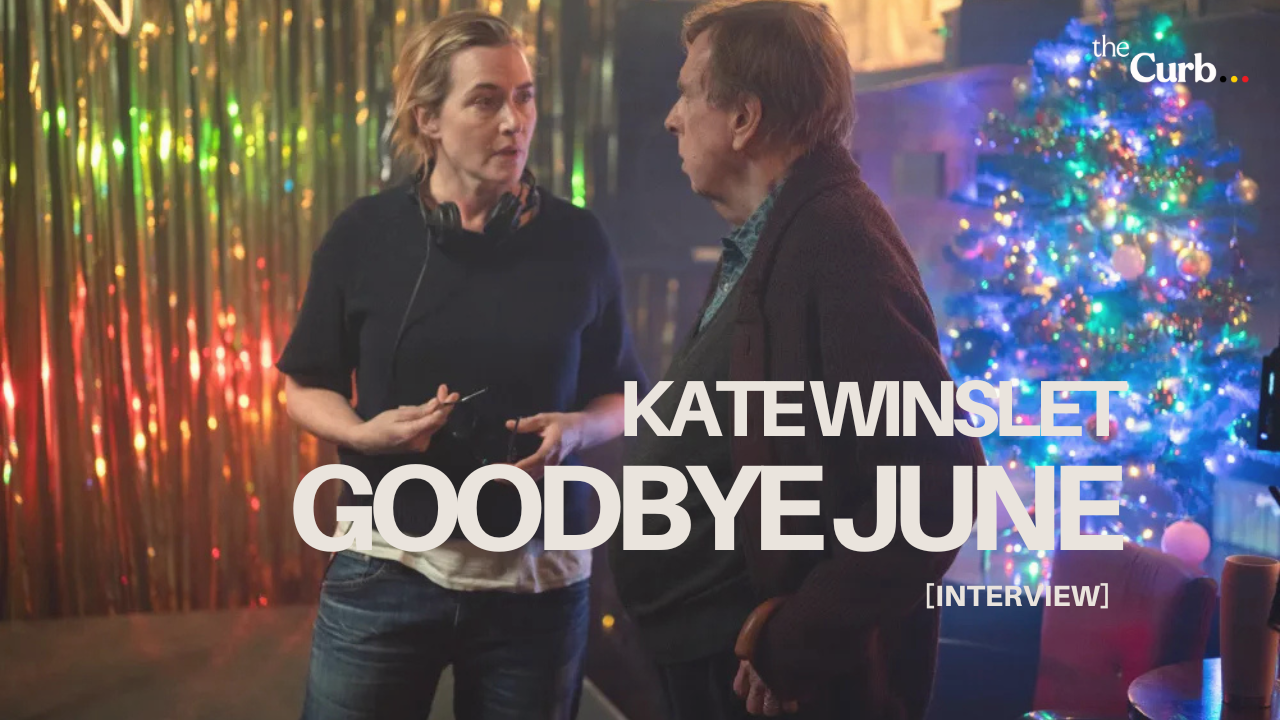
Academy award winning actor Kate Winslet makes the leap to directing duties with her feature debut film Goodbye June. Kate has talked about what reading her son Joe Anders script meant to her, and why she was the right director to bring the film to life. Set at Christmas time, Goodbye June tells the story of a family brought together by the imminent death of June (Helen Mirren). We flow in and out of the life of her extended family as she receives treatment in palliative care, with her husband Bernie (Timothy Spall) by her side, and her three daughters and son, Molly (Andrea Riseborough), Julia (Kate Winslet), Helen (Toni Colette), and Connor (Johnny Flynn), fighting, negotiating, and planning the best way to look after June. Swirling around their sides are June’s grandchildren, each of whom you can feel having formative memories being made as they spend time by their dying grandmother’s side.
Goodbye June is an interesting narrative for Winslet to choose as a directorial debut, with Anders script being influenced by the passing of his own grandmother. Those aspects are felt keenly on a structural level, as if Anders is trying to make sense of his own memories and emotions of that passing, and utilising the form of film to play them out. With his mother by his side, the two then manage to work through emotional aspects of their own lives, and in the process, they invite the audience to also reflect on what it means to live and what it means to die, all the while surrounded by twinkling lights and tinsel at Christmas time.
The below interview was recorded ahead of Goodbye June’s release on Netflix and has been edited for conciseness purposes.
Screening or Streaming Availability from JustWatch:
You’re stepping into a new life as a filmmaker. You produced Lee, and now you’re directing Goodbye June. How has the evolution from acting to producing to directing gone for you?
Kate Winslet: It's been a really remarkable experience. I think coming into directing, it was one thing for me to feel ready to do it, but it was quite another to actually be really ready. I have to say that from producing Lee and also executive producing Mare of Easttown and The Regime, there's so much that I now know about the actual construction of a production and producing itself. I think people often assume that when an actor gets a producing credit that they may not necessarily be doing all the nuts and bolts of that job, but they very much are, particularly on something like Lee. That was not only quite a complex production and involved so many years’ worth of development, but [I was able to] elevate and support Ellen Kuras as a first-time director after [she had] spent so many years being a cinematographer.
I really loved the opportunity of being able to elevate people and so coming into directing [Goodbye June] with my son being a first timer and myself being a first timer, I wanted to make sure that we were offering that opportunity to others as well. So we had a first time composer (Ben Harlan), we had a first time production designer (Alison Harvey) and a first time costume designer (Grace Clark), and what that really does to an onset experience Andrew when you're working on something that isn't a very big budget, is that you all have to hold hands and kind of be terrified and excited together and really just run at it and go for it. It was a truly amazing experience being in a position as a director where I was able to do my best to craft an onset experience for everybody, not just the actors and not just the children, but all the crew.
We all had to be in tandem with one another. When you're making a film that is about loss, and everyone on set had a different relationship with those experiences, you have to bring joy every day. So being able to make a film kindly and sensitively, looking out for everyone, collaborating in the truest sense of the word, and offering the actors a space that was as uncluttered as possible when it came to trying to keep as many crew out of the room as we could, that also meant planning, really planning with our crew. How were we going to be able to do that?
In our pre-production, which was only seven weeks, we worked very, very hard to make sure that we were setting up a situation for the actors that they felt everyone had their backs entirely. We were able to do a few things that I, myself as an actress, have dreamt of being able to experience and yet never have. We didn't have any overhead booms on our set and our sound designer, Denise Yarde, and I worked very closely together in making sure that her department could get everything that they needed, but in a different way. It meant we could keep those personnel out of the room once they had established how they were going to capture the necessary sound and the dialogue and so on.
We had lots of hidden microphones everywhere. Everyone was radio miked, which is typically the case anyway, all the grown-up actors would be, but also the children were as well. The reason why is because with children who are young, five years of age, you really can't teach them how to act, but you can encourage them how to be, and the more they felt that they were stepping into a make believe space that they really invested in, and they could just say what they wanted, then it gives children permission to just play and to just be. I would say to them, “I hope you haven't learned any lines today, because I want you to make up some interesting things and please make lots of juicy mistakes, because we love mistakes.”
All the children called themselves only in their character names. They introduced themselves to one another as their characters. I did that primarily for little Benji; we had this incredible thing happen where we found a wonderful child to play that role whose name was actually Benjamin (Shortland), and it was just a complete chance, serendipitous moment. I realised quite quickly, well, if everyone's calling him Ben or Benji, then it works that I would be suggesting that they all call each other in those character names, because you can't say to five-year-olds: ‘This is Nancy, she's playing Sydney.’ ‘This is Flora, she's playing Ella.’ ‘This is James, he’s playing Alfie.’ That's too many names. That's too much to remember. It meant that when we were on set and they were in the scene calling each other by their character names, it meant there were never any mistakes I would have to edit out because they were always just in it. It was really quite remarkable the way they would just play and go into these environments and just call everyone in character. It was phenomenal. I didn't know if it was going to work or not, but it really did.
Getting to see oncology and palliative care practices on screen is a way of inviting people to have that conversation about passing away and death and what living means and what dying means. Is there hope this becomes a bit of a conversation starter?
KW: You know, it's an interesting one, because often when doing interviews like this, people might say, ‘What do you think the message is?’ or, ‘What do you hope the message might be?’ and it's such a strange question, because it's almost quite presumptuous to assume any kind of a message. But actually, I do think that this film, the intention with it certainly is that it would feel uplifting and cathartic and hopeful in some way about the possibility of being able to have those very, very difficult conversations that no one really wants to have.
It mattered enormously that the film felt warm and intimate. We did some specific things to make sure we were establishing that; [by] my son setting this film at Christmas time, not only did it lend itself to that feeling of a clock ticking as everyone's ramping towards an event, but it also gave us the opportunity to include all those wonderful British touches of the warm twinkling lights and the different coloured tinsel and the tins of Christmas chocolates on the nurse's station and the little banners and things that really do exist and really do make up a part of being in a hospital space at that particular time of year, because they're trying to lift people's spirits and trying to give them a Christmas when they can't be in their home. It mattered enormously to have that.
We had a hospital space that became our location, but it also became our template for how our hospital room and the main corridor would look, because those pieces were a studio set build. It was the only pieces that we had in studio alongside the bathroom where Tim [Spall] shaves. We took a derelict hospital in Ravenscourt Park in London. It's a deco style building, so it actually had these kind of beautiful green linoleum and red floors that are so old, they've been polished so much that they shine. They had lots of chrome and little red banners down the sides of corridors. It gave us an opportunity to mimic these touches of colour.
We did use some of those corridors as other pieces of the hospital, like when the family are walking to the doctor's office at the beginning. That was this particular location, the area walkway, that very long walkway where they had the Molly and Julia scene. We took it as a blueprint for what we wanted it to feel like once you got into that space, because June herself is a very warm character, and it's really a story less about a woman who's dying, and very much about a family.
Even though those relationships are messy and they're complicated, the warmth that is generated because of June was massively important to capture in support of all the work as well that those wonderful palliative care workers offer. They are remarkable individuals who dedicate their lives to being there for people who are in devastating situations. They're incredible people.
Congratulations on the film and thank you for your time. We’re looking forward to eventually seeing you back in an Australian film one day as well.
KW: Oh I would love nothing more. I've loved the occasions I've worked in Australia and I cherish those experiences, so I hope so too.