
“The worst of men, they’ve got a little bit of good in them and that will be their undoing.”
Charles Williams’ brutal and blazing Australian prison drama Inside is underscored by its immense humanism and empathy. Williams is concerned with damage done by damaged people and their struggle to grow and change within the corrections system – an imperfect environment for rehabilitation especially for those suffering with generational trauma and hereditary conditions. The determined fates of children and men whose parents and postcode often define their paths like a “tape that always plays the same song” no matter from where it is rewound.
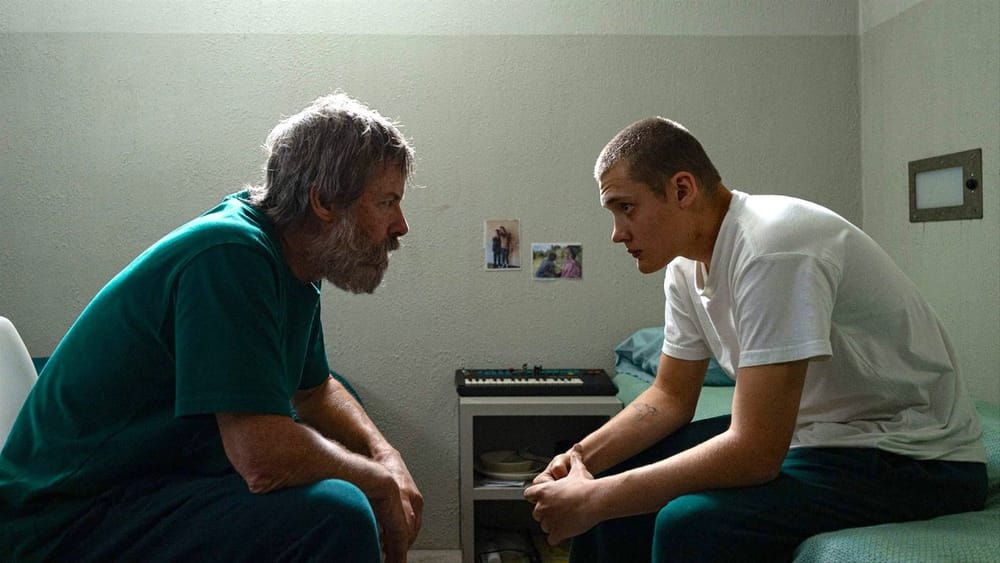
Mel Matthew Blight (Vincent Miller) has been in the system since birth. His parents were married in prison while his father was serving one of many sentences. By the time Mel was twelve years old he was a murderer. Transferring out of the juvenile system into Gadara Penitentiary to serve the remaining part of his sentence as an adult, Mel enters a tussle for his identity between two men. Child rapist and murderer, Mark Shepherd (an electrifying Cosmo Jarvis) and substance abuser and hit-and-run driver Warren Murfett (Guy Pearce).
No one has come to visit Mel since his incarceration, and no-one will. His childhood was spent being told by his recidivist criminal father that he was going to turn out bad, and Mel believed him. He doesn’t want to be paroled as he is convinced that his rage issues will manifest outside, but he does ask quietly for help. When Mark Shepard introduces him to the idea of the religious services he runs, Mel asks, “Do you think it will help… me?”
Shepard displays the intellect and fantasy projections of a child yet is a genuine physical threat if he chooses to be. Shepard has found God and wants to help Mel to become saved. To find the spirit of God's through Mel's music, he uses a small keyboard, the only connection has to his family before he entered the system.
Becoming saved in Shepard’s mind rests somewhere between God’s grace in creating him as he is (hence he is not to blame): God loving sinners with he and his fellow inmates being the ‘scape goats’ of society who have placed their sins on them to carry. He speaks in tongues. He has three miracles to unveil. He truly believes it all. It’s a delusion but one that is keeping him ‘contained’ until it becomes clear that it isn’t.
Parole is also on the mind of Warren Murfett. He’s close to release and wants desperately to reconnect with his estranged son, Adrian (Toby Wallace in a small but impactful appearance), shown in pictures as a young child is now an adult. Warren sees himself as one big bad decision after another. The only good decision he thought he made was ensuring Adrian didn’t visit him in prison, so he didn’t pass his ‘sickness’ to his son. When he hears that Adrian has accepted an unsupervised meeting with him, his hopes for a life outside with his son propel him.
He has to solve a few inside problems first, such as paying off a massive debt to a prison bookie. The family of Mark Shepard’s victim have put a hit on him. Mel has already decided he is going to kill Shepard to remain in prison. Warren becomes Mel’s cell mate a decides to push the kid hard into getting the job done.
Murfett is a manipulative piece of work and initially there’s no ‘heart of gold’ under his self-serving exterior. However, he really did want what was best for his own son and when he has another de facto son presented to him in the form of Mel he begins to understand that his failures don’t need to be transferred onto the damaged teen.
Mel is caught between two deeply imperfect men. One offers him a charismatic Christian version of absolution. The other offers him insights to worldly survival. The prison chorus around Mel is suffused with anger, self-hatred, and despondency. Men whose fates are determined before they reach prison by their postcode, class, education, inherited illness, poverty, and the failure of social institutions due to lack of funding, training, and staffing, to catch people before they fall.
Charles Williams directs with compassion but also with a clarity surrounding the environment in which his protagonists find themselves. Inside is a rare prison film that doesn’t paint the corrections department as being inherently corrupt. It also doesn’t pretend that prison is rehabilitative. It’s a despair filled place and simply put, some of the people in there are ‘bad’ both for themselves and others. It’s this ‘badness’ that Mel must direct himself away from – but with two flawed men and their “little bit of good” as his guides, Mel’s actualisation and transition to the outside is far from assured. Yet, there is something ‘inapprehensible’ that could, through a combination of violence and kindness, transform him.
By filming in a now disused prison Williams adds a palpable sense of veracity to his work that is made more pertinent by the casting of non-professional actors who had previously been in the corrections system. Andrew Commis’ cinematography in concert with Chiara Costanza’s score give Inside yet another layer of intense truth and humanity.
The realism of the film is again bolstered by the superb acting by the three main protagonists. Guy Pearce has never been better in an Australian film delivering one of his best performances. His embodiment of Warren Murfett is a highlight in his storied and impressive career. Cosmo Jarvis is unrecognisable as Mark Shepard – offering a vision of a man who is both dangerous (the most hated man in Australia) and pitiable.
Vincent Miller as Mel is a revelation. His soft face and blinking eyes reveal the depth of the trauma that pushed him into the system. Williams feeds the audience the foundational information about Mel through hazy and terrifying memories. Mel Matthew Blight is bound to be one of Australia’s best written young characters.
Inside is unforgettable top-tier Australian cinema – blazing with a ferocious humanism. With Inside Charles Williams makes his way into the pantheon of great Australian directors.
Director: Charles Williams
Cast: Vincent Miller, Guy Pearce, Cosmo Jarvis
Writer: Charles Williams
Producers: Kate Glover, Marian Macgowan
Music: Chiara Costanza
Cinematography: Andrew Commis
Editor: Dan Lee
Streaming Availability: