
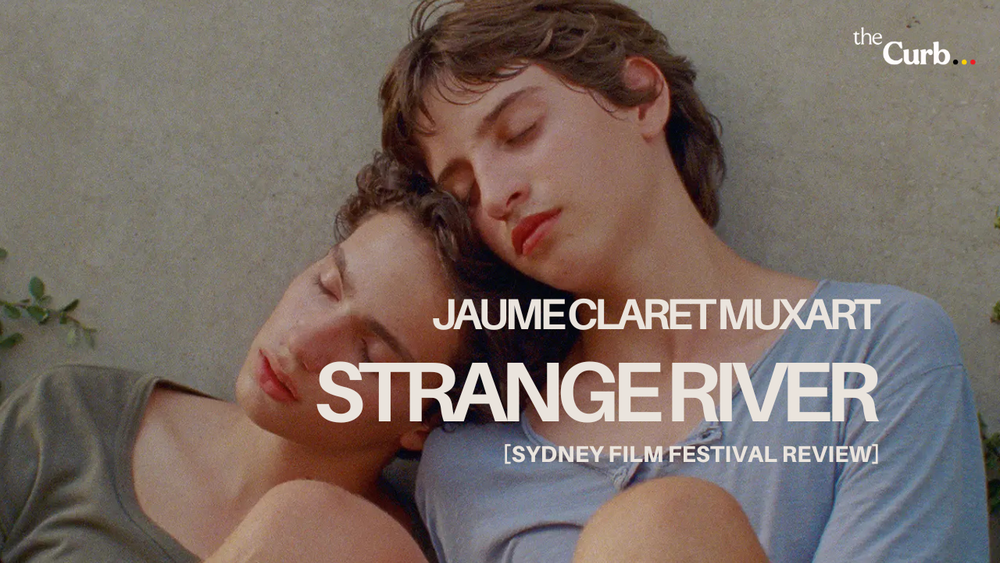
Strange River (Estrany riu) is a sensual coming-of-age drama that depicts queer awakening through picturesque lyricism, often favouring porous imagery over dialogue or conventional narrative. Following a family of five on an idyllic holiday along the Danube River, Jaume Claret Muxart’s debut feature is as alluring as it is elusive, blending reality and fantasy into a ponderous journey of desire, frustration, and familial reshaping.
The film follows 16-year-old Didac (Jan Monter), a moody, sensitive teen who shares a deep yet evolving bond with his family. The opening scene, a tracking shot of the five riding their bikes through a lush forest alongside the river, depicts a loving family constantly in motion. Didac is joined by his mother, Monika (Nausicaa Bonnín), an actress preparing to take on a leading stage role, his father, Albert (Jordi Oriol), an architect, and his two younger brothers, Biel (Bernat Solé) and Guiu (Roc Colell). The Catalan family begins their trip at the source point for the Danube in Germany, aware that they may not have another opportunity for such a bucolic escape anytime soon.
Didac is feeling impatient and restless about his sexuality, something he reveals in notably unjudgmental conversations with both his parents. He speaks to his father about a boy who kissed him, Gerard, but believes the kiss only happened because Gerard was drunk. He claims he doesn’t like boys, but he does like Gerard – revealing a sexual fluidity that his father doesn’t quite understand.
In conversation with his mother, Didac declares “the frustration of not being desired,” before Monika lovingly reframes it as Gerard’s loss, praising how handsome her son is. One funny scene has Albert making light of catching Didac masturbating, a follow-on scene that suspiciously juxtaposes self-pleasure with the sweeping streams of the river. Jan Monter does a convincing job to make the character both sympathetic and narcissistic – his taciturn persona and unruly libido often resembling his sexual ideals.
The three siblings often argue with one another by disrupting each other’s sleep and getting into physical altercations in their shared tent. They stop at various architectural spaces of interest, where Albert eagerly lectures his bemused children about the buildings and their history. Didac escapes from his family by swimming in the Danube, where he frequently sees a naked boy swimming beside him – a figure later revealed to be a mysterious boy named Alexander (Francesco Wenz). As the handsome spectre progressively enters Didac’s foreground, whether literally or through desire, Alexander’s presence is met with hostility from Didac’s brother Biel. By the time the film enters its dreamlike final act, Didac is left questioning both his connection to Alexander and his place within the family he has begun to naturally outgrow.
Under Muxart’s loose experimentation with perspective, both Didac and Monika witness events that are neither confirmed nor denied as part of reality. Didac sees his mother engaging in a nighttime dalliance at a stop-off that suggests a cruising spot, just as Monika is privy to the boy Didac desires. Monika also tells Didac the story of her first love, a tale that eerily mirrors the film’s more beguiling second half, in which Didac escapes on a romantic excursion with Alexander. In this ambiguous exploration of memory and longing, do the experiences of mother and son entwine?
In an interview, Muxart stated that he prefers the film to be labelled less as a coming-of-age and more as a “flowing of age” – a confluence of sorts. This idea is expressed through Monika, who took the same trip along the river when she was Didac’s age, a time when she first experienced love. Monika senses her son’s despair because it is familiar to her, a sentiment the film develops through its reflective and atemporal structure. She observes that the river had more water on her formative trip, suggesting nature as an echo of human behaviour. This thematic undercurrent is further amplified in one of the film’s more emotive scenes, when Alexander asks Didac to “let the streams decide for you” regarding his identity.
Strange River is as elemental an experience as it is contemplative. Feet move slowly and pensively through a shallow stream. Wind, birdsong, and sunshine frequently flood both the frame and the soundscape – the soothing score by Nika Son only adding to the soporific tone. Trees, leaves, and grass gently replicate Didac’s wandering yearnings. Shot on dreamy 16mm film, cinematographer Pablo Palomo uses movement and nature to hypnotise the viewer into observing Didac’s unfamiliar, emergent feelings within these calming surrounds. When Didac and Alexander go sailing out on the Danube, the camera feels almost lulled into quiet submission, surrendering to water, skin, and a warm embrace.
Strange River is a love letter to an emerging director's upbringing, using an ever-changing river as a reflection of the struggles of queer adolescence. The film may feel overly oneiric and distant, but what it suppresses in conversation and character, it makes up for in visual poetry. It is a story without answers, choosing seductive visual composition and familial convergence over the trappings of a traditional coming-of-age narrative. Didac's tale is one of constant change: ever-transforming, elusive, and caught between longing and belonging, and as mutable as the Danube itself.
Director: Jaume Claret Muxart
Writers: Jaume Claret Muxart, Meritxell Colell
Cast: Jan Monter, Nausicaa Bonnín, Jordi Oriol
Cinematographer: Pablo Palomo
Music: Nika Son