
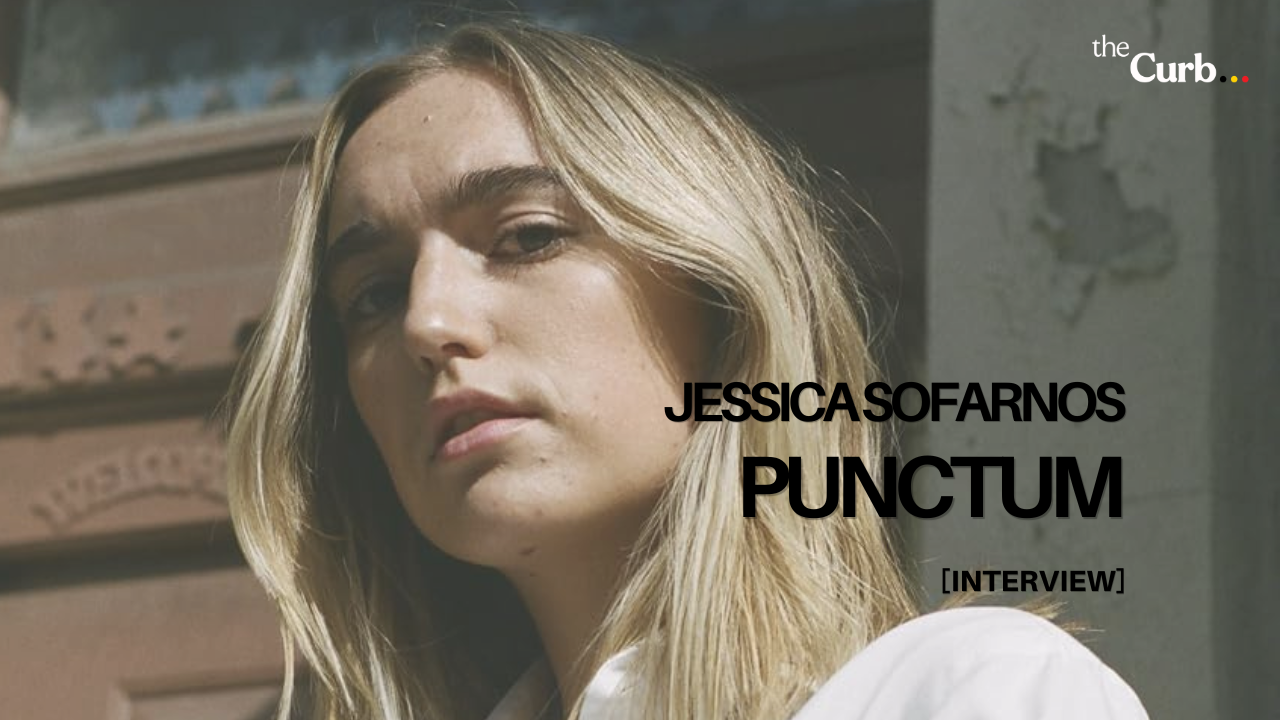
There’s a calm, lived-in nature to Jess Sofarnos’ films, one where she holds a mirror up to herself, reflecting emotions and experiences that are familiar and relatable, yet rarely seen in Australian cinema. Sofarnos joins her contemporaries (Kaite Fitz, Lucy Coleman, Annelise Hickey) by bringing internal experiences to life on screen in a manner that reflects the lives of city-based women finding their place in the world. This emerging talent has quickly built up a filmography that comfortably cements her as an essential voice in the Australian film industry, with short films like Punctum and Good Grief both offering introspective insights into personal and relatable experiences.
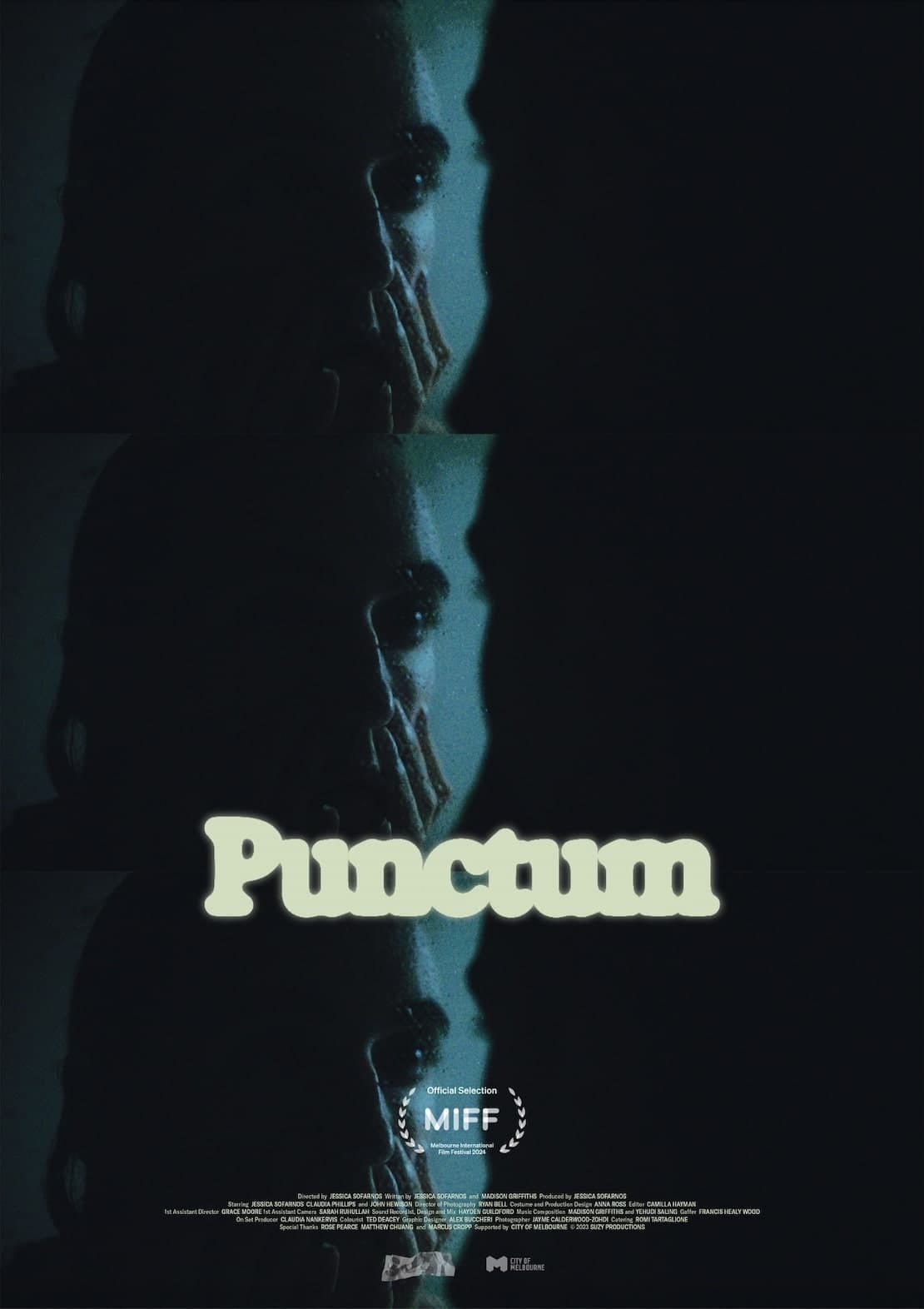
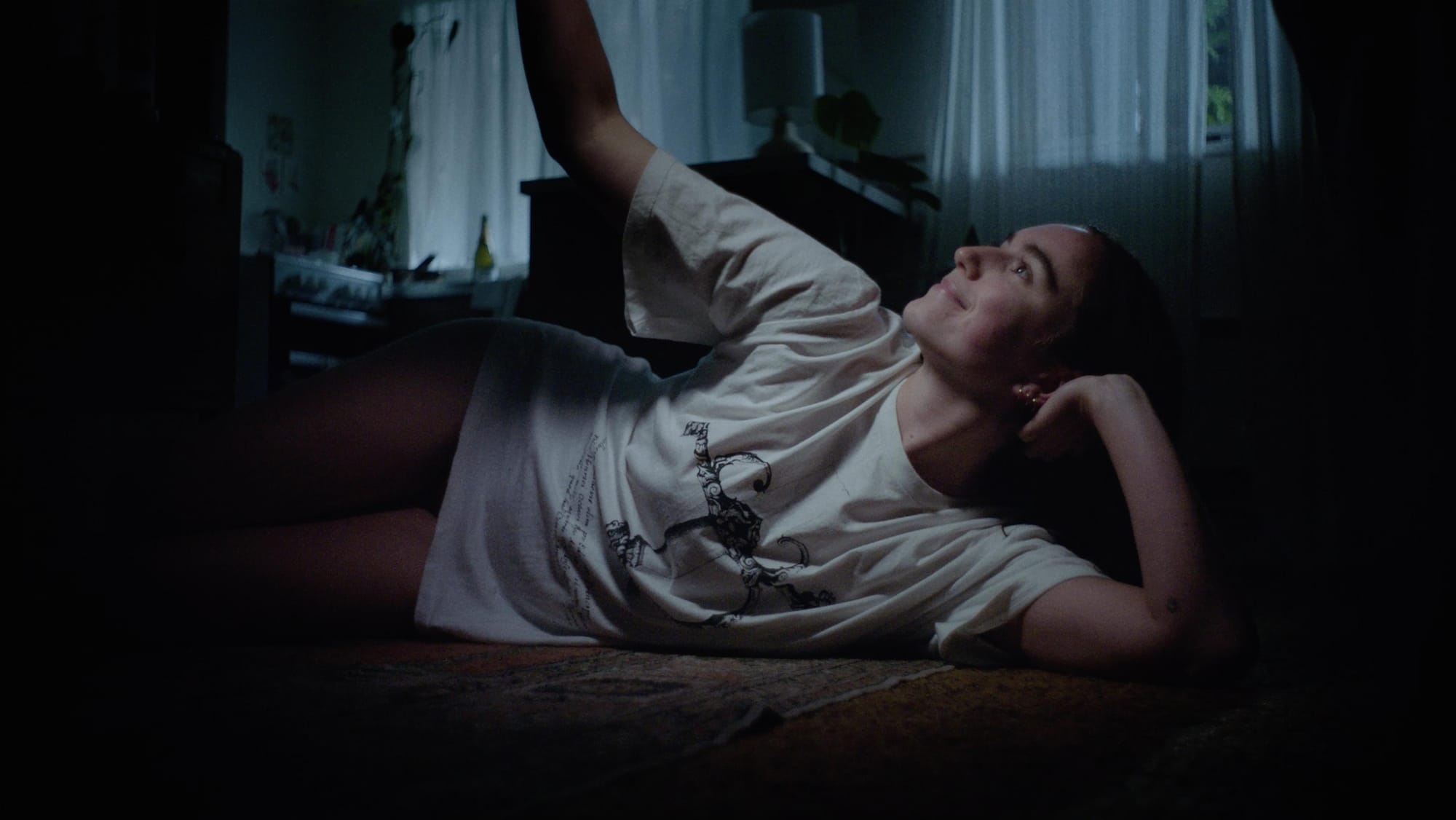
With her 2024 short Punctum – a perfect entry point to her growing filmography – we’re invited to spend time with Sophie (played brilliantly by Sofarnos herself), a young woman who whiles away the evening after her abortion. In building Sophie as a character, Sofarnos skews away from the expected emotions of someone who has had an abortion; she exists in the rooms of her home, slinking from the couch to bed and back again, often drenched in a darkness that’s pierced by the cold light of her phone. She is, quite simply, recovering and existing. There’s no heightened emotions or dramatic phone calls to the partner or overly supportive friends; Sophie simply exists as her evening plays out. What results is a film that’s calm and unsentimental in nature; it is life at work.
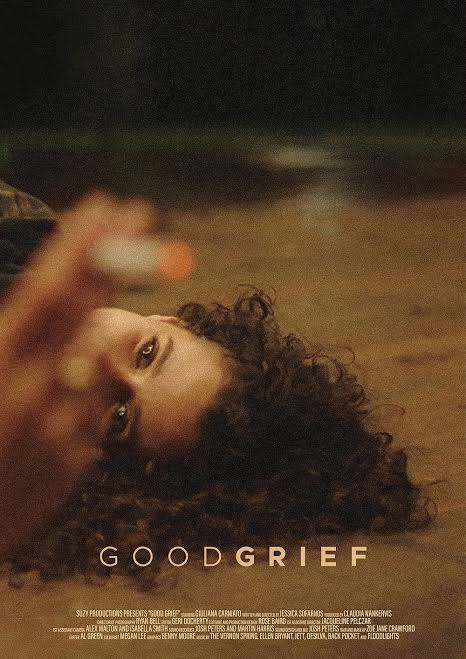
Her 2023 short Good Grief acts as a contrast to Punctum. One sees a character who innately understands how to process her internalised emotions, the other follows Ava (Sofarnos, excellent once more) attempting to navigate her changed reality after the loss of her mother. Ava seeks some kind of distraction, whether it be by drowning oneself in the atmosphere of being around just a few too many people at a house party, or by finding another adrift figure to hold onto for support. Like Punctum’s Sophie, Good Grief’s Ava isn’t crippled by explicit emotions, instead she’s weighed down by the presence of loss, an aspect of her existence which causes a subtle languid nature that stranger Maggie (Giuliana Carniato, superb) recognises as needing some friendly support. As they leave the house party, Maggie acts as a saddle for Ava’s grief; the act of compassion and empathy being as enriching for Maggie as it is for Ava.
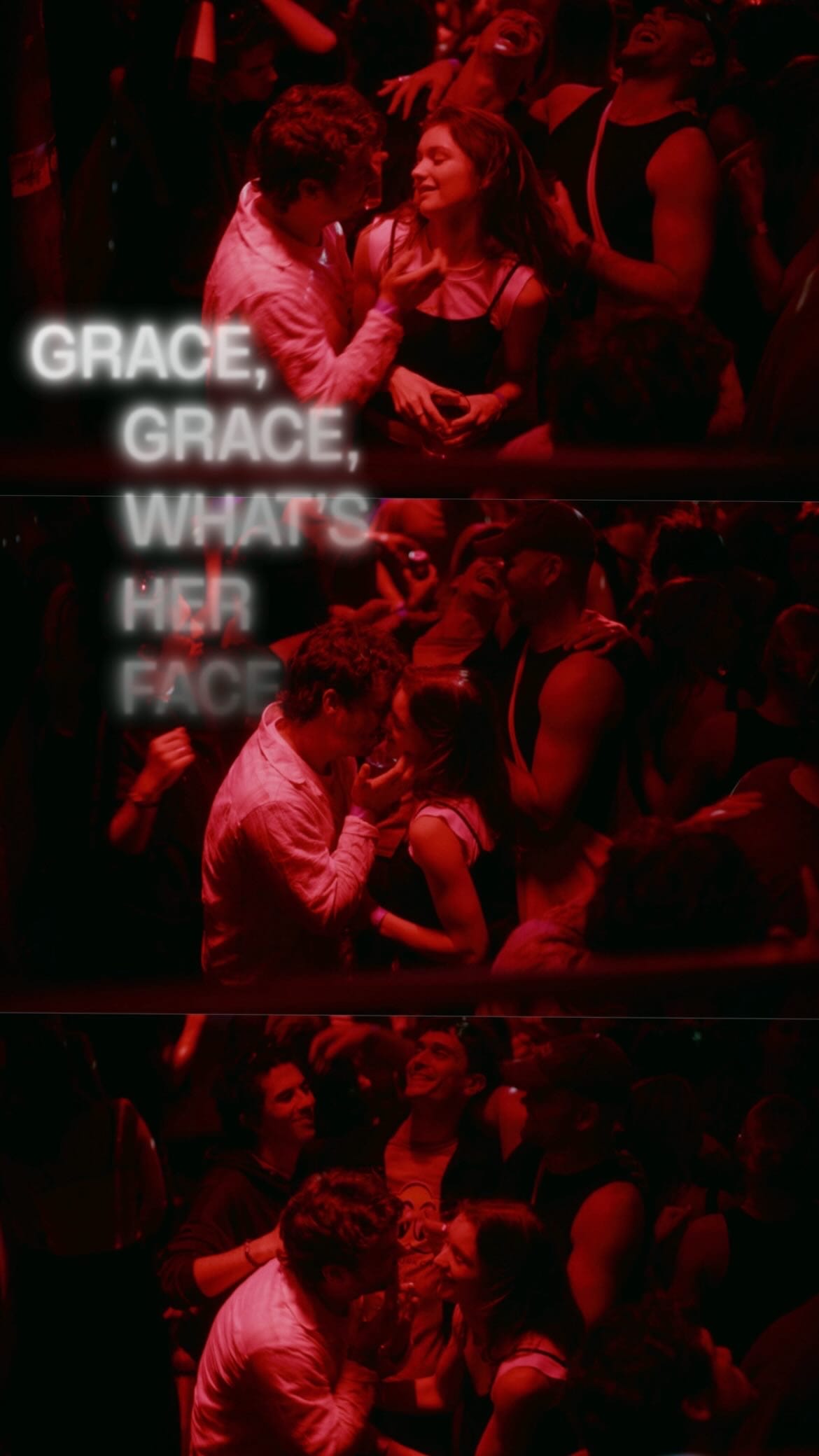
Night is a constant in Sofarnos’ films. We meet her characters at a time where societal expectations are at their lowest and their need to be ‘on’ or ‘perform’ for others is reduced. Sofarnos’ latest film, Grace, Grace, What’s Her Face, follows a young woman as she navigates the night of Naarm, a home for the night over Christmastime. Once more we’re invited to a character’s internal world and once more we’re invited to reflect on what it means to be a woman living in the cities of Australia right now.
As a writer and interviewer, I have the privilege of saying that Jess Sofarnos is a vital voice in Australian film and TV. Through her growing body of work as an actor, writer, director, and creative force, Jess is shaping what women-led stories look, sound, and feel like on screen.
In the following interview, Jess talks through her creative process, her desire to explore drama on screen, what working on films like Together and shows like All Her Fault taught her, and more.
Punctum and Good Grief are available view online. Grace, Grace, What’s Her Face launches online in July 2026.
To find out more about Jess’ work, visit:

Both Punctum and Good Grief are powerful experiences and beautiful films. They explore internal lives in a way that I wish more Australian films would. There is a group of filmmakers – who I think you're part of – who are telling stories that are so internal and relatable, who they invite audiences to consider what's going on in their characters’ lives.
Jess Sofarnos: Thank you. [Good Grief] feels so old to me now. It's funny that it's getting a second life. ACMI screened it last year, and when they emailed, I was like, ‘Oh, that's awesome. I'd love to screen it.’ I kind of forget that these things live on. That's why I released them online; I hope more people find them. Like, that's how I want to find shorts, right? Unless you go to festivals, you don't get to see them.
This is it. I'm forever telling filmmakers that when you make a short film, that once it's wrapped its festival run, put it out into the world, share it with people.
What kinds of stories interest you? What do you want to share as a storyteller?
JS: That's a big question. I was thinking about this the other day – I don't know why – I remember seeing Blue Valentine when I was in year 9 or 10, I was so young, like 14 or 15, and I was fucking rocked. There was something that, even as a teenager who maybe had just fallen in love for the first time, I just related so deeply to. It's such a sad film. But, to me, sadness is part and parcel of being alive. I find it really interesting. It’s so heartbreaking.
I always lean into stories that speak to a part of me that either I can recognise, or that I can't yet recognise, but I know is human, so I will [recognise it] one day. At 15, I watched Blue Valentine, and I hadn't been married. I don't know what that feels like to have a child and watch your whole life crumble. But I know now what it feels like to break up with someone. It's like my younger self knew I was going to feel that in some way as I got older.
I started reading an article that's fumbling around the internet about grief porn, and it really frustrated me. I wanted to understand where these people were coming from. Hamnet isn’t necessarily my favourite film of the year. The first hour, I was kind of like, ‘I don't really know what this is. Is it a love story? Is it a story about William Shakespeare?’ I couldn't really figure out what it was. And then, at the end, Chloe Zhao has just been budding all these tiny seeds to be able to rip your heart out and leave it on cinema five's floor.
I'm drawn to deeply character centric slice of life humanist stories. I love that you were talking about internal worlds, because that's something I'm forever trying to unpick. It’s something I've talked about with Punctum in particular. We never see people in their aloneness because they're alone. That was kind of where Punctum started. I was so fascinated with trying to work out the inner workings of my own mind. Of, like, what are these crazy tangents I go on when I'm by myself? Or what do people think about when they're in the shower or on the toilet? Or those moments where we're kind of in our own worlds. How do I bring that to life on screen?
Joachim Trier and Andrea Arnold are huge influences. Joachim talks about a lot how no one's an antagonist or a protagonist in his films, that it’s just a humanist lens. We're all just looking at everybody from their points of view. That's something that I feel deeply passionate about exploring.
You touched on something I feel is central to Punctum, and even in Good Grief, which is this sense of witnessing an emotion that you know that you might feel one day. In Punctum, it's almost like we’re witnessing the maturing of this person who maybe never anticipated that they would be going through what they're going through. They might have seen other people go through it or heard stories, but they're experiencing for the first time, and they don't know how to consciously process it or to walk through the steps to get through to the other side. It's a quiet gift to audiences. And to yourself too, because you're wearing multiple hats in that film – acting, writing, directing – and you’re inviting people to spend time with this person and empathise with her and see what her life is like. In this invitation is a nod to say ‘you might not feel these emotions right now and you might never have felt them, but you might in the future, and this film gives you a touchstone to refer back to.’
JS: That’s what frustrated me about the conversation regarding Hamnet. I don't know if you can relate to it, but that scene where she's just screaming, and Chloé just sits with Agnes, she just sits there, and people are saying that's a manipulative scene. That baffles me. That's real pain. I’ve never lost a child, but I lost my mum, and that primal screaming for having someone pass in your arms, I would imagine, is far worse losing a child. But just like a mother yearns for her child, I felt the same yearning for my mother. I find it fascinating that people find that moment manipulative. I guess people can only meet others how deeply they’ve met themselves. And I understand that not everyone has that capacity. But that’s what good art strives to change -- that capacity. We're just asking people to sit and be with someone's pain. And people find that really difficult. Maybe Good Grief was a meditation on that. She found someone to just sit with her pain and not run away from it.
In Good Grief, you show one character who recognises that somebody else is in pain. In media, at least, depression or trauma is so often presented in an overt way. It's often explicit – this person is self-harming, this person is acting out. They're not internalising things because that's not cinematic or dramatic. We're taught to feel that that's not dramatic. It's not dramatic to sit there and just think and feel what you're going through, and yet you make it compelling on screen. Did you feel that you were taking a risk or a challenge in saying, I'm going to present something internal on screen and I’m going to trust the audience to come along with it?
JS: At first I was really battling with [the thought], ‘Is this arrogance if I'm doing it all myself?’ Now I kind of laugh at that. I’ve watched so many videos with the Duplass brothers, or people in indie film, who say if you need to do it yourself, do it yourself. So outside of that, I never probably thought about the storytelling being a risk, mainly because I'm not imaginative enough to write too far outside of my own experience.
I've never had an abortion, but I love a lot of people who have. I co-wrote Punctum with Madison Griffiths, who's an incredible abortion activist and writer, so initially she was onboard as a voice to what that feels like. I write from, if not personal experience, then threads of something that I'm curious to understand about myself, or something I've noticed in others that I'm curious to understand. It kind of all blends from there.
With Good Grief, it's a 26-minute short, everyone said to me, ‘cut the story. It's too long. It'll never get into any festivals.’ And it didn't really. It got into about four online festivals. But cutting it would have meant that I had to cut the story. It would have meant I had to cut sitting with Maggie, just sitting with her, slowly coming into the party, sitting with her internal dialogue during the party, sitting on the road. I could have cut that scene on the side of the road straight into Ava approaching, but then we're missing all that amazing richness of what life feels like to just be in these uncomfortable or sad or joyful situations. Missing what it feels like to be in life.
So, I've never interpreted it as a risk. I just try to write and work from instinct. If something doesn't feel authentic, then I don't really want to make it, and that's why I just keep making my own shorts. I’ve been told to stop making shorts, but at this stage I don’t want to because it's the only time I get to direct. Until someone hires me to do it, it's the only time I get to do what I love. It keeps giving me that opportunity to kind of find that vessel.
You touched on collaborative work there. You mentioned Madison Griffiths on Punctum, but then there’s also Michael Shanks, Jonathan Levine, Minkie Spiro. Artists who might have a similar tone or work ethics that you might have. How do you determine what projects you’re going to work on? Is there the mindset ‘I’m going to trust that my career might be in the right hands if I work with these people?’
JS: Honestly, so much of it has been timing and a strike of luck. I work really hard, but particularly on back-to-back long form jobs; a lot of surviving it is just stamina because it’s so demanding. I'm shocked that more people don't thank crew in speeches when they win awards, because it’s crew that are in that job-to-job cycle non-stop. Producers/writers/directors/actors usually have bigger breaks trying to get their work up, but some of the grips or gaffers who I've worked with have been at it consistently for like 20 years. I'm like, ‘Are you guys okay? I'm exhausted!’ But I’m inspired being around them and I guess I feel fortunate that it’s kind of just flowed.
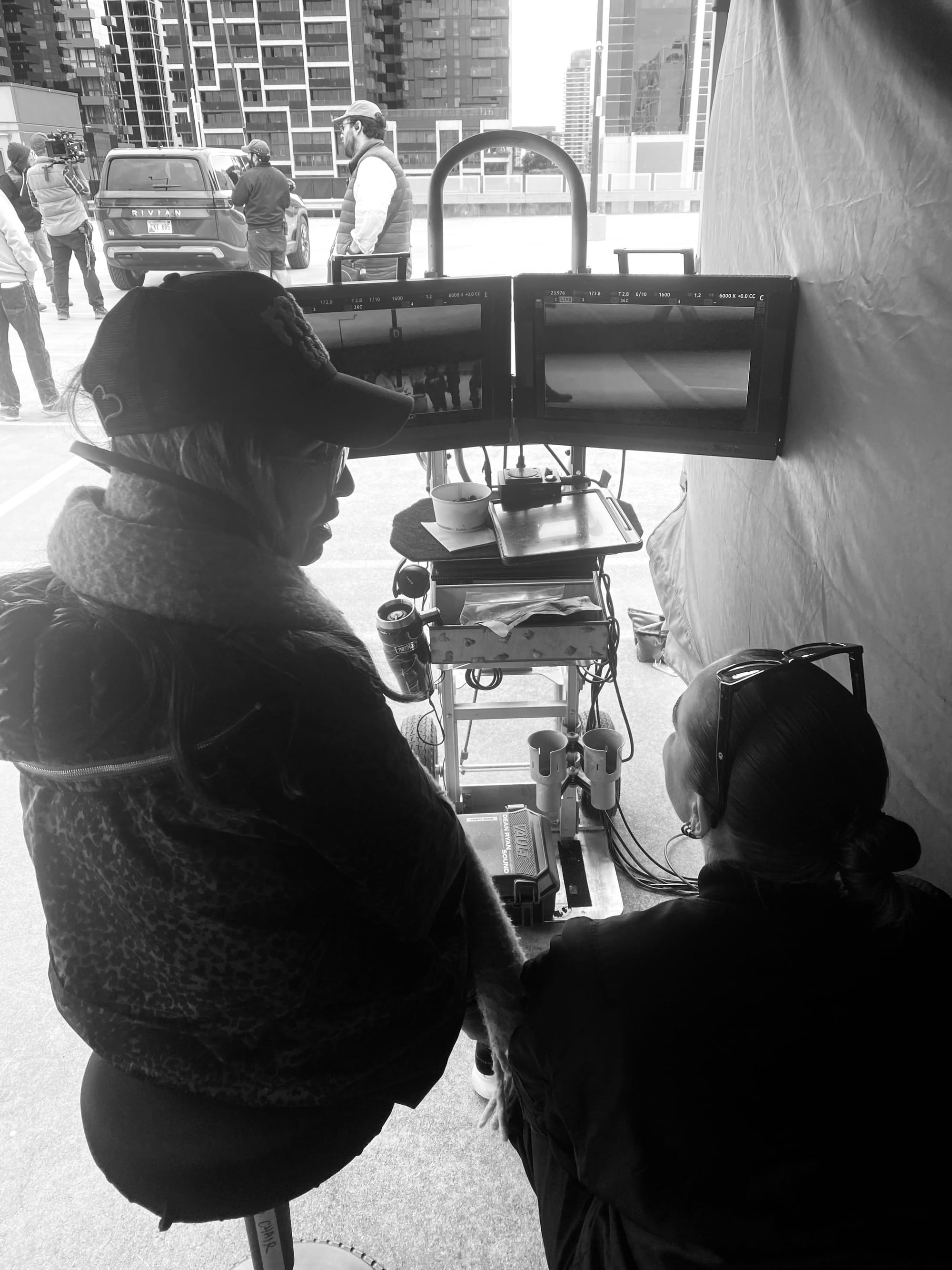
Getting your foot in the door is the hardest part. Once you do and you're nice to work with and you're decent at your job, and if the work is available, you just hope to keep getting a call. Together was an amazing experience. I got to assist Dave (Franco) and Alison (Brie). To be able to watch them so closely every day drop into their jobs as both performers and producers; it was such a joy to be able to learn from them. I didn't even see them looking at their scripts. They're the ultimate professionals.
Then the second AD on that job recommended me to Minkie because he'd worked with her before. It's one of those things where I got really lucky. 2024 was my Angel year or something, where things fell into place. I was really lucky with Minkie. When I met her, I just said, transparently, ‘I'm not in my early 20’s. I'm not fresh out of film school. If I'm not learning from you, I think I will find this exhausting. I have a show in development and I’m serious about it and I’d really love to understand the process.’ And thankfully for me she really respected that. She was like, ‘Yep, let's do it.’ She took me under a wing. She was and still is such a mentor for me - getting me to listen in on every big meeting and every casting decision that she could. She knew I was an actor, so she let me audition for a role in the show [All Her Fault, 2025], which I ended up getting. She let me do the cast reading, sitting at a table with Dakota Fanning and Sarah Snook. It was dream scenario and such an important six months of my life. But you need people like Minkie who believe in you; to give you the opportunity to prove yourself.
Then because I'd worked with Dave, and because Jonathan [Levine] and Dave are friends, Jonathan’s interview was, ‘Dave's recommended you, do you want the job?’ It just kept flowing. Now I'm on Hotel Hotel Hotel Hotel with Shanks, who's a dear friend. I just feel very fortunate.
I guess I kind of choose them based on what I could learn from this person or what I can learn from the opportunity. I've been really lucky that I haven't had a disappointing experience because I hear that can happen a bit, but truthfully everyone has given me so much or something. I get to work with crews who have become some of my dearest friends each time. That's been the best part. I just laugh all day. I love being on set. It’s where the magic happens.
While it is a job, you’re open, you're a sponge. You're having a good time and you're learning. And that patience to a feature or a series is really hard, especially in Australia, where we are still so far behind on getting equality on set, or equal numbers of women director led films or stories on screen. The numbers are so far behind compared to how many male storytellers there are. I'm sure it's already conscious in your mind, but how do you feel about stepping into an industry which hasn't really nurtured women's voices as much as it should do. Is it by building up your own filmography and saying, ‘This is what I'm able to do creatively?’
JS: I've been lucky to be on big sets to see what that feels like, and then, with my own small short films of five people, like on Grace, Grace What’s Her Face over Christmas, it was like six of us running around the city. I had no money. Sadly nobody got paid. It was one night of ‘you either jump in or don't’. Having those two ends of the spectrum has given me a lot of insight. But all of my work and choices are just instinct. Particularly with Good Grief, now with the series, you start getting out into the market, and the market doesn’t like dramas anymore. ‘Can you make it a comedy?’ ‘Can you make it a horror blend?’ And I'm like, ‘No, it's a drama. It's an Australian drama.’ It's got comedy through it, but the project is what it is. I wish we weren’t so afraid to explore that as an industry here.
Because for that for real and consistent change to occur in terms of industry equality, there needs to be a real shift in the mindsets of producers/HODs to make it a priority to give, not only female, but particularly young female voices a go and provide the scaffolding and the frameworks to support these voices so that they get their start, and get the momentum to actually have a chance at longevity in their careers. From directors, to production designers, to DPs — we need people in positions of decision-making power to find the importance in looking for these people and not just relying on their usual guns-for-hire out of ease. Because we’re all here, and we’re not only keen and eager — but we’ve got the talent and skills to really do the job. We just need people to let us do the job. I've never understood the idea that it's a 'risk' to back and invest in the work of young female voices — we're shown time and time again, overseas in particular – Lena Dunham, Michaela Coel, Charlotte Wells – that it not only yields return but huge audience. Isn't it more of a risk to make the same outback crime thriller with the alcoholic cop that everyone's already seen before?
People want to feel things. They want to sit and be a part of stories that show worlds, internal worlds that they aren’t able to put words to, or experience yet. And that’s our job – to give them that.
I've been really lucky with women like Minkie, and Amanda Higgs, (EP on Good Grief), who obviously did The Secret Life of Us, which was a huge reference for the show. I've been lucky to be surrounded by female filmmakers who have given me a leg up or an opportunity or trusted my voice. And, yeah, you go into sets, and while it’s not always initially conscious, you do eventually notice that there’s half the amount of women in the room. But I've also been lucky enough to work with a lot of wonderful men who also want to give me great opportunities, which might not be something you hear all the time and I think is important. They have to be part of the change we want to see. The gaffer and the grip that I've worked with on the last three jobs, they're like, ‘The next short you make, we're sending a truck. Whatever you need. You just let us know.’ That’s the kind of generosity young filmmakers need.
But also, in the same breath, I had no fucking idea how to get people to trust me so I subconsciously started to make my own opportunities, by making my own work. In short form world, I haven't yet had someone stand at the gate and tell me no, except festivals. I think making my own portfolio is the way that I've been able to kind of stay sane alongside diversifying [my roles]. I was only acting before. And by changing my mindset and being like, ‘Alright, I'll be a production assistant.’ ‘I'll be a runner.’ I just want to get in there and learn. And then there’s producing commercial and creative projects too. I've been producing ads for the last six months. This kind of 360 degree understanding of the industry makes me a better director, it makes me a better writer, and then it makes me a better producer, because I understand, ‘Okay, well, we can't do that from a monetary perspective. So how can I [get it done?]’ It's been an incremental build, and for a long time it was something that frustrated me, because I was like, ‘What am I doing? Is this worth it? It’s so exhausting, I have no money.’ I want to make a feature. I want to make this.
And now I'm realising this is the job. Being a part of this industry was my dream for so long, and I'm doing the job. Actually making the film is the icing on the cake.
You're part of a growing change of voices within Australian film. You're talking about making your own work and owning your own voice and stories and being the driving force behind it. Go back 20 years, and you'd have to ask for approval. Then you end up being part of something like ACMI’s New Voices of Australian cinema program where you are highlighted as an emerging talent changing what Australian cinema is. I see your work sitting alongside people like Lucy Coleman or Kate Fitz who have crafted internal films that invite us into worlds that we don't get to see on Australian screens. They're also driven by people are like yourself and say, ‘Well, I don't get to see the stories that I want to see, so I'm just going to make it.’ This is how Australian cinema changes. Do you feel like you're part of that change?
JS: No, I don't feel it consciously. I just make short films by myself and go to work and come home. That feels very generous to say, but I do see this really beautiful cohort of people like Annalise Hickey (Hafekasi), David Robinson Smith (The Shirt Off Your Back), Bonnie Moir (Not Dark Yet), who I have admired for a long time. Bonnie has started directing TV shows (Exposure). And then suddenly Australian television has just a different hit to it. It's just got this young, fresh, modern, cool casting, underrepresented voices. It's got heart and that really excites me. I hope that that collective change is coming.
Annalise’s films are so beautiful. I said it to her a couple of months ago, and I was like, ‘I hope you don't take this the wrong way. They're so simple. It's just a simple, beautiful story, but it's told with so much heart and great casting and beautiful performances and great direction.’ I guess that's what I try to do too.
I come from an indie film background; I've never had a grip on a set before. Andrew, I wouldn't even know what to do with a grip. I just applied for funding for another short and if I get 30 grand, I will die. I'm like, what would I do with 30 grand? That's so exciting to me.
I'm interested in just sitting with actors. I prioritise performance. I think casting is like 95% of the job. I arguably could just watch two really good actors have a conversation at a dinner table and the cameras locked off. I find it fascinating. It's always story first and how that story is told is the most important part and usually that's through performance.
But, yeah, I don't know if I can say I'm a part of it, but if I was, then that's really cool. I love to just keep making stuff.
The really good thing about what I get to do is I get to say that you're part of it.
JS: That's very nice and very generous of you.
Tell me about Grace, Grace What's Her Face?
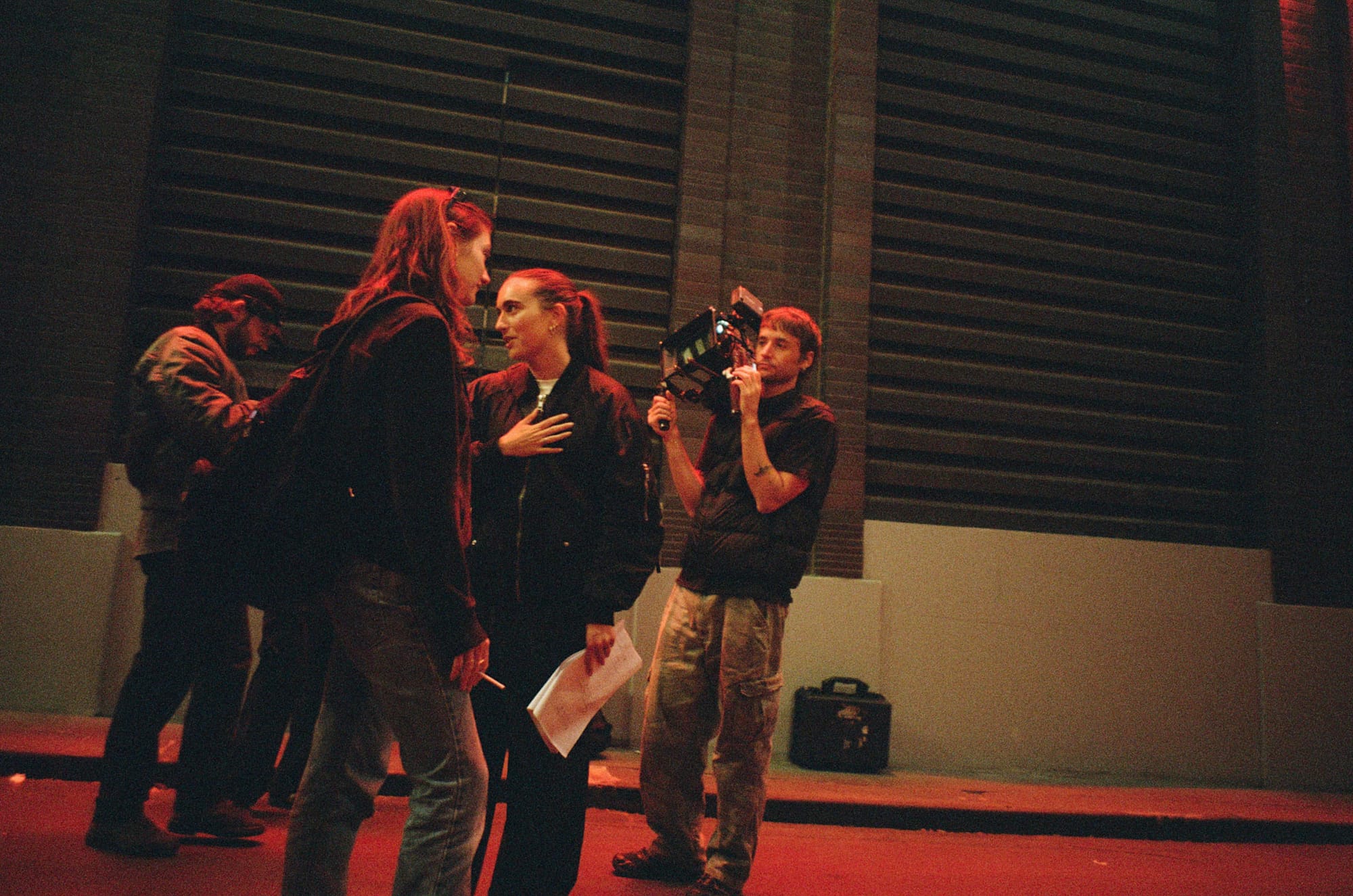
JS: It's a short I made over Christmas last year. I wrote it overnight, and then I just did a call out on Instagram, ‘Is anyone free in two weeks?’ It was the 27th of December and a bunch of amazing people said yes and we just ran around the city with a camera, very guerilla, fly on the wall like. I produced it as well, which I'll never do again, in the middle of the city at Christmas time with drunk people coming across the camera, being like, ‘Are you guys Channel 7 news?’ It was complete chaos, but it was so fun.
It's about a young woman who's left her family in a rural country town, and you don't know why. She makes her way to Melbourne by herself on Christmas, and she's alone, and you can kind of see this sense of excitement and wonder of being by herself in the city. A few hours into her journey, she loses her phone, and she goes on a mad scramble to find it. When she realises she can't, and all the shops are closed, she ends up meeting people along the way in the city that bring her back to herself. Every person she meets, she introduces herself as someone different. It's this idea of ‘who would you be in a foreign city if you didn't know anyone and you were trying to run from a life that you didn't connect to?’ How would that make you feel more like yourself? I was thinking a lot about how Christmas has the pressure to be this really joyous time but for a lot of people, it's a really difficult and really isolating, lonely period.
I'm often very itchy and wanting to be overseas and wanting to be in different places and experience different cultures and be around different people. I can find home, whilst it's where I need to be and where my career is and where things are moving, and I feel very safe – I find it quite suffocating at times. I was very curious as to what that battle in me really represents. What is it about being overseas, where I feel more alive or more free or more like myself? I kind of submitted to that. In this instance, for Grace, our relationships, for better or for worse, particularly in our home environments or our families, they like to keep things as they are because it's more comfortable for everybody. And I think when we learn to fly and feel untethered and get that opportunity to expand who we are as people, away from those beautiful yet often sometimes restrictive relationships, we can really find essence of who we are. It's a journey of self-discovery, and it's funny.
Our colourist Ted Deacey, when I first sent him the cut, he was like, ‘Oh, the whole time I thought something bad was gonna to happen to her, and then it just didn't. She just was having fun.’ And I was like, ‘Oh, that's great.’ A lot of men have watched Grace, and they've been like, ‘Oh, I thought she was gonna get sexually assaulted,’ or, ‘Oh, she was in an alleyway with these boys, and nothing happened.’ They're so, so relieved that nothing happened. It doesn’t always have to be a spectacle to be impactful. It's just this journey of her trying to find her voice being alone.
We come back to the internal here. Everything is often so directed to the external, it's about who we're engaging with. It's about the world around us and it's not about self-improvement or self-realisation or self-understanding. Those themes feel quite important and personal to you, but then, by virtue, they become personal to the audience as well. I'd love for you to give a summation on what exploring the self means in a creative way.
JS: What does exploring the self creatively look like for me? I have always been interested in sitting with the shadow aspects of myself. I'm deeply emotionally honest and curious with myself. I like to look at all my flaws, and I like to look at why they're there, and kind of unpack that and how that connects from an intergenerational perspective, what my mother passed down to me, how my sister's life has influenced how I shape my days or not. I'm perpetually fascinated with the human brain, and I think that's why I'm interested in making films that are so deeply rooted in reality. There's so many stories about escaping to other worlds, but this world we still don't know so much about or we don't give the space to understand.
I draw strings from things that I'm trying to understand in myself or I want to ask of myself, which means I am asking the audience to look at the emotional complexities of everyday life and the nuance of everyday life, because it's too easy to just shut it all out. I think when we do that, we create more space and compassion for ourselves, which in turn gives us more space and compassion for others.
Grief is at the center of a lot of my work, probably because Mum died. Mum died very suddenly, and it really rocked my sense of self. That's what the show is about. It's about how to become an adult without a parent, when you've been enmeshed with someone for so long, and so much of them is who you are, and you are so much of who they are. And as a child, you believe that's such a beautiful thing, because it is. I was so loved and cared for, but now without her as an adult, I've been really floundering, and I have had to learn to become not Sue's daughter, but Jess.
The more I've shared it on Instagram through writing about my mum I've noticed, by total surprise, it's a selfish endeavour of just wanting to get her memory down, or wanting to understand things about myself, and then when I share it, I'm always floored Andrew about how many random DMS I get of people being like ‘My dad died 12 years ago. I've never been able to put words to that experience. I've never talked about it before. Thank you for writing this.’ That gives me that motivation of, ‘Oh, this means something to someone somewhere.’
I looked for those pieces when mum died too, or when I was going through a breakup, or when I'm feeling funny about a friend, or any relationship. There's still so much here that we need to understand before I'm interested in exploring anything else out there or something. So, yeah, it's a selfish endeavour because I'm trying to unpack things going on in my own life, but then once it's shared, it becomes universal.
That's what I love about The Worst Person in the World and Sentimental Value –and I could just list his whole filmography –, they are about internal worlds. They're about young people not even being lost, because that's so trite, but just young people being young, that we're all just trying to figure it out. I think that's the driving force. It's just something that I usually do for my own self exploration, and then in doing so, I realise it helps others in some way. And then that feels good. So then I keep trying to do it.
View Jessica Sofarnos' work at: