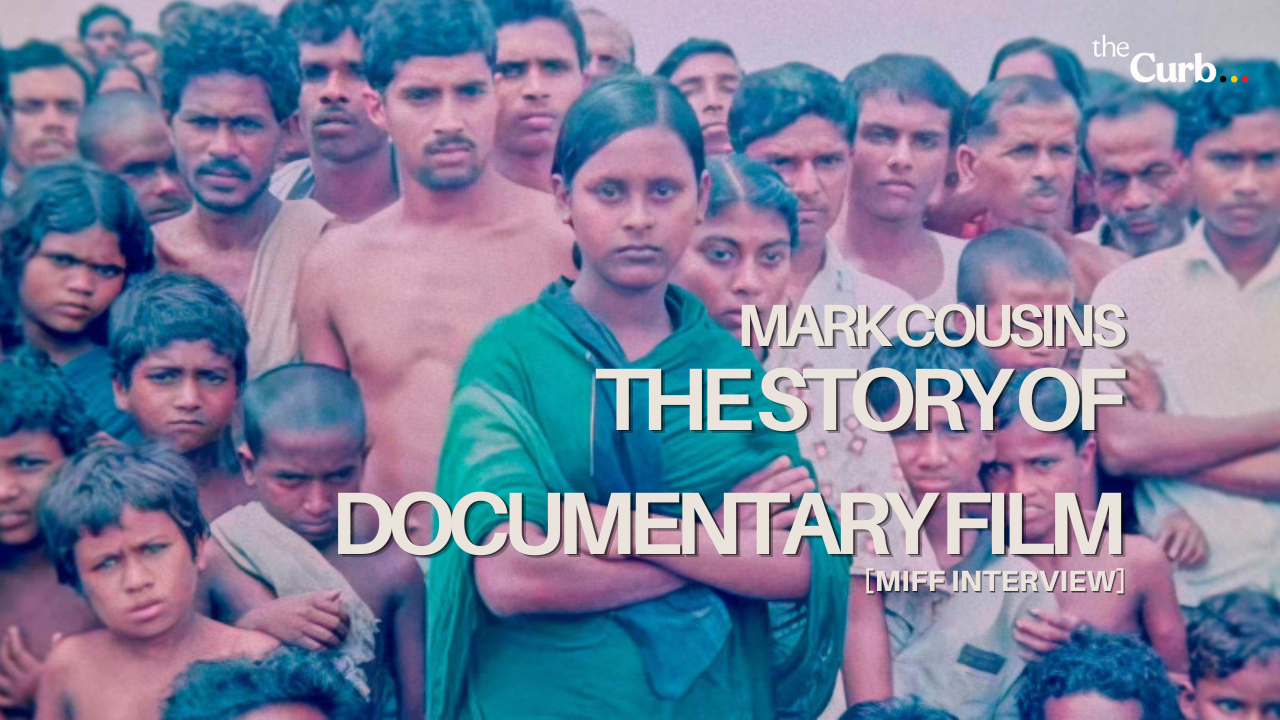
One of the most ambitious works at this year’s Melbourne International Film Festival is the Belfast-born, Edinburgh-based documentarian’s latest attempt to map the history of cinema.
Mark Cousins is dressed in a black kilt, thick black socks, black boots and a black t-shirt emblazoned with small white letters that read ‘documentary kills fascism'. As he sits down to speak with me, he explains that he has just come from a photoshoot.
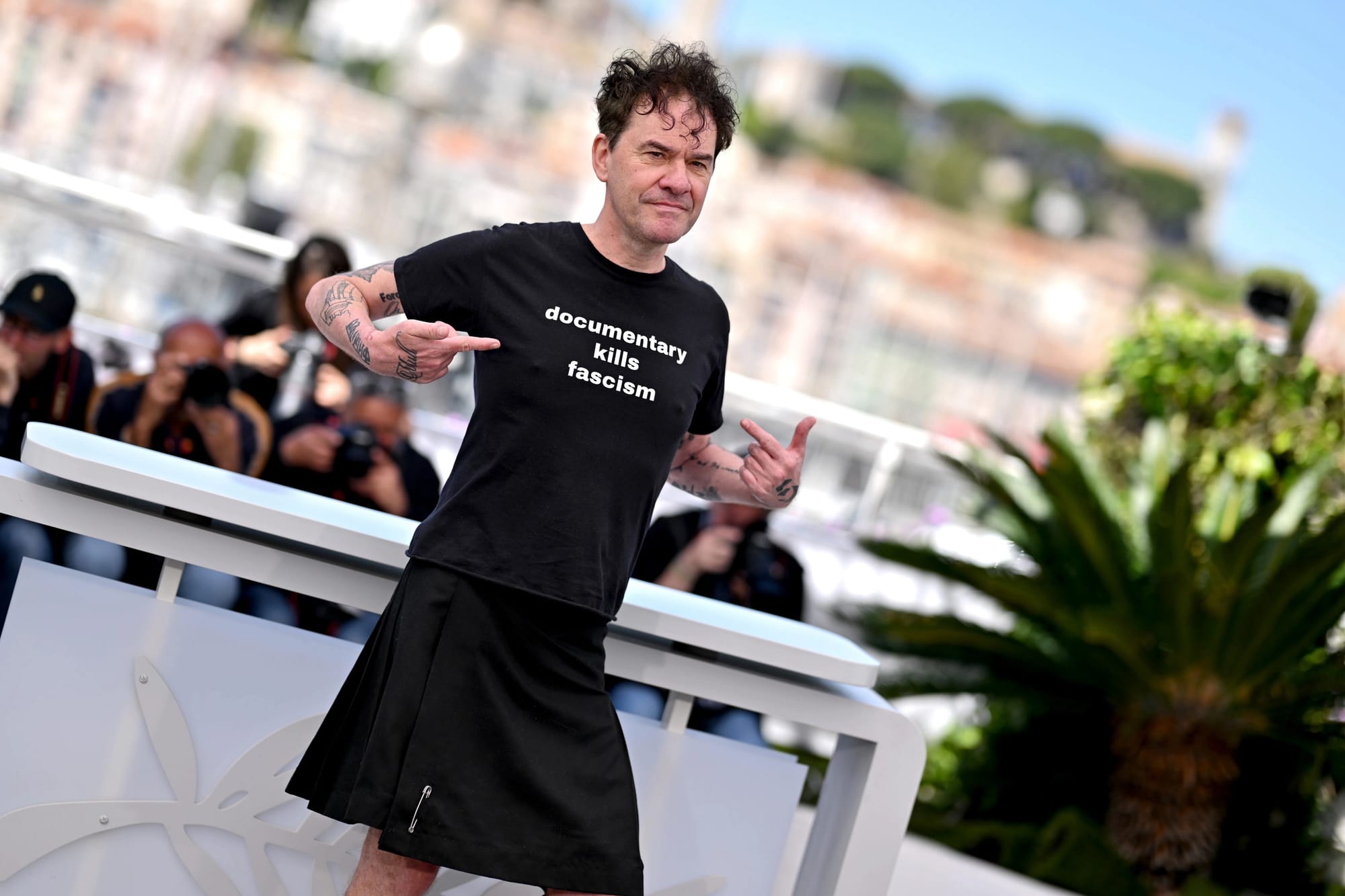
"We did the photo call and my God, Catherine Deneuve was there and Léa Seydoux, and they were first and the press went wild, of course," Cousins says with uncharacteristic speed. "And I thought, 'Fuck, I have to follow that'. And then I showed this t-shirt and the photographers went 'ahhh!' and 'click click click click'. Bad things are happening in many countries. We started making this film long before this, this swing to the right, but it's relevant. The Story of Documentary Film is relevant, you know, because it's about solidarity and it's a plea for compassion."
Few individuals have examined the history of film with the rigour and passion of Mark Cousins. Through The Story of Film: An Odyssey, Women Make Film, documentaries about Orson Welles and Alfred Hitchcock, and essay films on Belfast, Stockholm, childhood and the act of looking itself, Cousins is, he admits, obsessed with creating films about film.
"I am not a good sleeper," he says. "Four hours a night or something like that. But the reason I make a lot of stuff, I think, is a kind of addiction to making. I'm happiest when I'm making imagery. You just feel your life stop. You can feel your anxieties disappear when you're making an image. Some of my friends spend five years trying to get a film made, to get the green light. But I just think, 'fuck it, go on red', you know?"
Cousins’ lilting voiceover is the most recognisable thing about his films. Hearing that Belfast brogue move from ASMR-adjacent sincerity to ribald enthusiasm is jarring at first, but it matches the passion he clearly feels about not only his subject but his process. Cousins’ latest work, a sixteen-chapter, sixteen-hour series called The Story of Documentary Film, traces the birth, rise and explosion of non-fiction cinema from the 1890s to now. Chapter one premiered at Sundance in January, the Berlinale took chapters two to four, and Cannes unveiled the 1970s chapters in May. MIFF is presenting the first nine across three sessions, the biggest run of it assembled anywhere yet. Unlike the films in which he charts the evolution of cinematic language, this one looks at society itself.
"Fiction films tend to be adjacent to reality rather than on top of reality," Cousins says. "So, if you're interested in the dream life of humanity, the desires, the erotics of humanity, maybe fiction film is better. But if you're interested in questions of society and relationships of power, then documentary is a better way to go. The Story of Film was more about film style. This one is the relationship between style and content."
At the beginning of our interview, Cousins wanted to show me how he manages a project of such staggering scope. About half of all films ever made – two million, he estimates – are documentaries. Grabbing his black backpack, he pulls out a sheaf of papers, taped together, that unfold, and keep unfolding until its breadth exceeds the reach of his heavily tattooed arms.
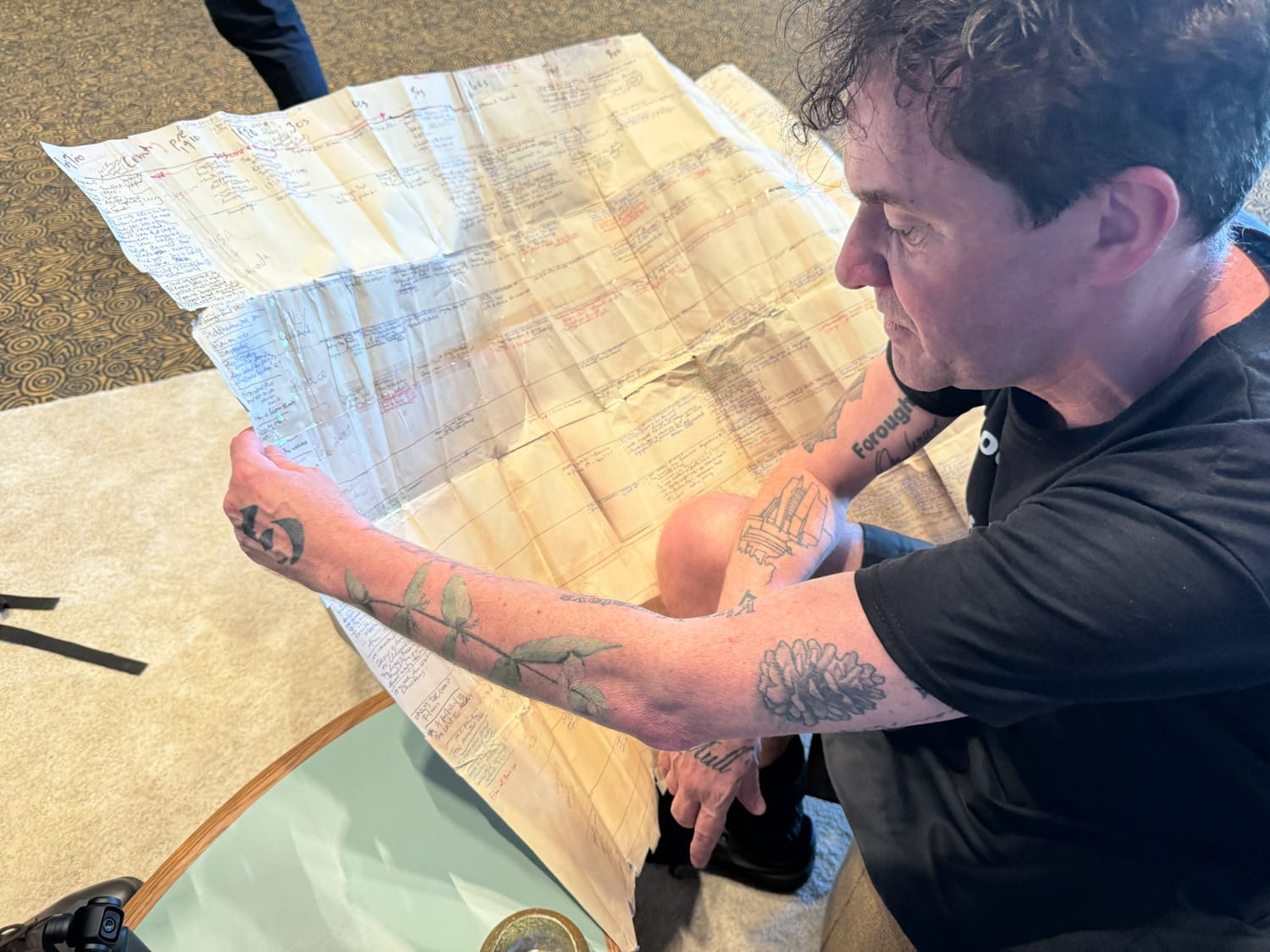
"This is my process," he says. "You know who Walter Murch is, the great Walter Murch? The editor from Apocalypse Now. He told me, as he told many people – use big sheets of paper. Don't use a computer screen to try and plan your film."
Cousins’ sheet is divided into columns by decade while down the left side are rows of regions and styles. Classics, obscurities and genres like 'poetic masterpieces'. "This was two years' work to get there," he says, shaking out the creases, "and crucially you work out what you're missing." He points to an almost-empty square. "Like Africa in the '40s, there's nothing there. Africa in the '30s, nothing. And look at the Soviet bloc when you get to the '70s and the '80s,” he jabs toward the centre. “It explodes."
The empty squares are the point, he explains. "I start with what I know. But then you see where there are gaps, and you have to ask, are there simply no good docs there, or is it just that I don't know about them? And it's often the latter. Your ignorance is your best friend when you're making a film like this." Did he know about great female Egyptian documentarians? No. Were there some? "Most definitely" — Ateyyat El Abnoudy, who in 1971 made Egypt's first documentary directed by a woman. "So, there’s the discovery of that."
Around twenty-five Australian films make the cut, "which is quite a high number", Cousins says. Among them is Essie Coffey's My Survival as an Aboriginal, the 1978 film that made her the first Aboriginal woman to direct a documentary. “She’s good,” says Cousins. “She's sincere… and the film is genuinely interesting.”
When it comes to selecting films, the canon is the melody, Cousins says – Leni Riefenstahl, Michael Moore, the Oscar winners. "But it's the bits that are in the dark, in the penumbral sort of thing, that then create the kind of harmony."
What holds two hours of harmony together is an overarching statement of intent. "When I got to the '60s, I knew that I was going to have to go to the Berkeley student protests and all that, and I decided that I needed a headline. It took me a few days, and then I realised it is 'Not willing to obey'. Then I immediately knew what the first clip should be, which is the Stanley Milgram experiment. Then your story begins, and that thread can go through two hours." Each chapter begins with a headline like that and ends with a coda of films too strange to file. "Some simply don't fit because they're too avant-garde," he says. "It doesn't fit now, but in ten years' time it will be influential. That's the magic stuff."
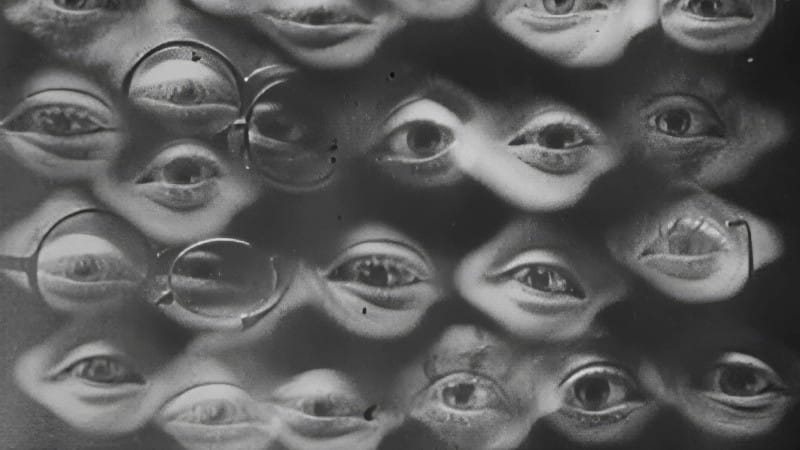
Cousins’ films share their spirit with the DIY aesthetic that epitomises much of the art that comes from Belfast. Each is built backwards from the way most documentaries are made. "The image always comes first,” he says. “You can tell those films where the script comes first, because the image is illustrating in a kind of wallpaper way." Instead, he edits, then sits and writes what he sees. "My voiceovers are usually present tense. I use the word ‘this’ and ‘here’, not ‘that’." And ‘look’. "I got ‘look’ from Pasolini." Then he records it himself, at home, never at a studio, with the microphone almost touching his mouth. "I'm not making it for a producer, I'm not making it for an audience, I'm making it for you, one other human being. We're looking together at an image and I'm saying, ‘look at that’."
In The Story of Documentary Film, his voice is everywhere, but the word 'I' arrives only at the very end, over a scene from Agnès Varda’s The Gleaners and I where the French filmmaker grabs at a passing truck. "My hand comes into shot because I wanted to say ‘Look, I'm a grabber too. I've grabbed the history of documentary.’ If people have been with me for fourteen, fifteen hours, I think by that point it's okay."
Even though he is grabbing into history and looking back, Cousins is impatient with the idea that younger people are not coming to cinema in the way that previous generations did. "Older people think cinephilia is going down the toilet. But when I travel, I attract film fans, and a lot of them are super young. When Béla Tarr died recently, in Edinburgh they put on Sátántangó, sold out immediately, young people. Sold out again, young people. A lot of young people are realising that the algorithmic experience of a small screen, whilst it is dopamine-y and it's like a hit – you want more than a hit."
Cousins points to a tattoo on his arm of Orson Welles and paraphrases a speech Welles gave in Edinburgh in 1956. He said he didn't need fifty million people to see his films. One million was enough. "Let's say there are ten million cinephiles in the world,” says Cousins. “That's enough. We shouldn't dilute our aesthetics or our love of cinema to try and reach an audience which perhaps is never going to love us."
The form itself, he thinks, is barely out of its infancy, which is perhaps why so much of the invention in cinema right now is happening in nonfiction. Asked whether documentary's appetite for innovation makes it more resilient to generative AI, he declines the comfort. “I don't think it is more resilient. The problem is that documentary's Hippocratic oath to us is 'I will not lie to you’.” He pauses to let his steady eye contact make the point. “Obviously lots of documentary filmmakers do lie.”
“Béla Balázs called cinema in general a new consciousness of the world,” he continues. “When those early films of the 1890s came, this was a new way of seeing and thinking, of saying, look at these mountains, look at these flowers. They move, they're alive. The bell jar has been broken. The medium is fully alive and full of spark."
Which is why he thinks it can't disappear. He reaches for the French phrase l'esprit de l'escalier – the spirit of the staircase, the retort that arrives on the way out. "You walk out, you're going down the stairs, and you think, 'I should have said'. Documentary is like that. It's trying to capture what should have been said and perhaps hasn't been said. There'll always be documentary because we'll always be trying to understand ourselves."
The Story of Documentary Film screens in three sessions at the Melbourne International Film Festival, 6–23 August.